Hezbollah and Chopin

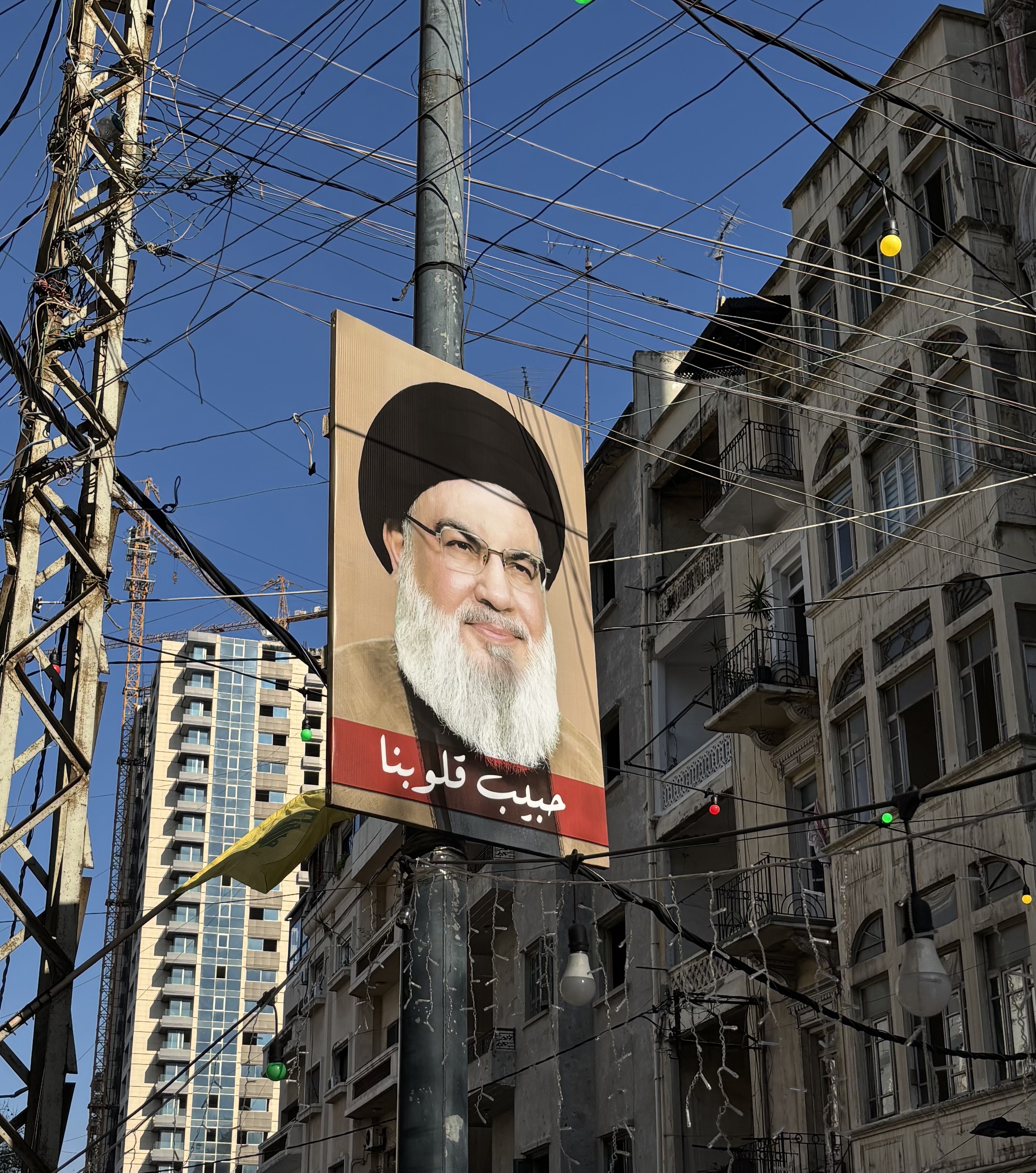
A poster of Hassan Nasrallah, “Our hearts’ beloved”.

The funeral of Hassan Nasrallah and his lieutenant was a somber and stately affair.  The crowd wore black against which the yellow flags of Hezbollah flickered brightly.  There was little evidence of the Lebanese national flag but the Iranian national flag was prominent.  For this there was much criticism, notably including a member of Amal, the rival Shi’a party.  It was a Shi’a family affair. Neither the Lebanese president nor the prime minister attended.

Nasrallah and the party have always been matters of ambivalence and controversy in Lebanese life but even those who opposed Nasrallah begrudgingly admired him.   His command of formal Arabic was much appreciated for its eloquence: this, in a culture where poetry, not painting, is the supreme art form. So too, was his policy of tolerance for other religious cultures.  While Hezbollah regularly disputes territory with its neighbors, especially the Maronites, and their own ways reflect the strictures of Iranian religious authorities, there has generally been a live-and-let-live policy towards others.  I would like to think that this is an expression of their Lebanese origins.

What struck me most forcefully watching the funeral from the hospital was hearing Chopin’s Marche Funèbre played by the Hezbollah orchestra.  Hezbollah and Chopin?  It seemed a perfect example of an observation by Robert Fisk about arriving in Lebanon: that when approached from the East, one thinks one has arrived in the West; when approached from the West, one thinks one has arrived in the East.

But I have to admit, I think my surprise also sprang from the same roots as the jitteriness of the Christians and Sunnis about the possibility of violence on the day of the funeral.  I think I had absorbed their othering of the Shi’as as the underclass.  It is much like the fear white Americans have for their Black compatriots, a projection that fears retribution.  In fact, the city was very quiet that day, a peace only broken by Israeli jets flying low and breaking the sound barrier. They bombed other parts of the country.

During their invasion of southern Lebanon last fall, the Israelis were also reported to have been surprised at the presence of pianos and other evidence of Western high culture in the homes they invaded, looted, and trashed.  It is an area where Shi’a who have made their fortunes abroad come home to retire in well appointed villas.  The realization that the despised other has achieved the same cultural attainments we value has the potential to restore their humanity, at least for an instance. One thinks of William Jennings Bryant as Secretary of State being surprised that the Haitians could speak French.  One appreciates all the more the wisdom of Edward Said and Daniel Barenboim in establishing an orchestra for the youth of Israel, Palestine, and other Arab countries. This West-Eastern Divan Orchestra travels the world bearing witness to the healing and elevating qualities of music across human manufactured divisions.

Last night I attended an organ concert, part of a week’s festival of organ music here. This was its tenth year and has been sponsored by various embassies and cultural institutes. Last night we heard a varied program from an organist flown in from Avila, Spain. His last offering was by a Lebanese composer, Naji Hakim, who first encountered the majesty of this instrument as a child in Beirut before the war.

Here is where we Westerners would say the Lebanese are so cosmopolitan, their cultural so liminal between East and West.  But I think in fact that this region dissolves the dichotomy altogether.  The organ has been here all along throughout the centuries.  This is the land of the organ and the oud, the land of polyglots where the educated quote Shakespeare in addition to Abu Nuwas. I am beginning to wonder if what we consider Western Civilization isn’t just a diffuse subset of Middle Eastern, or, as is now expressed, Western Asian Civilization, however much we try to own it and keep it apart.

A fourth century mosaic in Syria showing a woman playing the organ.

Anxiety and Loss

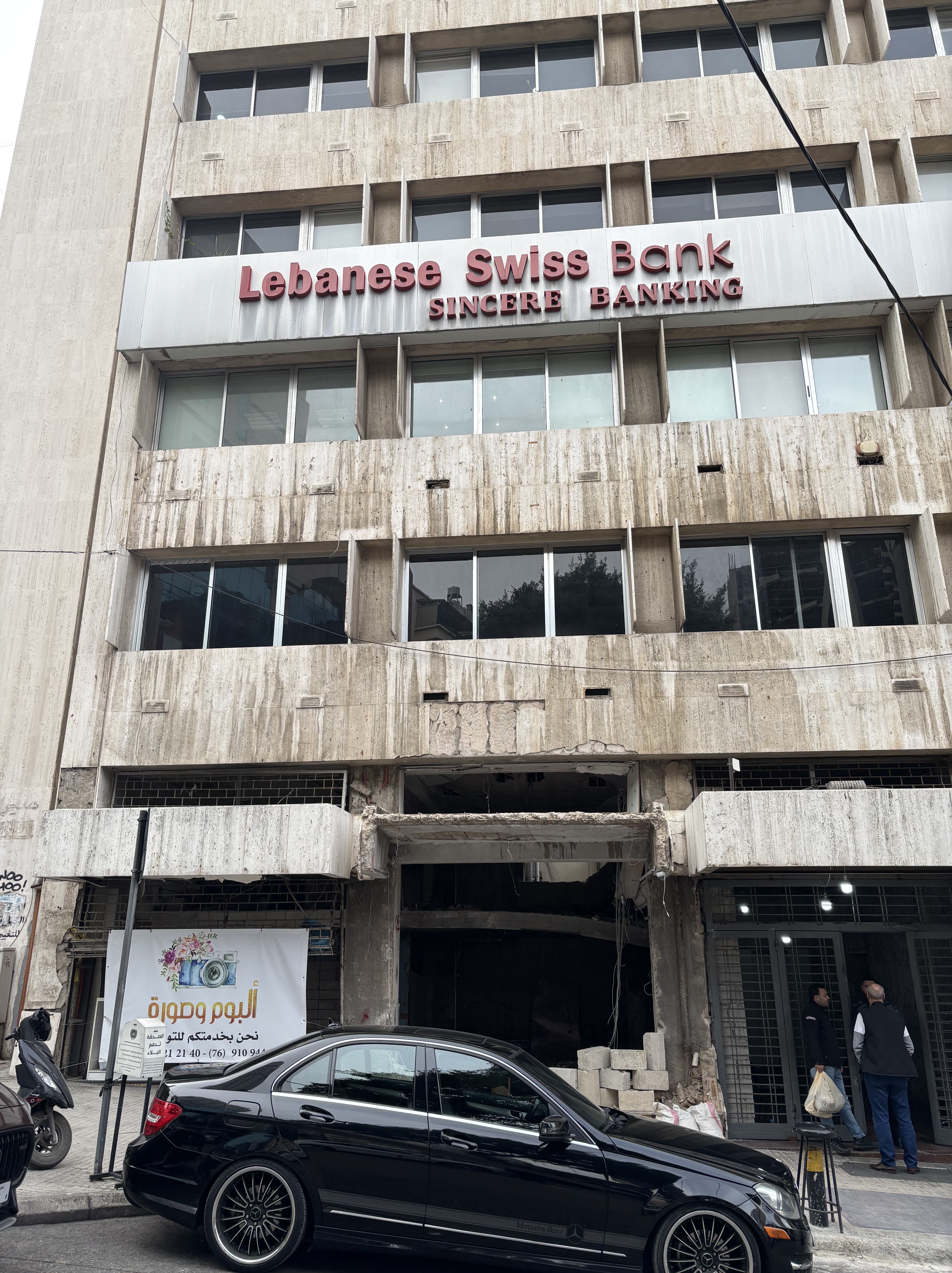
A storefront hit in my neighborhood, understood as lethal political theater for this mostly Sunni neighborhood.

A photograph of my neighborhood in Beirut would show a place little changed by the events of the past few months. True, those begging on the street are mostly Lebanese Shi’a rather than Syrian Sunnis of previous years but the vast wave of Shi’a from the South has returned to their towns and villages if not their actual homes.  If anything, the streets seem a little desolate at times as if the city were permanently stuck at 7 a.m.. Drivers are again going the wrong direction on one-way streets as there is often so little traffic.

But step into this photograph and one immediately senses the change.  The menacing hum of Israeli drones is a continuing reminder that Lebanon, having no air force, is completely exposed.  This is a violation of the ceasefire but what country is going to enforce that?   The humming sound alters how one hears airplane flights overhead – are they Middle Eastern Airlines planes coming in to land or are they Israeli bombers reminding us of who controls the skies?  So far, my windows haven’t rattled so I think it’s just been MEA.

The Lebanese themselves seem at the breaking point.  My pharmacist said that he can’t keep up with the demand for Prozac and other psychopharmaceuticals.  He takes them himself.  Friends who previously coped by gardening or hiking tell me that they are just drinking.  I put one friend in touch with AA and Al-Anon. Unlike in America, where war is a video game called “Shock and Awe”, here war is felt in the gut.  A lawyer friend lost his sister when she was mortally wounded while taking dinner to their 95-year old aunt – the missile that killed her was aiming for a man who was running in her direction. The local hospital had been hit and shuttered. By the time the UN had negotiated with the Israelis for permission to transport her to a hospital in Nabatieh, it was too late.  A journalist friend lost three colleagues in an Israeli attack that injured four others where they had been housed for weeks as they reported on the war in the south.  As Israel has a long history of targeting  journalists no one seriously thinks this was anything but another war crime accorded impunity by the West. Relatives of a friend, a Christian family north of Beirut, bravely rented their family house in the village to an extended family of internally displaced Shi’a only to have it pancaked by an Israeli missile. Two survived.  

But the war has other, less visible effects, like the children whose education was once again interrupted because of security concerns on the roads or the use of school buildings as shelters. Or take my elderly friend from church, a woman in her nineties in general good health.  For months she was unable to find green leafy vegetables at the market as they come from the agricultural areas of the besieged south.  Her intestinal issues became so severe that she now has a prolapsed rectum.  Today I took her to the hospital for surgery tomorrow — a partial colectomy and an exterior bag. Our church is praying for her survival.

Lebanese society has also taken a gut punch.  The million internally displaced fleeing to Beirut and north were mostly Shi’a seeking shelter in Christian and Sunni areas.  Many refused to rent to them, fearing an Israeli strike or for reasons of general antipathy.  The ghosts of the civil war were roused with a fury when the militias like the one down the street from me began breaking into apartments to make them available to those who faced sleeping in their cars or on the street.  This is what it looks like when there is no effective government. The Shi’a have suffered greatly from this war only to have lost power and prestige.  They are feared and resented, they are angry and distraught.  Rubbing salt into the wounds, here is a link to the messages the Israelis left on two surviving homes in the South: https://today.lorientlejour.com/multimedia/1446252/in-images-provations-stars-of-david-soldiers-names-in-khiam-the-israelis-scrawled-messages-on-walls.html

There is an ominous Schadenfreude among some Lebanese over the recent fate of the Shi’a and Hezbollah.  But they have not been spared: Israel hit areas it generally doesn’t strike to the tell the Lebanese that they will suffer a collective punishment if they don’t rid themselves of Hezbollah. That isn’t going to happen.

The so-called ceasefire has been extended although Lebanese trying to return to their homes in the South have been shot at and killed.  Like everyone here, I just try to go about my business as there is nothing to be done. Nasrallah’s funeral is Sunday the 23rd in South Beirut.  Might be a good day to stay home.  We’ll see.

A Few Simple Stories

I don’t know where to begin. The assassination of Hassan Nasrallah is just mind-boggling. So I will just tell some simple stories.

A datura, the flower that brought on tears.

This morning a Lebanese friend sent me a photo of a flower blossoming in his weekend home in the mountains, a place he and his wife bought just to rescue their money while the banks were collapsing a few years ago.   The photo was accompanied by an uncharacteristically poetic message as he described the white flower as a radiant bride, a testament to love against the hideousness of war.  He wrote that tears streamed down his cheeks when he noticed this flower at breakfast.  This is a man who returned to Lebanon at the height of its civil war to take care of his elderly parents who had fled the fascist allies of Israel operating in the South.  He’s been through so much with wars and currency collapses. He has witnessed terrible things as a man and as a doctor.  And now a flower undoes him.

I also received a phone call also from an elderly friend from my Beirut church whose apartment overlooks a main street in Hamra, two neighborhoods away from Dahiyeh where Israel has been wreaking destruction.  She said the streets are thronged with the internally displaced, children everywhere, some of whom are sleeping on the streets. She feels guilty for her lovely home with its plant-filled balcony but what can a 91-year old do?   Before I left in April I bought her two weeks of canned provisions and yesterday her nephew bought her more just before the bombardment. She expressed apprehension that the supermarkets and shops would close for fear of looting.  With the decimation of the top three levels of Hezbollah leadership, no one knows how to access their usually well organized humanitarian aid.  

I received a call, too, from a couple who came to the States for two weeks to do some business in the academic world and visit his aging father in Pennsylvania.  They are borrowing my car because they can’t rent a car in the States as Lebanese credit cards are worthless.  They called to say that they are not going back to Lebanon until there is a cease-fire and even then they plan on relocating permanently.  The Lebanese wife is afraid her American husband will be attacked in the aftermath of Nasrallah’s death.  Last week he lost a former student, a relief worker living in the Bekka, when Israeli artillery hit her home.  Her young son died as well.  

And then there are the messages on the WhatsApp of our Beirut church.  Scattered between the prayer requests and calls for volunteers for the Sunday service was a spat between a Lebanese and an African member over Christian Zionism.  Zionism was initially a Christian idea that Theodore Herzl took over for his Jewish nationalism project.  Lord Balfour espoused Christian Zionism as he facilitated the establishment of a Jewish homeland in British Mandate Palestine.  President Biden calls himself a Christian Zionist as he channels munitions to Israel.  Arab Christians reject Christian Zionism as a false teaching, as do mainstream American denominations, including my own.  But it is embraced by many of the evangelical churches of the American South and is spreading worldwide.  Hence, the African proponent in a Beirut church challenging her Lebanese sister to bless Israel.

The Lebanese are so tired.  They are trying to rebuild their levels after so many catastrophes in the past five years. And now they fear their country is about to become another Gaza. No wonder a flower can bring a doctor to tears.

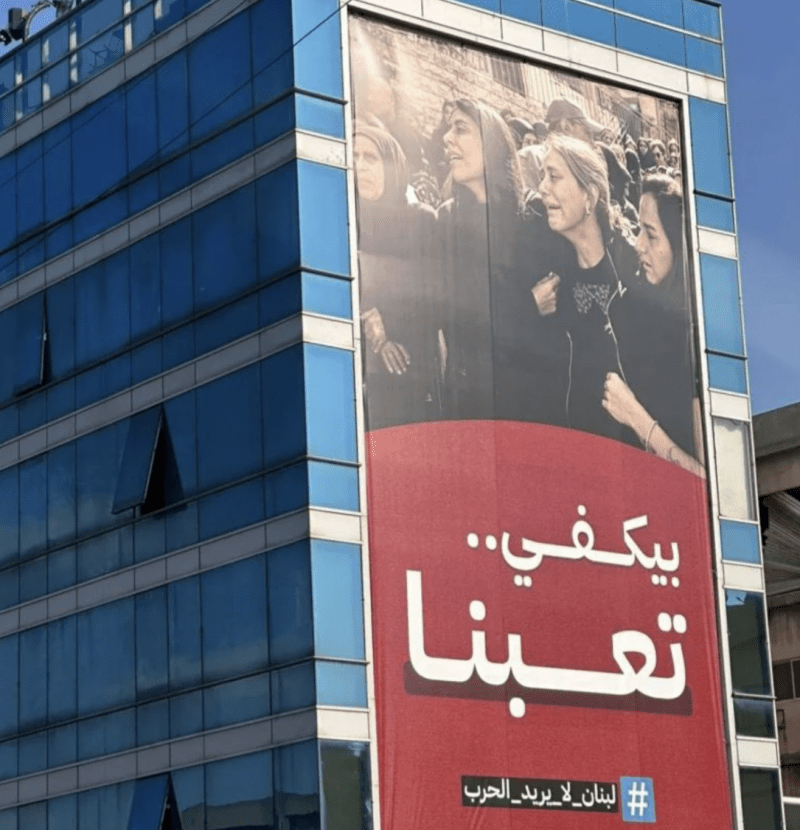
A billboard in Beirut erected this summer: it says “Enough….we are exhausted. Lebanon does not want war.