Dispirited at the Supermarket

In the past, when I came back to Beirut, I would ask my friends what I could bring them from the States.  “Nothing” was the cheerful reply, “we have everything here”.  I’d  just bring friends a box of maple cream cookies or salt water taffy, little treats from America, and consider the job done.
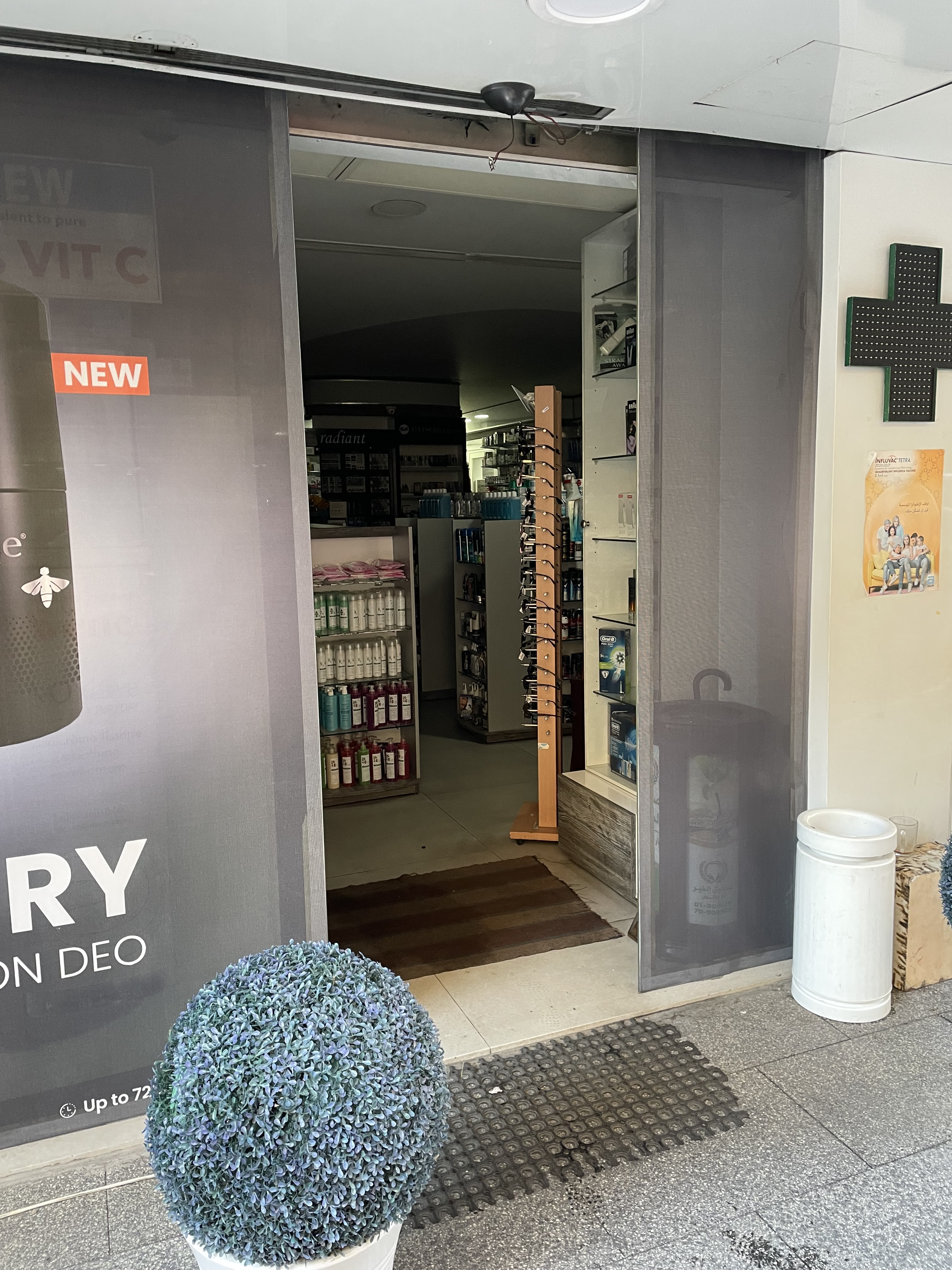
A pharmacy operating in near darkness

This time it was different.  Along with the maple creams and taffy went their requests, among which were: Tylenol, aspirin, Salonpas, vitamins, make-up, brown sugar, Crest toothpaste, walking shoes, flea collars, fleece blankets, flashlights, prunes, and vegetable seeds.  One friend likes to make her mother chocolate chip cookies so I brought six bags of those; another friend misses a licorice candy so that went into the bag.   The children of another were missing Kraft macaroni so those, too, made it in. I also packed large jars of Nescafe which is very popular here for some reason and is now a luxury item and special treat. Land’s End had a sale on down vests so I ordered one for each friend and for myself, knowing how cold it gets with stone floors during the winter rains.  

I did not neglect my own needs.  Friends told me to bring all my own toiletries, so I did but I drew the line at shampoo.  It’s too heavy and could spill.  I didn’t even buy a plane ticket until I had three months of my medications in hand.   I packed a three pound bag of vegetable wash and batteries for my flashlight and reading light.  I also packed a canister of pepper spray for myself and the daughter of a friend whose 14th floor apartment with the spectacular view now requires hiking up and down stairs where anyone could be lurking.  The lack of electricity means that building security gates are often open for hours at a time.  This is true in the building I am staying in as well.

In packing clothes, I thought about how difficult it might be to find a functioning dry cleaner and even reliable electricity for an iron.  I packed all knitwear.  I thought about walking up seven flights of stairs to my AirBnB apartment, and walking down, and left my long raincoat at home lest I trip on its hem.  I packed thermal underwear, a duvet, and a wool throw because the apartment doesn’t have heat except during business hours as the building is mostly office space.   The landlord offered me a space heater with a gas canister but it looked like something that would blow up in my face and I asked him to take it away. As I write this I am keeping myself warm with three layers of clothing and a woolen wrap.

I am staying in a new apartment this year.  The landlord of last year’s apartment doubled the rent in dollars.  This reflects the increasingly two-tiered reality of Lebanon these days.  Those who have the means to insulate themselves from the higher prices pay dearly for the three sources of utility power these days: government supplied electricity (if any), back-up generator electricity (about 10 hours a day) and battery supplied electricity to a few wall outlets.  The most deluxe buildings have two generator contracts but even they don’t have 24/7 coverage.  In my apartment, I can’t use the oven or microwave after 7 p.m. or on weekends.  I don’t need to be reminded that this is a high class problem.  Most of Lebanon is sitting in the cold and darkness.  This is the coldest winter in forty years.  It snowed in Beirut a few days before my arrival. A dentist friend had to close his clinic those days as it was too cold for his hands to work.

Blemished lemons at Spinney’s

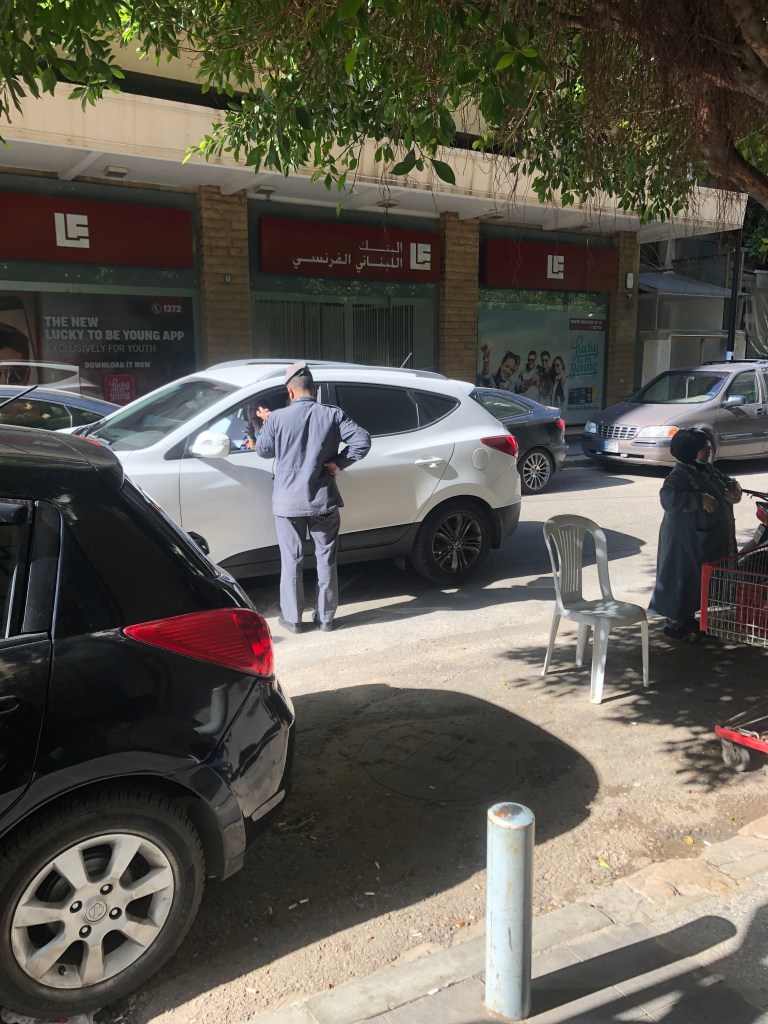
I am still getting my bearings in this land of scarcity.  There are two supermarkets in my neighborhood, a Spinney’s and the more down-market co-op.  Spinney’s didn’t have flour last week, nor butter.  Its selection of goods is pared down.  No more Asian products like tofu or European cheeses like Parmesan. I expect this reflects not only the high cost of imports but also the loss of the customer base — the cosmopolitan professionals who have left the country in droves.  Walking down the supermarket aisles one sees that most of the manufactured goods come from Turkey these days.  This has always been considered the inferior stuff.  But it’s all inferior stuff in the supermarket these days: it is clear that the Lebanese agricultural sector is sending everything it can abroad, leaving the Lebanese with the bruised and misshapen remainders.  There is one exception: a special refrigerated section at Spinney’s displaying exquisite baby vegetables and choice fruits.  They even had lychee nuts last week from South Africa. It was almost an affront.
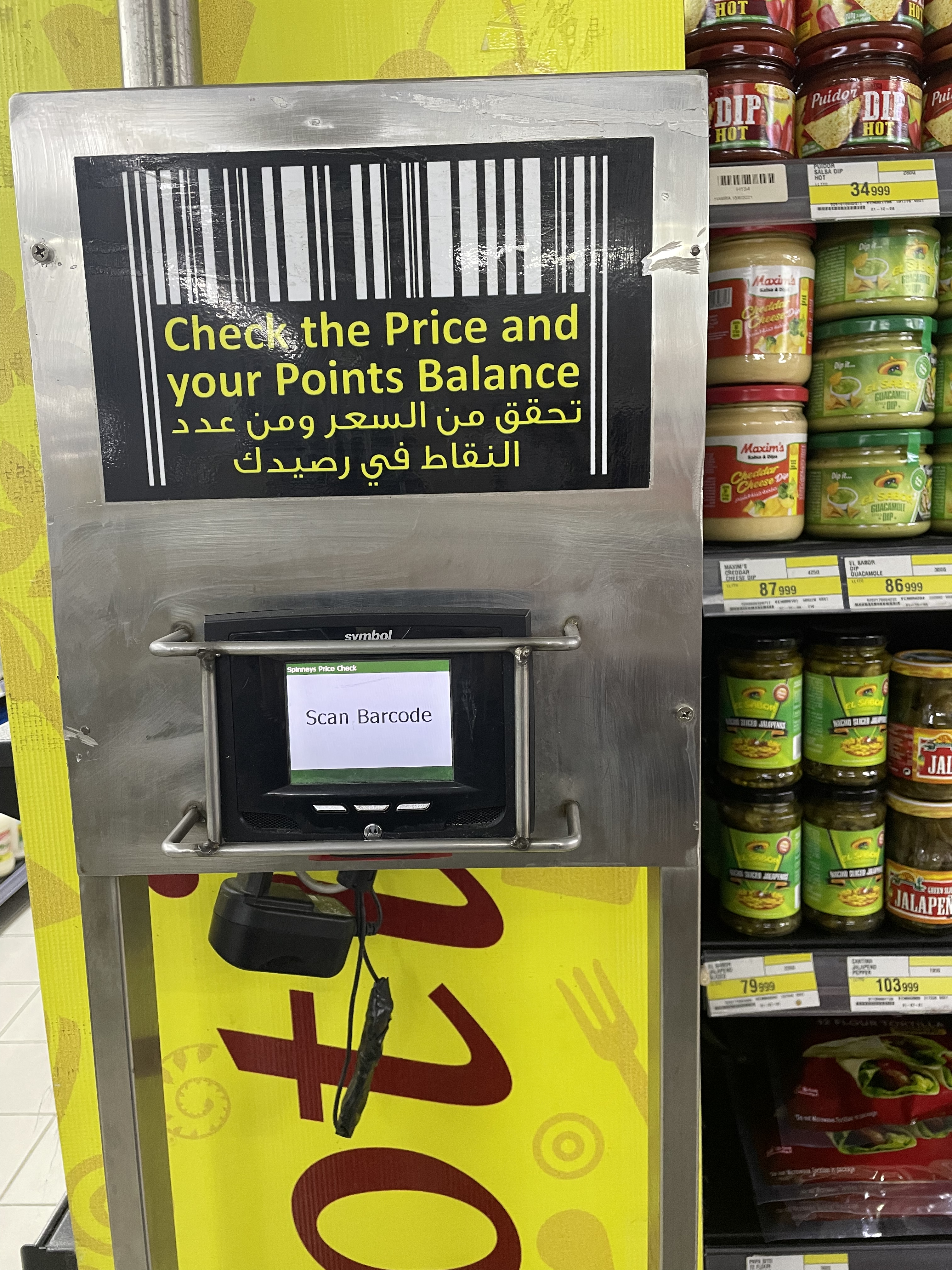
The price checker at Spinney’s

Watching people shop for food is truly painful. Their faces are etched with anxiety.  For the first time I’ve seen couples shopping together as the purchase of food is now a major financial undertaking for the household.  Before last June most basic foodstuffs were subsidized and were very cheap.  Now the prices paid for food reflects the fact that Lebanon imports 80% of what it consumes and is paying for it with increasingly expensive dollars.  Many shoppers use their cell phone calculators to keep within budget.  They price-check before placing items in their baskets. While standing in the checkout line they lament prices together.  There are always items to be re-shelved at the head of the checkout counter.

Just after I arrived, a friend came over for coffee and said it was nice to see me because mine was the one face she’d seen lately that was not taut with anxiety.  Now I see why.

God knows what is going to happen to this country but story a friend told me does not bode well.  An acquaintance of his, who is an army officer, told of a soldier in his unit who showed up late for muster.  “You’re late!” he shouted at the soldier.  The soldier replied, “You’re lucky I came at all”.  Instead of disciplining the soldier for insubordination the officer responded, “You’re right”.  That soldier’s pay used to have the purchasing power of $800/month in an economy with subsidized goods.  Now his salary has the purchasing power of $55/month with nothing subsidized.  This is the one public institution in Lebanon that most Lebanese respect and that many credit with holding the country together.  What happens if it unravels? 
How the Lebanese Are Trying to Cope

I made it my business to try to find out how people in Lebanon are coping with the collapse of their currency and the severe reduction of their purchasing power.  I asked everyone I could how they’re dealing with the new normal, for that’s what it is.  I can’t claim this inquiry does more than scratch the surface but maybe it gives a hint.

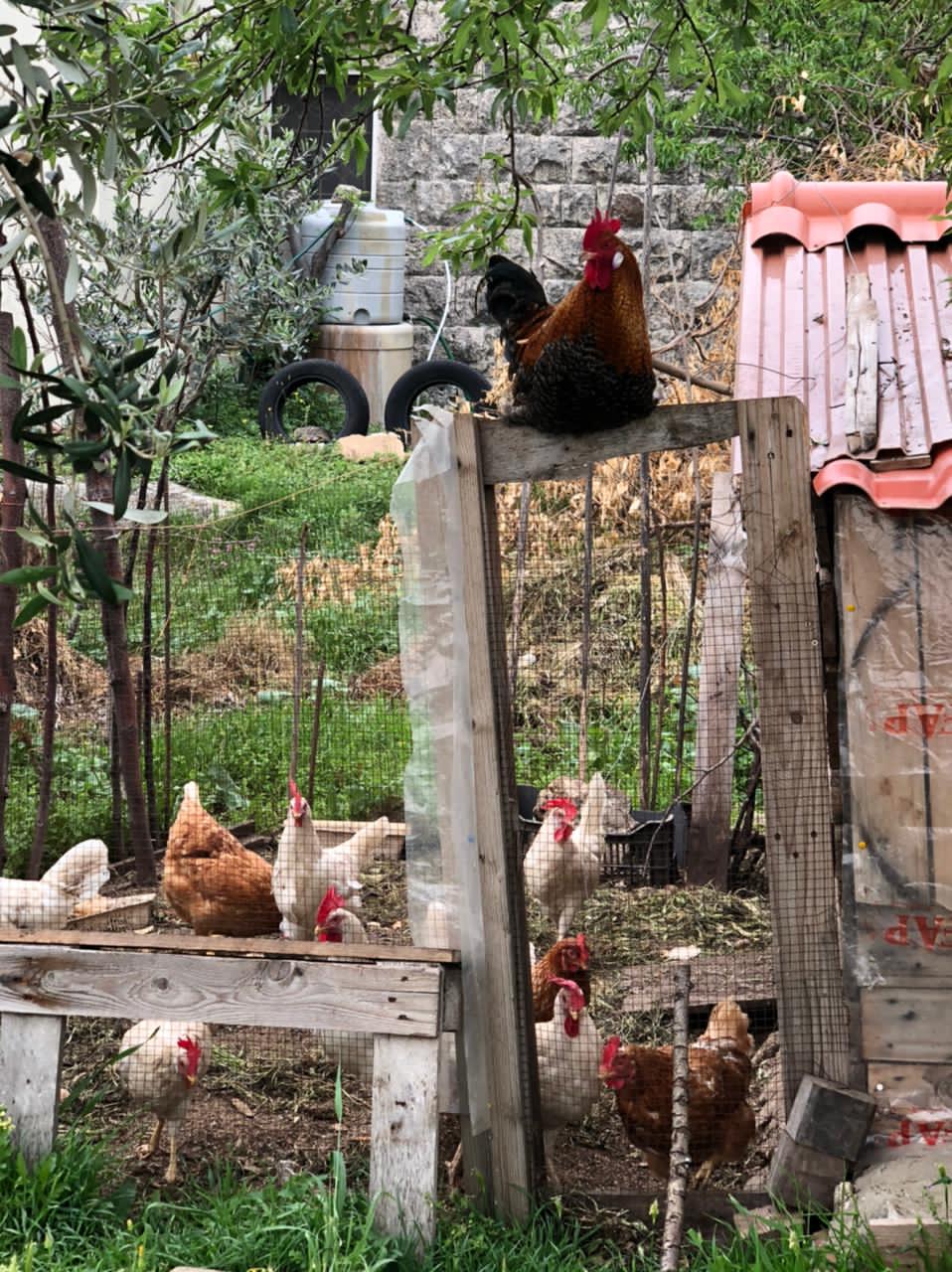
Chickens in a friend’s backyard

The first thing to note is that the currency collapse has divided the country into haves and have-nots. Those who have access to dollars or euros are doing just fine. Foreign aid workers can live like kings.  Anyone with a pension paid in dollars is winner, like the retired telephone operator of my acquaintance whose pittance of a pension from the American Embassy is now supporting three generations.   About 150,000 families receive regular remittances from abroad via OMT, the wire transfer company,  and for now, I believe, they can receive these transfers  in dollars and not be forced to convert them to Lebanese lira at a fraction of the market rate.

Among the have-nots, many are simply leaving.  A common greeting now is “you’re still here?”  Medical professionals are in the forefront of this exodus as their specialties are desirable and their English or French is fluent as those are the languages of science instruction in Lebanon. In addition to doctors, nurses, and pharmacists, teachers of English are also leaving and at about the same 20% rate. 

Those with less fungible professions are hoping for employment in the Gulf.  There has been a sizable Lebanese ex-pat community there which commutes home on weekends. This is less sure a solution now than it has been in the past and not just because the Gulf states are trying to develop their own professional class out of their rich wasters.  The Lebanese are reportedly being offered lower than usual salaries there as they are in no position to bargain.

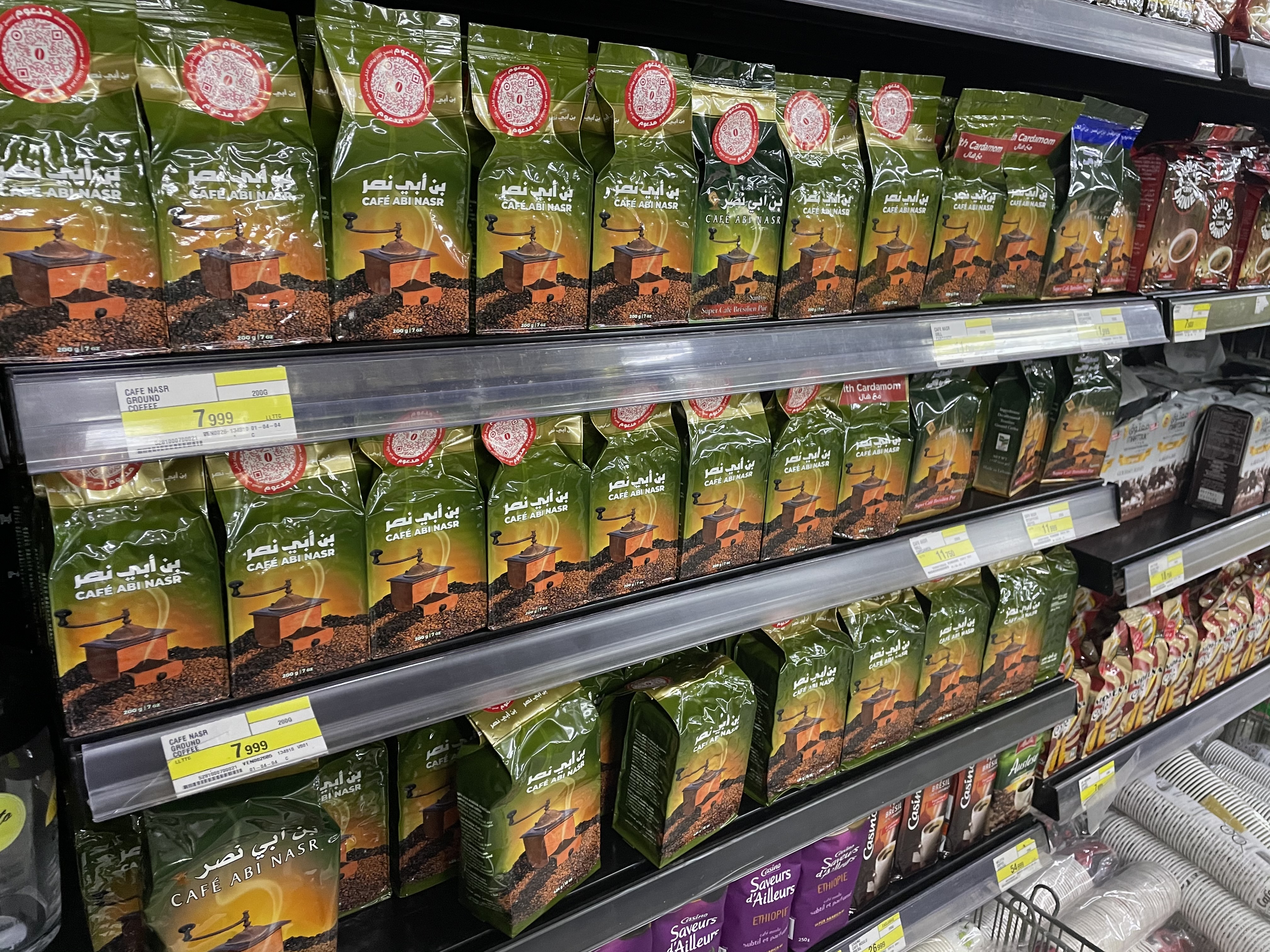
Subsidized coffee at 7,999 LL
Coffee sold at market rate — nearly eight times the price of the subsidized.

Those who remain are resorting to their wits.  Take the Lebanese armed forces, for example.  They reduced expenses last summer by no longer serving meat to their troops. Now they are trying a new income scheme — giving rides to tourists in their helicopters. Anyone with land is cultivating it.  Last year I read that the Greek Orthodox Church, a major landowner here, was offering land for allotment farming.  How people will get to their allotments now in the face of a severe gasoline shortage is another matter.  People with backyards are even raising chickens as beef, chicken, and fish are not just expensive but their freshness is becoming questionable, especially now with the power blackouts. Food is expensive as about three-quarters of it is imported to the land of milk and honey. Food subsidies have helped people manage basic nutritional requirements.  Rice, beans, pasta, cooking oil and coffee are among the foodstuffs that have been subsidized by the government.  The government covers the price differential by reimbursing the seller. The potential for abuse is a business opportunity for some.  Subsidized Lebanese foodstuffs have been found in their original packaging on shelves in Sweden and Turkey.  Truckloads of subsidized foodstuffs and fuel are being smuggled into Syria where people are starving, thanks to the West’s sanctions program.  This annoys many Lebanese as they see their frozen bank accounts as the funding source for subsidies.  Before subsidies started to end last month there was a good deal of hoarding going on amidst the general anxiety.  Now food prices are rising to their real market rates and are becoming astronomical for the poor.

The scramble for cash is relentless. With an unemployment rate upwards of 50%, it is no wonder theft is increasing. The theft of cars and car parts is on the rise. One scam involves hitting a target car from behind and stealing it when the owner gets out to investigate. A friend wrote that three Kias were stollen from her village above Byblos — she is now taking the battery out of her car at night.   One of the reasons I had to move from my original residence a few months ago is that friends were afraid to park their cars in that neighborhood. Another scam is to ring intercoms in apartment buildings, claiming a delivery and then robbing the apartment that opens its door.   

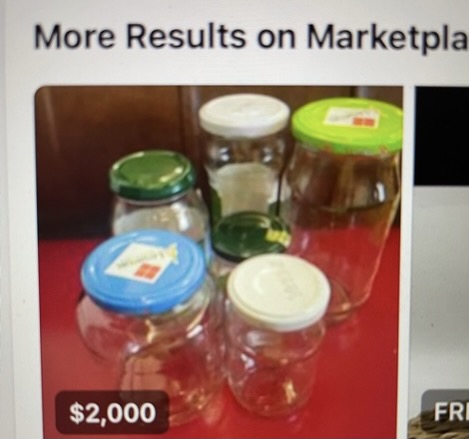
Supermarket jars on sale at Second Hand Beirut. The dollar sign is used in place of Lebanese Lira.

Even the well-to-do are liquidating assets – the yachts in the marina are being sold to Saudis, I heard from a man at church who until recently used to work on one of the yachts there.  Second-hand stores are cropping up on Facebook and even on Hamra, the main shopping street in my neighborhood where until recently global brands like American Eagle and the Body Shop could be found.  The Facebook page Second Hand Beirut is a painful testament to desperation — one recent entry proffered empty supermarket jars.

The self-employed are dealing with their patients and customers differently from before when they would simply state their fee for services.  My dentist now tells patients what the cost of materials is and tells them they must cover that.  His services, though, are up to their discretion.  Most patients pay nothing or very little but some who are working aboard pay the dollar rate of the past.  The shirtmaker in my neighborhood took an order from me on the same open basis.  He is using his studio as an art gallery now and collects old tires for their metal content — he can get $300 for every 300 tires he brings to the salvage yard.  It turns out that the Beirut port explosion was a bonanza for metal salvagers — no wonder the clean-up was so quick!  A retired teacher of my acquaintance tutors a family’s children in exchange for a meal at the end of a lesson.  My hairdresser no longer bothers with the full salon treatment of washing the client’s hair and combing it out before the cut.  His customers want only the most basic service so he just sprays the hair with water prior to cutting it.  Even right before Easter when there should have been an especially high demand for his services due to the holiday and  lifting of Covid restrictions, I found his salon empty.   

And what of the foreign domestic workers?  Until recently, a live-in maid was within the budget of a middle class family.  Now, even the small salaries paid to these workers are too much for those whose salaries are in lira.  Some families have sent their maids back to their home countries.  Many have simply deposited them at the doors of their embassies, most of which do little for them. To its great credit, the Philippines has chartered planes to brings its nationals home.  But poor prospects at home were the reason these people, mostly women, came to Lebanon in the first place.  Many have simply melted into the slums, hoping to find day work.  A friend who works at a Christian NGO trying to help foreign domestic workers said that more of these women are having children now, suggesting that these women are hooking up with men in some kind of concubinage arrangement in the hopes of support.   One can only imagine their vulnerability to pimps.  This NGO accompanied one foreign domestic worker to her embassy to ask for a repatriation flight and the embassy official suggested that she should earn her airfare by turning tricks. 

There is no government safety net in Lebanon.  The World Food Programme has been ramping up its aid in Lebanon but only serves the destitute.  A Syrian refugee family I know was rejected because the mother works two days a week cleaning houses. She has six mouths to feed.  Religious groups try to help, like the Maronite project of identifying and helping the needy within their dioceses or mission dollars flowing in from denominations abroad like the Presbyterian Mission Agency.  I expect the Muslims have similar initiatives.  Families and friends try to help one another, especially in the countryside where roots run deep and the land can be put to use.  But I am told that a larger and surer source of aid are the clientelist sectarian political parties, notably Hezbollah and the Lebanese Forces, a Christian party.  This crisis is an opportunity for them to solidify loyalty among the rank and file by providing stipends and other resources.

Right now the resources most scarce these days are gasoline and electricity.  Even the financially comfortable are finding it difficult to fill their gas tanks and recharge their computers.  People are organizing their working lives around the hours of electricity provided by the public utility and the back-up generators.  The gasoline lines are so long that at the end of the evening people park their cars in line, go home to sleep, and get into their cars the next morning to inch towards the gas pumps.  A friend managed to get gas this way so he take his family to their mountain house to water the garden they had planted a few months earlier.  When they got there they found that there was no water because there was no electricity for the village water system. The garden was dying. I asked him if he was going to be okay.  He answered, “As long as there is peace here, we will be okay.”

Desolation

A satirical poster in the form of a public death notice announcing the end of the Lebanese lira.

My computer crashed three months ago so I wasn’t able to update this blog while in Beirut.  I could have tried to have had it repaired there but I don’t trust repair services in Lebanon these days.  

There, I said it.  

Too many friends have taken their cell phones, computers, and cars in for repairs and found that they have paid for used replacement parts or have had, in the case of car repairs, other parts of the car stollen.  This is what a currency collapse does to otherwise good people.

I could have gone to an internet cafe to get the job done but apart from concerns over Covid, there was a great deal of pressure on one’s time during off-curfew hours.  The Ministry of Public Health instituted multiple curfews and lockdowns, especially during during Ramadan, normally a period of evening socializing and conviviality for those observing the daylight fast.  Between lockdowns and curfews we were all forced to spend a good deal of time at home.  When allowed out, we reverted to our ancestral patterns of hunting and gathering, especially for medicines and food basics, which the currency collapse has made scarce.  I joined the bands of neighborhood people going from pharmacy to pharmacy looking for prescription medicine.  My own pharmacist showed me the waybill of his most recent order — he had received exactly one box of every medicine he had ordered.  As pharmacies are supplied every ten days, my pharmacist can help exactly three cardiac patients a month with their Irbesartan.  I told him he had first dibs on medication for stress.  At least he’s still in business. Seventy percent of recent pharmacy graduates have left the country. About twenty percent of the medical professionals have left as well.

Normally, my trip to Lebanon is a very social experience. But this year it was a tough trip for me — the curfews and lockdowns kept me isolated from those I wanted to see and the lack of restaurant dining made it difficult to get together even when we could. I felt a loneliness that I hadn’t felt since my first year there and even then I had church for socializing. I quickly learned that the purpose of this trip was to bolster the spirits of my friends and to help them when I could. Foreigners like me were repeatedly told how it lifted morale to have us visit during this desperate period.

I was able to experience some pale semblance of normalcy before I left in the two weeks after Ramadan. The curfew was moved back enough that it was possible to go to restaurants with friends in the evening.  It proved a wistful experience.  Many establishments had closed for good.  And many friends were missing as some had not come back from abroad for their work this year and others had left with their families for a new life elsewhere.  But it felt wonderful to spend evenings with the friends who still remain, at least for now.

So many activities I normally do in Lebanon I couldn’t do this trip.  I like to travel to see friends outside Beirut and visit new places. But travel is now a fraught experience there.  Angry demonstrations regularly cut off roads and streets.  For my much of my trip, travel within the country required a permit from the Ministry of Public Health. My first application to visit a friend in the seaside town of Anfeh was denied. Street lighting and even traffic lights have gone dark as economy measures so travel by car is hazardous.  When I was able to go a few weeks later to Anfeh I was terrified by the ride back on the darkened autostrade where the only light was the high beams of oncoming traffic blinding our eyes. After that I made only two other trips outside of Beirut and both in daylight hours.  

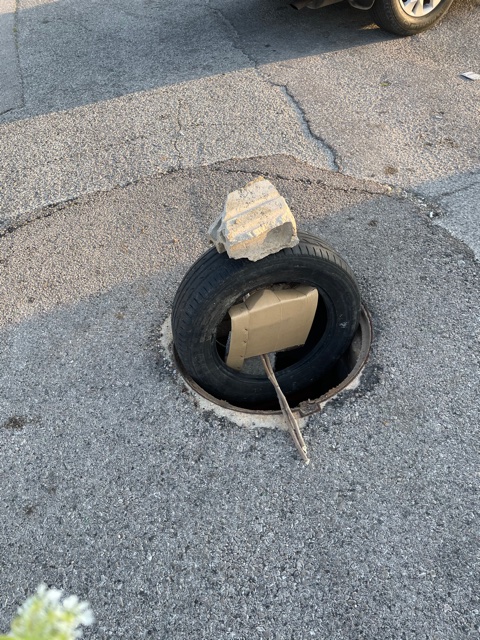
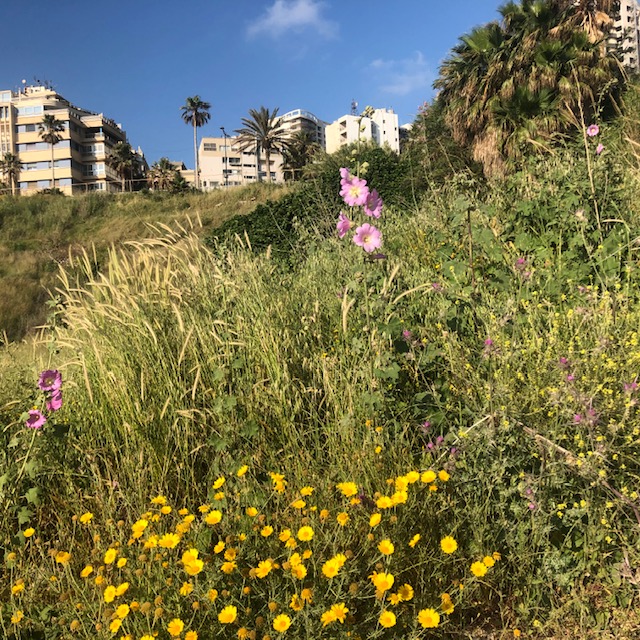
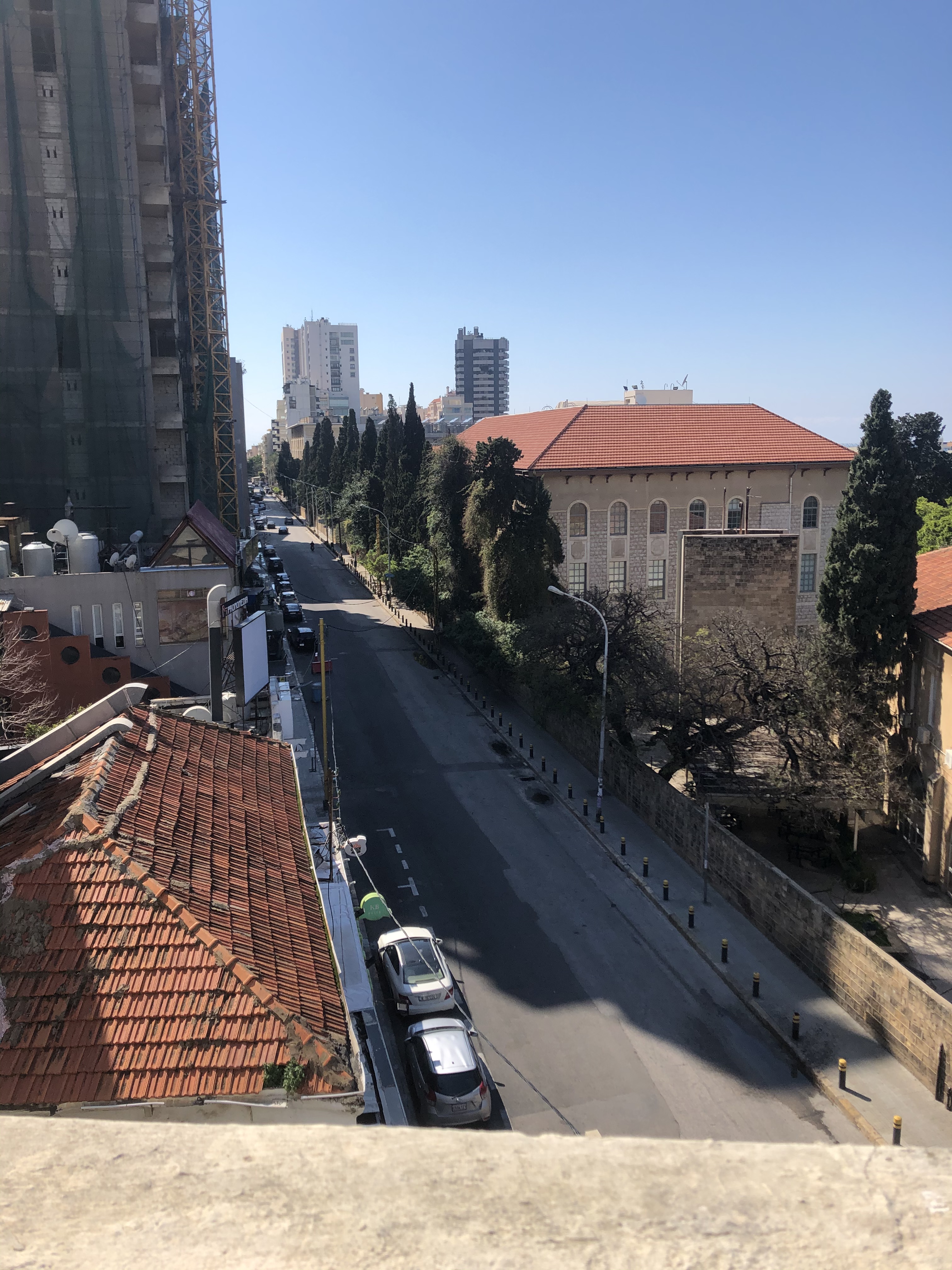
Nor were my excursions inside Beirut comfortable.  Normally, I go on walks on wasteland near the beach to collect wildflowers, get a little exercise,  and enjoy the seaside air.  Usually there are people fishing off the rocks but this year they weren’t there. I expect the August 4th Blast poisoned the fish.  I didn’t feel safe with just a friend to keep me company.  Walking along the city streets also proved hazardous as manhole covers are now routinely stollen and sold for scrap.  In the darkened streets,  it is hard to see where one is stepping.  The streets at night are eerily empty of cars and pedestrians.

An old tire has been affixed to a manhole whose cover has been stollen; the wasteland under Raouche where I used to pick wildflowers; a gasoline line from a few days ago.

I like to say that the Lebanese are Italians who speak Arabic.  They are fun-loving, sensual, cosmopolitan, and  wry.  But this year, they were morose and anxious. The word my pharmacist used to describe the mood was “desolation”. It is now a commonplace to think back to the Civil War as a better time.  Part of me hears this in light of human nature, very much akin to the ancient Hebrews trudging through Sinai nostalgic for slavery in Egypt. But, as friends explained, the Civil War with all its invasions and bloodshed had periods of peace and normalcy and, mostly, the economy ticked along.  There was always the concrete hope for the peace that finally came.   

Now, what concrete hope exists?  What roadmap shows the way out of the tsunami of crises battering the country — the collapsed currency, the catastrophic national debt, capital controls preventing withdrawals from a now fragile banking system, 50-70% unemployment, two hours a day of government electricity, political stagnation and increasing sectarianism, and corruption holding the country together like a cancer?  Endless articles describe the problem but I have yet to read one that proposes a solution.  The problem is deeply structural. The Lebanese tried a peaceful revolution in October 2019 and were attacked by partisans on motorcycles wielding bicycle chains.  The Lebanese refer to their political parties as “mafias” with good reason.  

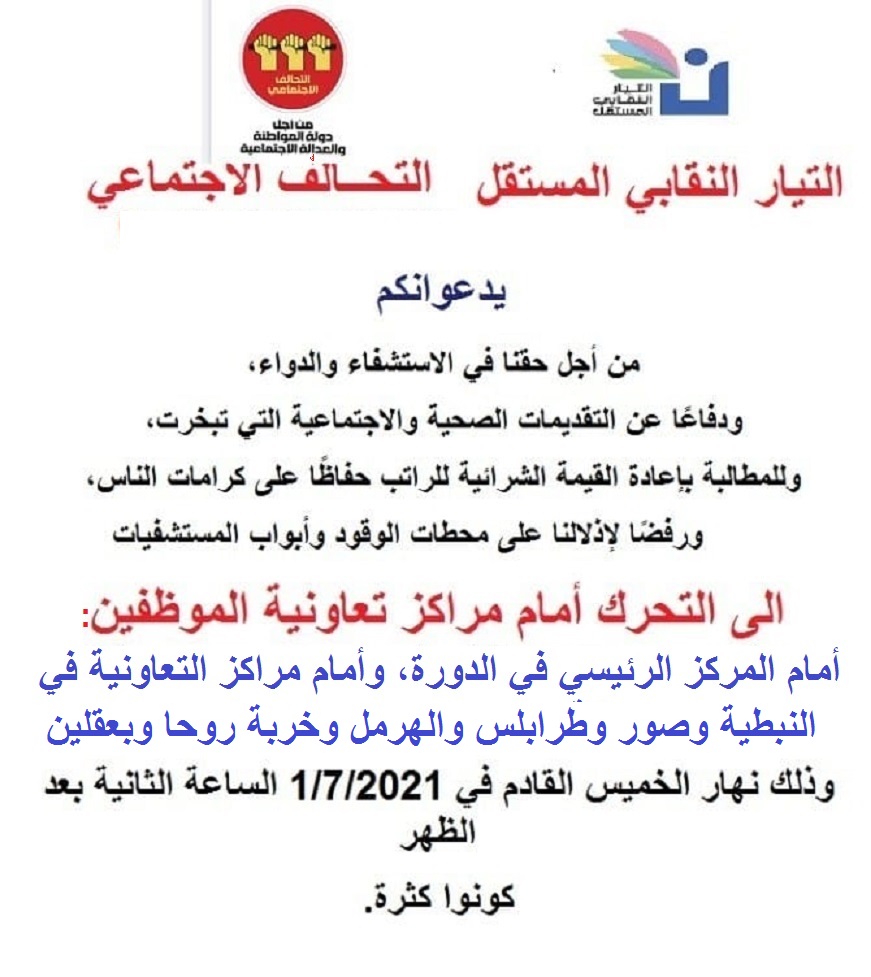
Announcement of multiple simultaneous demonstrations for healthcare and medicine

I left Lebanon wondering if will be safe enough for me to return. I don’t see how the collapse won’t lead to general lawlessness. Tuesday’s headline in The Daily Star, the English-language newspaper was: “Lebanon seen drifting toward total chaos amid collapsing pound”.  It reached 18,000 LL to 1 USD the other day.  That is about 20 percent lower than it was when I left.  Until a year and a half ago the pegged rate was 1,500 LL to 1 USD.  Now, at this moment of immiseration, the subsidies are coming off baby formula and other foodstuffs.  There are severe shortages of gasoline for cars and of diesel fuel for generators.  Even people with jobs can’t work if there is no electricity.

I tell friends I’ll return if there is fighting in the southern suburbs but not if there is fighting in my neighborhood. Lebanon needs a miracle.  Pope Francis is on the case — he’s summoned the leaders of the Lebanese Christian denominations for a summit at the Vatican.  Yesterday’s headline in the Daily Star reads: “Lebanese look for divine intervention to rescue their country”.

In the meantime, I’ll try to catch up on this blog. And keep praying for that miracle.

How long?

“How long will this period last?” is a question I get asked all the time here.  “When do you think we will return to normal?”

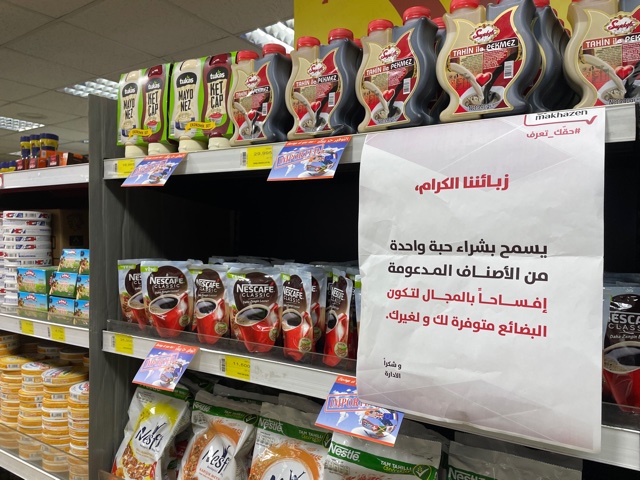
Subsidized foodstuffs at a local market with a sign limiting the customer to one each. Subsidies are due to run out in June.

I’ve responded reasonably with the example of Greece and its economic meltdown.  Many of the same conditions apply – hyperinflation, capital controls and the lack of access to bank deposits, high unemployment, the brain drain, an entrenched political class, and corruption. But in Lebanon, all of these conditions are worse.  A 25% unemployment rate would be a huge improvement here. There was no worldwide pandemic at the time of the Greek crisis. And there was never a worry about a currency collapsing because Greece was on the Euro.  Yet still, twelve years on, Greece is not back to normal.

I’ve come to realize that it is not my considered opinion on economic matters that is driving this recurring question.  No one would mistake me for an economist.  It is not the words but the music that one should listen to in this question.  What is really being asked is, “Do I have the strength to weather this crisis?  Will I live long enough to see Lebanon restored?” As the Psalmist achingly wrote: 

How long, O Lord? Will you forget me forever?
    How long will you hide your face from me?
How long must I take counsel in my soul
    and have sorrow in my heart all the day? (Psalm 13:1-2a)

Yesterday the lira dropped to 15,000 LL to the U.S. dollar.  It is now at 10% of its value of 18 months ago.  The middle class has been effectively wiped out, their savings gone.  Even those with the prescience to save in dollars cannot access them as dollars now.  Demonstrators reacted to the bitter milestone by forcing stores to close on Hamra Street, the business street near my apartment, and cutting off the roads with burning tires and trash.  No one blames them. The acrid taste of anger is in everyone’s throat. Fifty-five percent of the people here now live below the global poverty line of $3.84/day.

The political class is unmovable. A friend read me the president’s schedule for last Wednesday, March 10: he was napping in the afternoon to preserve his health.  When he is awake he is demanding select posts for his party in any new government.  There is no roadmap in sight for this nation in distress.

There is the persistent dread of worse to come, of waiting for the other shoe to drop.  Surely, the August 4th blast was a reminder of the power of the unexpected.  There are fears of Israel exploiting the moment and invading; of ISIS gaining a footnote, which it attempted to do about ten days ago but the army caught them; of what Hezbollah might do to maintain its considerable power. What is coming around the corner next?

Eyes are now turning to the army, one of the few public institutions held in high regard here.  Soldiers, too, are feeling the economic plain.  Their purchasing power has been reduced to about $150/month.  Retired soldiers are reportedly in the forefront of the demonstrations. The army commander, a distant relative of the president, went on television and reassured the Lebanese people that the army was with them.  This was widely interpreted as a shot over the bow aimed at the political class.  Is a coup really how this impasse is going to end?  How much longer can the people here hold out?  Already one sees the reddish hair of malnutrition among the poor. Food, medicine, and gas subsidies, a clumsy system that incentivizes the trafficking of subsidized goods into the disaster that is Syria, are supposed to end in June.  The other day a fight broke out in a Spinney’s supermarket over a box of powered milk, an incident now famous here as the reporter on Egyptian television took it as an indication of how far the country had fallen.

The newscaster, who used to live in Lebanon, bewails what has happened to a land known for its food and cuisine.

Today protestors tried to storm the headquarters of the Economics Ministry but were repelled.  

The mood here is so different from what it was little more than a year ago.  In those long ago days the lira was at 2,000 to the dollar.  People were nervous but were still looking for a miracle.  That was the word they used, “miracle”.  And they described the circumstances they were living in as “the situation”.

Nowadays there is no longer talk of miracles.  The word “situation” has been replaced by “catastrophe”. It is all people talk about. The pandemic is just an irritant.

Friends advised me to move out of my apartment hotel with its view of the sea and find somewhere safe.  They didn’t feel safe walking there, or even driving, as car thefts are on the rise.  So, I am back in my old neighborhood in a fortress of a building and see nothing but buildings across from me.  But at least I get to see my friends.

Today I stocked up on water, detergent, and basic foodstuffs.  I don’t know where things are going.  I heard shots fired this afternoon.  Ambulances arriving at the hospital.  Church bells ringing.  Is there a connection? I don’t know how to interpret this environment of sounds.

A friend just called.  There was a sectarian shooting in Verdun, a tony neighborhood near mine.  The shops have all closed and the streets are empty. 

“Never mind”, says my friend.  “We are used to this”.   Then he went on to talk about exchange rate of the lira.

Back to Beirut

Permission to board the flight to Beirut and begin the journey back to a country in deep distress

I thought about not returning to Beirut this year. Apart from traveling in the middle of a global pandemic I’d be going to a country whose hospital system had been crippled by the port blast. Seeing my friends was going to be tough as the Lebanese government has always taken the pandemic seriously and is implementing strict lockdown measures.  Any Arabic instruction that I take these days will be over the internet, but in Lebanon the internet is wobbly at best.  Not to mention the electrical grid, which is near collapse and is only providing three hours of electricity a day from the government.  But my main personal concern about being in Lebanon these days is personal security.  With nearly half the population living in poverty now it’s only expected that crime is on the rise.  My Lebanese friends are worried about crime, too. 

But then I thought of how I’d miss people if I didn’t come back.  And how it felt like a betrayal not to come back during this season of despair.  And how, when I asked them what they needed I saw I could at least make their lives a little easier by bringing the requested toothpaste, deodorant, over the counter medications, vitamins, foodstuffs, and clothing. I filled an entire suitcase with these items.  Because things are really that bad in Lebanon.   The collapse of the currency to 12% of its former value has made the import of everyday items very difficult.   My one proviso for coming back was that a friend scurry about Beirut and gather up a supply of my medications so my own health wouldn’t suffer.

Implementing my return was no easy matter.  The Lebanese Consulate closed for three weeks around Christmas due to a Covid outbreak there after which they would only accept documents by mail.  Not Fedex.  Not courier service.  Only USPS mail. The very service that the Former Guy did his very best to destroy and which was still delivering packages mailed in early December a month later.  No way was I going to submit my passport to the vagaries of a sabotaged mail service, not to mention a consulate where the mail wasn’t even getting collected regularly. I was going to have to get a one-month visa at the airport and deal with an extension later.

And then there was the flight.  I had read enough about air circulation on airplanes (I can’t believe I wrote a sentence like that) to know that one sits by the window or one doesn’t board the airplane.  Qatar Airlines wouldn’t let me choose my seat in advance of booking as I was delaying my scheduled return.  I just took a chance that a mid-week flight would be okay and it was.  I was prepared to throw the ticket away otherwise.

All set, thought I.  I just needed to notify the apartment hotel of my date of return.  Alas, they informed me, they had just closed.  All those good people thrown out of work with no government safety net to catch them. They now have to rely on a patchwork of help from family, friends, U.N. agencies, NGOs, and, of course, the sectarian political parties looking to buy their votes.  I was going to miss them and my rundown apartment with the lovely view of the sea. I had anticipated this possibility last spring so I had looked around then.  I settled on one in an adjacent neighborhood near the sea which had a view.  I do love watching the sun set and the planes come in to land.  So, I notified my Plan B apartment hotel and it was all set.

As the day of my departure approached, I had to submit to the caprices of PCR testing.  The Lebanese government requires a negative result within 96 hours of the flight.  In Beirut one gets one’s PCR test back within 24 hours but in New York last August it took almost two weeks for me to get a result.  So, I spread the risk around and did two tests in New Hampshire – one came back too early to be useful – and a test in NYC.  The NYC test came back with 48 hours to spare.  

And finally, on the day of my departure there was the form to submit to the Ministry of Public Health showing one’s negative Covid result and indicating compliance with the public health measures they were taking.  Proof of acceptance was necessary for a boarding pass. Wouldn’t you know, there was a glitch in the computer program and the form kept bouncing back.  I called a friend in Beirut to see if I might be expressing my Lebanese phone number incorrectly but in spite of various iterations, the form wasn’t moving forward.  Computer glitches do to me what stalled traffic does to some others – I just go berserk.  As I was frothing at the mouth, my husband told me we’d sort it out at the airport so off we went.

At the airport there were unfortunate souls who had gotten the wrong Covid test and were not allowed to board.  I was given another Lebanese government website to which I could submit my negative PCR test so I was allowed to proceed to the airline counter.  I felt sorry for the airline personnel who were trying to enforce the restrictions of overseas governments.

When I finally landed in Beirut I was given another PCR test at the airport and a few days later was told it was negative.  I looked up my flight on-line and saw that all of us on that flight were equally fortunate.  Only one or two passengers on flights from Turkey were found positive at the airport that day.  Ten days later I got my final Covid test as required by the government and I was finally allowed out of quarantine and given the same freedoms as everyone else here, which were nearly none. I had arrived in the middle of a strict lockdown.  A friend arranged  grocery deliveries for me as that was the only way to get food.  I had arrived in Beirut six months after the port blast, a disaster I had missed by a week. As the taxi took me from my quarantine hotel to the neighborhood where I was going to stay, I passed familiar streets, now desolate of people and commerce. I found myself saying “good-bye” rather than “hello”. The Beirut I love is gone and I doubt it will return.

The Blast

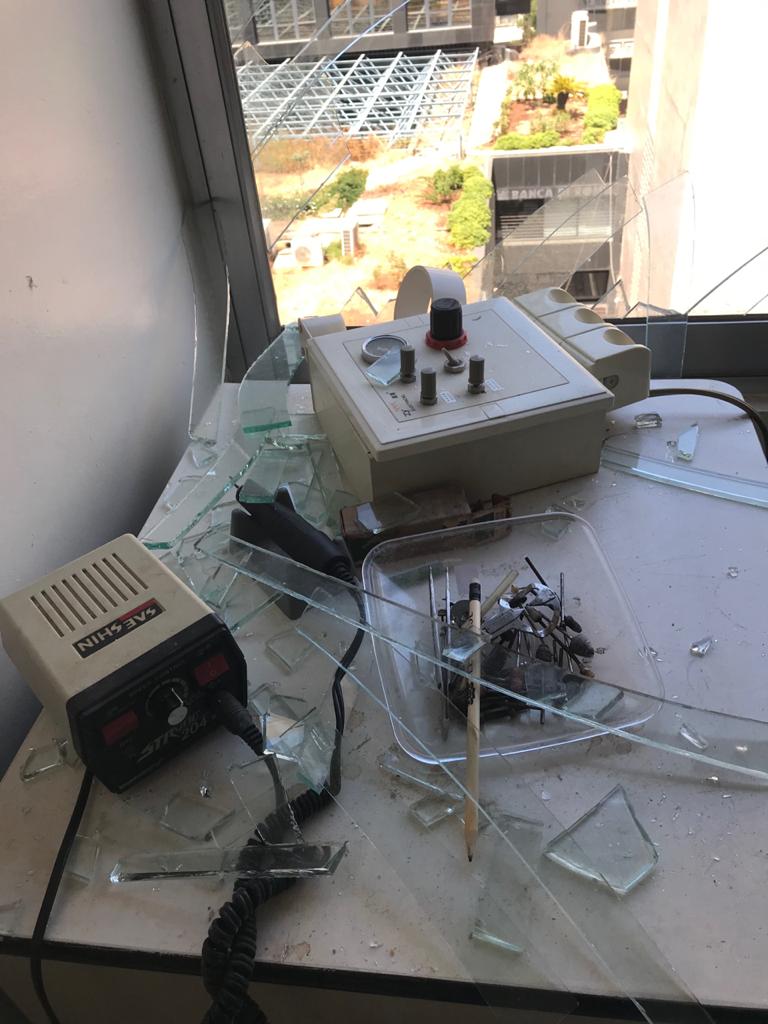
Shards in a dental office in Hamra, two miles away from the blast site. Both the dentist and his patient received cuts.

I was in New York City finishing up my quarantine when the cataclysmic blast shook Beirut. It took me a day to track down friends there, all of whom are alive but two are part of the 300,000 who have lost their homes.  The Lebanese have just learned that their insurance isn’t going to cover the damage as exclusions include not just war and acts of God but also damage resulting from chemicals. One friend told me his insurance company insists it was an act of war. Insurance companies are the same everywhere.

The Lebanese were already angry at what passes for their government but now it’s white hot fury.  What is remarkable to me is that they are not pointing their fingers at Israel with whom they are on low level terms of aggression and technically at war. The negligence of the Lebanese government in permitting ammonium nitrate to sit in their port for six years is the focus of their wrath.  The government has arrested port officials and frozen their bank accounts but it is doubtful that scapegoating will do much to appease the anger of the citizens. The opposition’s accusation, via a brother of the former PM Saad Hariri, that Hezbollah controls the port begs the question of why the government of Saad Hariri did not do more when it was in power.  In fact, friends tell me that the top management of the port was Christian.

Not that going up against any of these armed political parties is easy. Last night I read an article on the website The961.com about Hezbollah ambulances breaching the security line around the disaster zone suggesting that there was something questionable afoot.  Today the website is unavailable.  Hezbollah had influence over the port and reportedly used it to receive weapons as well as other goods.  About a month ago it was said that they had received a container of cell phones and did not pay duty on them.  The phones would have been used as emollients for their supporters or sold to retail outlets for mutual profit.

The port itself has always been notorious for its corruption. A 2012 article from The Daily Star gave details of how it was den of thieves, requiring a small conspiracy of owner, supplier, port security, goods inspectors, and tariff officers to misrepresent the bill of lading or its value in order to evade proper import duties, a practice that costs Lebanon one billion dollars a year.  

The courts, too, are also notoriously corrupt and this story involves the lack of response from the court to letters from a senior customs official seeking permission to sell or donate the chemicals.  One wonders if requests from the purchaser of these chemicals in Mozambique also went into the black hole.  Surely they noticed a million dollars worth of chemicals had not arrived.

While there has been an outpouring of grassroots help for the neighborhoods most afflicted by the blast from street sweeping to food deliveries, the anger at the political class is seething. “Where’s the state?” is the refrain, echoing years of protests. Neither the president nor the prime minister has visited the blast site. Today two members of the cabinet did try to make appearances in the residential areas surrounding ground zero but they were driven away by hostile crowds.  Tomorrow, Saturday, there is a demonstration. 

At this point, even some politically well-connected are disassociating from the system.  The Foreign Minister quit earlier this week, citing the impasse on negotiations with the IMF which is requiring some transparency and accountability before loaning more money to Lebanon.  The chief negotiator quit in June.  After the blast Lebanon’s ambassador to Jordan quit, citing disgust with the corruption and incompetence: “We must not show any of them mercy and they all must go”, she is quoted as saying.  An MP associated with the opposition resigned calling the government “a monster”.  A daughter of a prominent Sunni family, Sara El-Yafi, wrote that “justice can only be found in the destruction of this wretched political system”. Her website is also not accessible today.   A prominent protestant church official called on the one protestant representative in Parliament to resign so as not to have his name tarnished by association with the government. 

Will we ever know exactly what happened? Was it a warehouse accident set off by a welder’s spark? Or was this part of the chain of by sabotage such as has been occurring in Iran of late? Is Trump’s use of the word “attack” based on real intelligence or is it disinformation aimed at discrediting Iran?  Many Lebanese and NGOs are calling for an international investigation, a call taken up by Emmanuel Macron on his visit to the people of Lebanon yesterday.  But president Michel Aoun, former warlord, has rejected this, claiming that it would obscure the truth.  

Here we come upon what is called “the judicialization of international relations” which is supposed to extend the enjoyment of human rights.  Unfortunately, in the Middle East it became associated with George W. Bush and Western machinations for regime change.  Today was supposed to bring the announcement of the Special Tribunal for Lebanon on what persons they were holding responsible for the bomb blast that killed ex-prime minister Rafiq Hariri along with 21 others in 2005.  This crime occurred during Syria’s occupation of Lebanon. There were serious irregularities in the collection of evidence at the scene of the blast and much of what the tribunal has relied on is telecommunications evidence, quite a bit of which came from Israel.  The Lebanese had been bracing for the pronouncement of the tribunal’s judgment with every expectation of mass demonstrations and possibly riots. Some believe it was Syria disposing of an opponent of the occupation; others believe it was Israel sewing discord between Lebanese factions while setting up its enemy Syria to take the fall.  And there are other theories.

What is clear is the political consequence of the Hariri assassination: mass demonstrations and the withdrawal of Syria from Lebanon in what has become known as the Cedar Revolution.   This week’s catastrophe will surely add oxygen to the October 17 Revolution and its call for a new social and political contract.  The Lebanese people are tired of being a fiefdom run by political mafias. They want a state: there are warehouses to inspect, the poor to care for, infrastructure to build, and some wealthy criminals to bring to justice.

A beauty parlor in Hamra

Bleed, bleed, poor country!

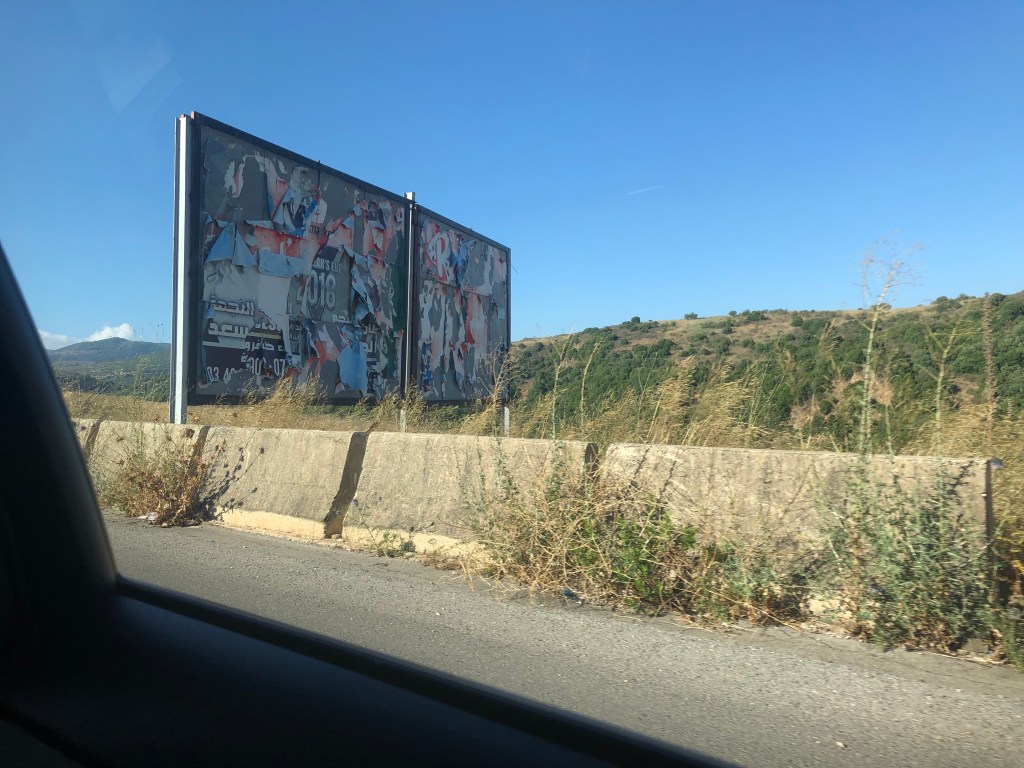
Empty billboards: what is there to advertise if no one can buy?

In a few short hours I will be driven to the airport by some friends.  I have an acute case of survivor guilt leaving Lebanon during this moment of collapse.  The currency has lost 80% of its value and half the people aren’t working.  Electricity is only running three hours a day in Beirut and the back-up generators can’t cover the rest of the day. Pharmacies and hospitals are running low on supplies.  Food is eating up family budgets. The airport lights cut out last week while a plane was trying to land.

Everyone has a scenario for what will happen in the next six months and none of them is positive. Quite a few people worry that Israel will take advantage of the country’s weakened state and invade “for security reasons”.  That would help create a diversion for Netanyahu and his corruption baggage and perhaps secure water sources.  Others fear a clash of militias, mainly Shi’a versus Sunni, another front in the proxy war between Iran and Saudi Arabia.  Some see the “revolution” turning violent and/or the military taking over. No one doubts the continued emiseration of the Lebanese people and a rise in crimes for survival.  On my own street, we had a two-man break-in of an apartment building in which a doctor for an international NGO got quite cut up fending off the intruders (she and her husband have since left the country).  One of the intruders was the bawwab (super) of the building next door, someone who at least had a roof over his head.  Last week, a woman was robbed of her purse on the street and got a black eye.  The robber was a Sudanese, probably a house servant whose wages hadn’t been paid.

Those who dare hope hope that Hezbollah leaves the government in a gesture of solidarity so that the IMF loans can come through.  Some place great store on the Lebanese diaspora coming through and in fact, in the last week or so, I’ve seen Lebanese expats in my hotel and in neighborhood restaurants. But there are not enough of them to turn the tide, I don’t think. It’s a seasonal appearance to visit family.   Some predict the rise of disaster capitalism with corporations buying up public assets like the coastline just as they did in Thailand after the tsunami.  Except, of course, the Lebanese political mafia has already found a way to get ahold of much of this supposedly inalienable property.  Mostly, though, people are hoping for their families – and that hope lies in leaving the country. One of my teachers told me that even unmarried Muslim women from conservative households are being pushed to leave the country, unchaperoned, to find employment.  Turkey and Cyprus are favored locations for their ease of entry.  Residency and even citizenship can be had for the price of an apartment, as I understand it.

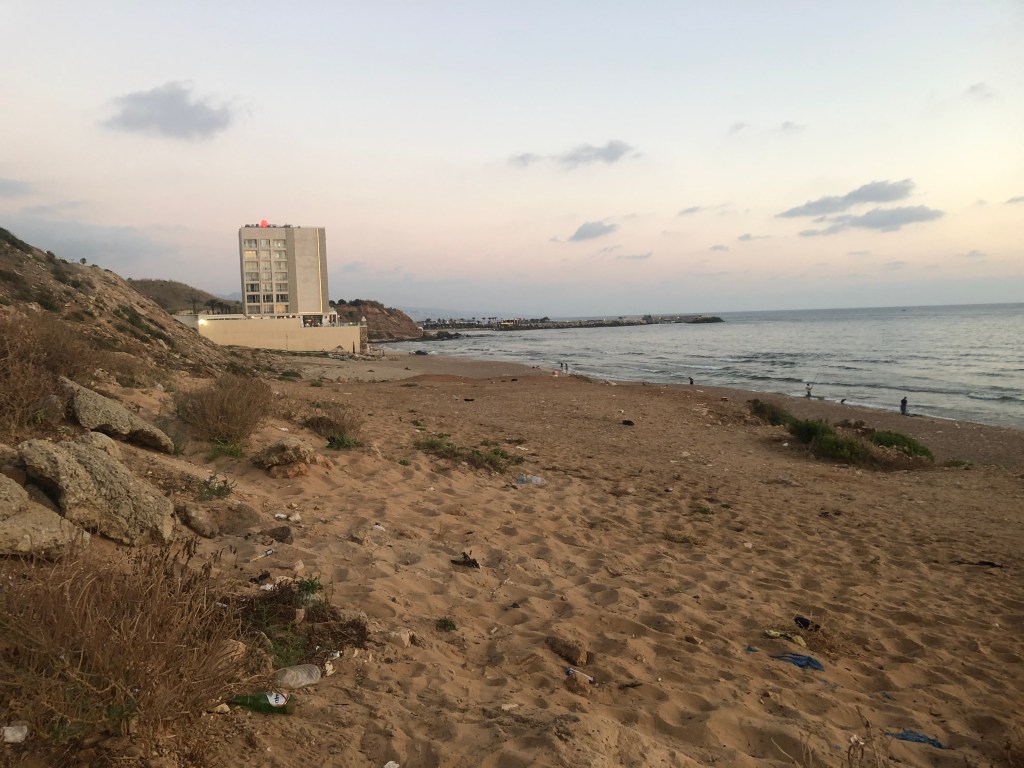
A hotel illegally built on the coastline which is public property

One of the great concerns is bank failure.  Lebanese banks used to be solid, gold-backed institutions. It was a point of pride that Lebanese banks did not get involved in the casino capitalism ending in the 2008 crash. But then came “financial engineering”, the Ponzi scheme of attracting dollar deposits by offering high interest rates. Now, people can’t access their dollar savings accounts.   Many Lebanese working in the Gulf have found themselves in this position. The only thing a depositor can do is write a check to be deposited in another Lebanese bank, so this has meant the real estate sector, in a slump for years because of the overbuilding of high end apartments, is now experiencing a rush of investment.  People are trying to buy land or housing just to clear out their bank accounts.  The sellers are often in the category of people who are allowed limited access to their dollars – people with children studying abroad, for example.  Within families, people are buying up the debts of their children and other relatives so that they can clear out their accounts and become the family banker.  There is no FDIC here so when a bank fails, the money is gone for good.  Buying real estate only exacerbates the problem of non-productive uses of capital in Lebanon, of course.  How will the economy be financed if the banks are cleared out?

Institutions of every kind are now shutting their doors.  The venerable Bristol Hotel, neighborhood stores and restaurants, and private schools.  Even the American University has furloughed staff, mostly from its hospital, where low level administrative staff were let go this week in their hundreds.  Quite possibly these were mostly patronage jobs shoved onto the university by the political mafia, but these are families without an income now.

Bizarrely, the prime minister, Hassan Diab, is suing AUB for a million dollars of salary to be paid into a foreign bank account.  He was an administrator there before his political elevation. This tone deaf initiative has little legal merit as an AUB employee only receives an unpaid leave of absence under these circumstances. The suit has become a sign of how detached the political class is from the problems of subsistence gnawing at the rest of the Lebanese.

Where is the revolution?  It has split.  One part wants early elections and a change of personnel at the top of political life here.  The other part sees the problem as systemic and that elections would only benefit a new generation of politicians who would succumb to easy corruption.  And who believes that there isn’t vote buying, ballot box disappearances, and other corrupt practices in the election system?  In three months we will have the first anniversary of the revolution and its fault lines will become more apparent. Maybe it will be re-energized.

When I arrived here in January, as the lira was losing value and banks were breaking trust with their depositors, the word “miracle” was on everyone’s lips.  They saw trouble ahead and wished for a miracle to take Lebanon in a new direction.  This was before Corona and hyperinflation.

Now, though, no one talks about a miracle.  There is just an agonized litany of terrible conditions, a pervasive sense of dread.

A friend here quoted to me from MacBeth:

“Bleed, bleed, poor country!

Great tyranny, lay thou thy basis sure,

For goodness dare not check thee.

Wear those thy wrongs;

The title is affeered.”

We can only hope that the corruption and mismanagement of Lebanon will not come to as bloody an end as Shakespeare’s play. 

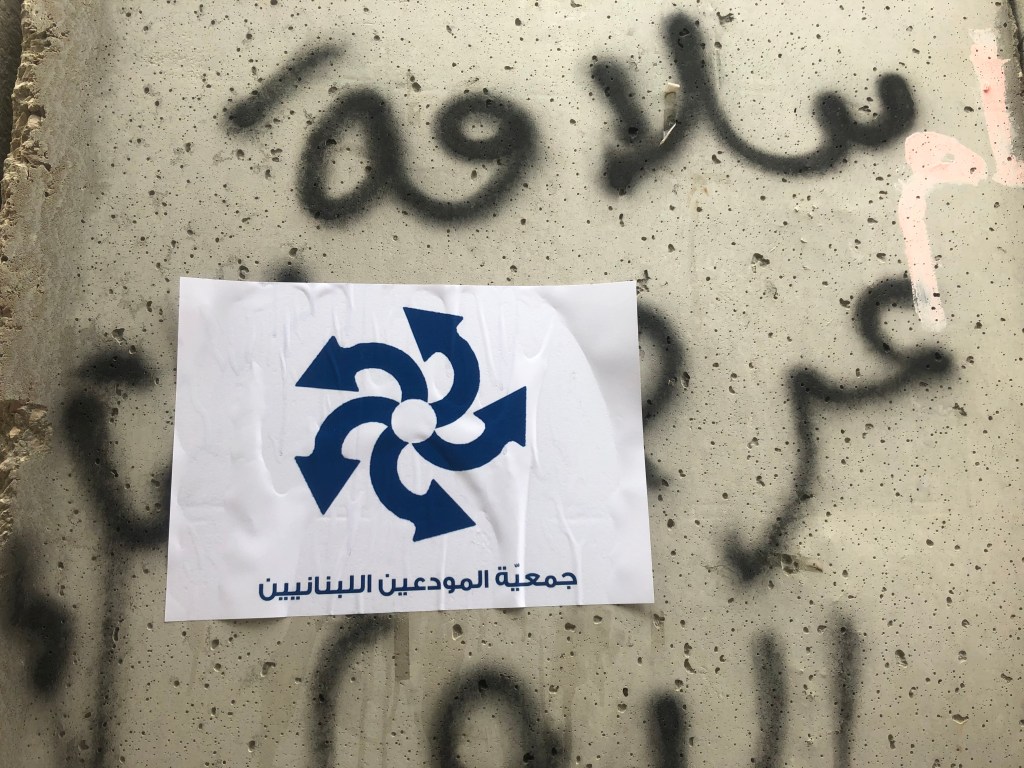
The symbol of the Lebanese Depositors Association on a barrier in front of the Bank of Lebanon

A Lack of Energy

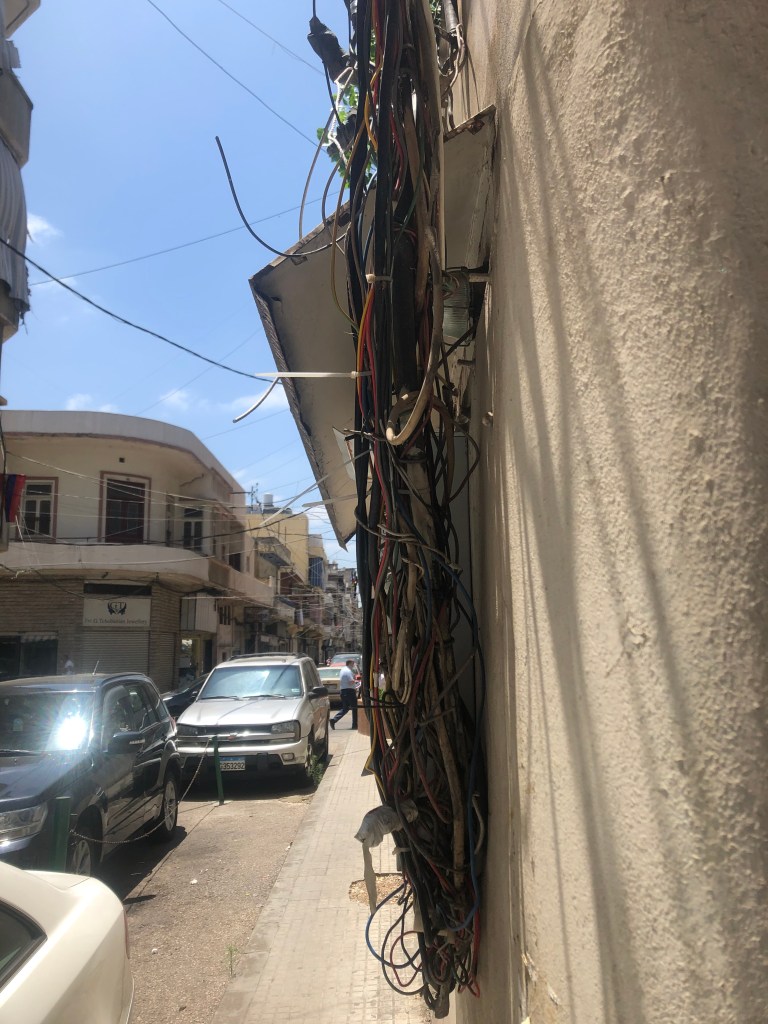
It’s so easy to steal electricity in Lebanon

The other day I left my building for a dental appointment and saw the shopkeepers of the area milling about on the street.  Accident? There were no police. Block party? Not a festive feel.  I went up to the shirt maker and inquired.  “No electricity” he said.  “The back-up generators aren’t working either.”  Sure enough, their shops were in darkness.  The shirt maker, the tailor, the falafel maker, the dry cleaner – these are the lucky ones who still have paid employment and now they can’t work.  Then the dentist called and said his building didn’t have electricity either.

The electricity sector has been a problem since the civil war started forty-five years ago.  That was when back-up generators became commonplace.  Since the war in Syria and the increased pressure on the system by the flood of refugees, there have been regularly scheduled three-hour power cuts in all neighborhoods of Beirut.  Nowadays, the power cuts last most of the day and during the hours of service they still cut regularly.  One evening I counted eight power cuts.  The traffic lights are out on the city streets so crossing an intersection is now especially terrifying in a country where road travel already was a white-knuckle experience.

Part of the lack of service is structural.  The back-up generators are now part of the economy and close to political power.  The last thing they want is a functional electrical system.  A few years ago Zahle, a city in the Bekka, managed to get 24-hour electricity going and found its transformers mysteriously shot at.  People who can afford it now are doubling up on generator companies so they can do their jobs.

Fully half the population does not pay for its electrical use.  Partly this is government subsidies, mostly to Shi’a neighborhoods.  It is also bold theft of electrical lines.  The Baptist church near me had both its telephone and electrical lines spliced by a family of squatters in the basement of their building.  They removed the telephone line. When I asked why a friend why they didn’t call the electrical company to remove the splice, she said it was the price of peace.  A small Protestant community can’t go up against Shi’as.  Maybe it would be different if they were Maronite or Greek Orthodox.

Reforming the electricity sector is one of the major demands of the IMF and other sources of foreign loans.  There have been loans and grants in the past to upgrade the system and the money has been misappropriated. Now foreign lenders are getting tough.  They want the $2 billion a year loss the government takes on the electricity sector to end and that means ending subsidies and theft, a heavy lift during this current economic collapse.  Smelling opportunity, Gebran Bassil, the Maronite president’s son-in-law and a former minister in the Parliament, is demanding that a power plant be built in a Maronite community because “Lebanon is a Christian country.”  Could he be more offensive to the Muslims and Druze? He regularly trolls members of other faiths.

There are rumors that China may buy up the national electrical company.  It already has a large presence in Africa and the Middle East may be its next step.  It has been expanding its presence in Lebanon of late by building Beirut a new music conservatory and sending medical supplies during the pandemic.  It has troops in UNIFIL (United Nations Interim Force in Lebanon) ensuring Lebanon’s sovereignty and has a field hospital near the southern town of Marjayoun. Hassan Nasrallah, the Secretary General of Hezbollah, is encouraging the government to look East for its partnerships and to forget the West.  The United States has not done its standing here any favors by imposing yet more sanctions on the region, this time via the so-called Caesar Act, which penalizes any person or institution doing business with Syria.  The effect on Lebanon could be catastrophic as the economies are intertwined. America’s influence here may well dwindle as a result of its punitive policies.

The economic problems here are now drawing comparisons with Venezuela.  The hyperinflation is being accompanied by scarcities in supplies.  Food prices are astronomical — I spent 72,000 LL on four cans of black beans last week — in official terms that was $47.52 but as the dollar is trading for ten times more than the official rate, it was more like $5.00 for me — still, a ridiculous price and nowadays most Lebanese don’t have access to dollars. The hospitals are two weeks away from running out of medical parts.  This means, for example, if a surgeon wants a particular size screw, he may have to adapt a screw of a different size to do the job.  Pharmacy shelves are already looking bare. I have to cut some of my pills in half to get the right dosage.  The dry cleaner asked me to bring back the plastic covering they wrap my order in —  I was already bringing back the hangers.

The other day I was walking down the street feeling so pessimistic about Lebanon. Then I realized I heard the bangs and clangs of building construction.  “Surely,” I said to an acquaintance shortly afterwards, “they wouldn’t be building unless they were confident in eventual sales and no invasion from Israel.”  The reply? “What you heard, my dear, was the sound of money laundering.”

Instead, what the Lebanese mention when the Venezuela comparison crops up is that Lebanese ex-pats will not let the country or their families collapse into poverty.  Foreign remittances are a big part of this economy.  The dollars they have built up in the banks here may be as good as gone but new dollars, or “fresh money”, will not be touched.   Or so the banks say. At least for now using “fresh money accounts” is the only way to wire dollars into the country so the recipient can receive them.

In the meantime, the sardonic humor of the Lebanese is as active as ever.

Q: Why is Lebanon the safest country for children?

A: Because they can put their fingers in the light sockets and not get hurt.

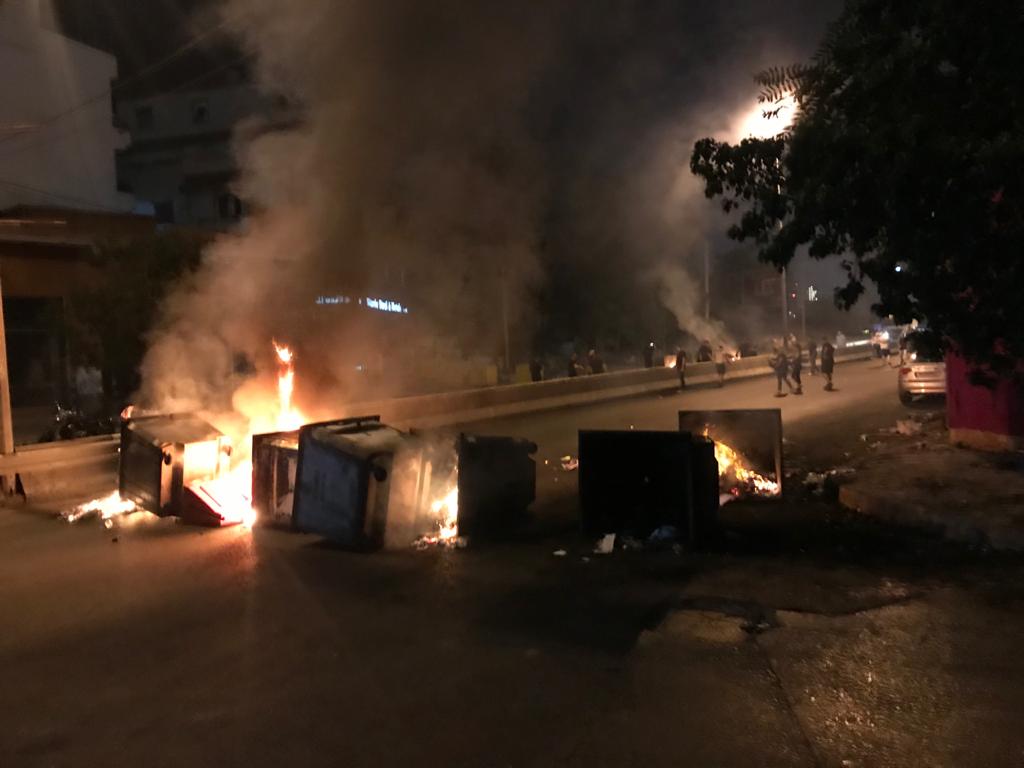
Burning trash bins — our new lighting source. (Photography courtesy of I. Mahfouz)

Bread and Guns

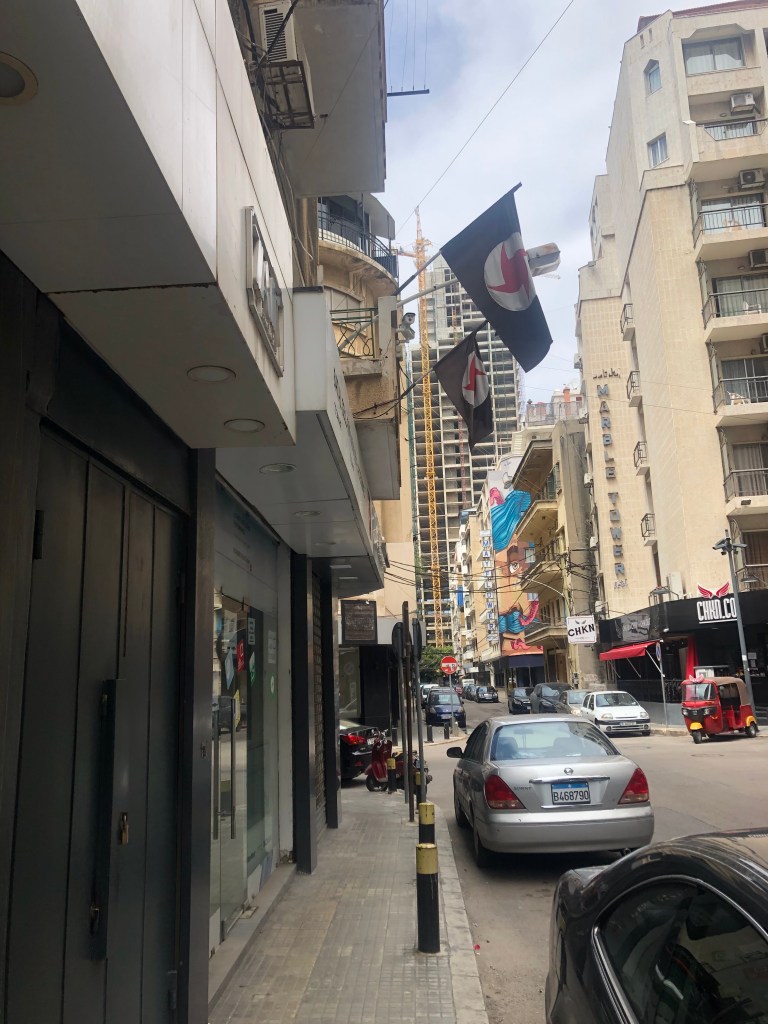
The flags of the Syrian Socialist Nationalist Party fly over Hamra, a Beirut neighborhood the militia considers its turf.

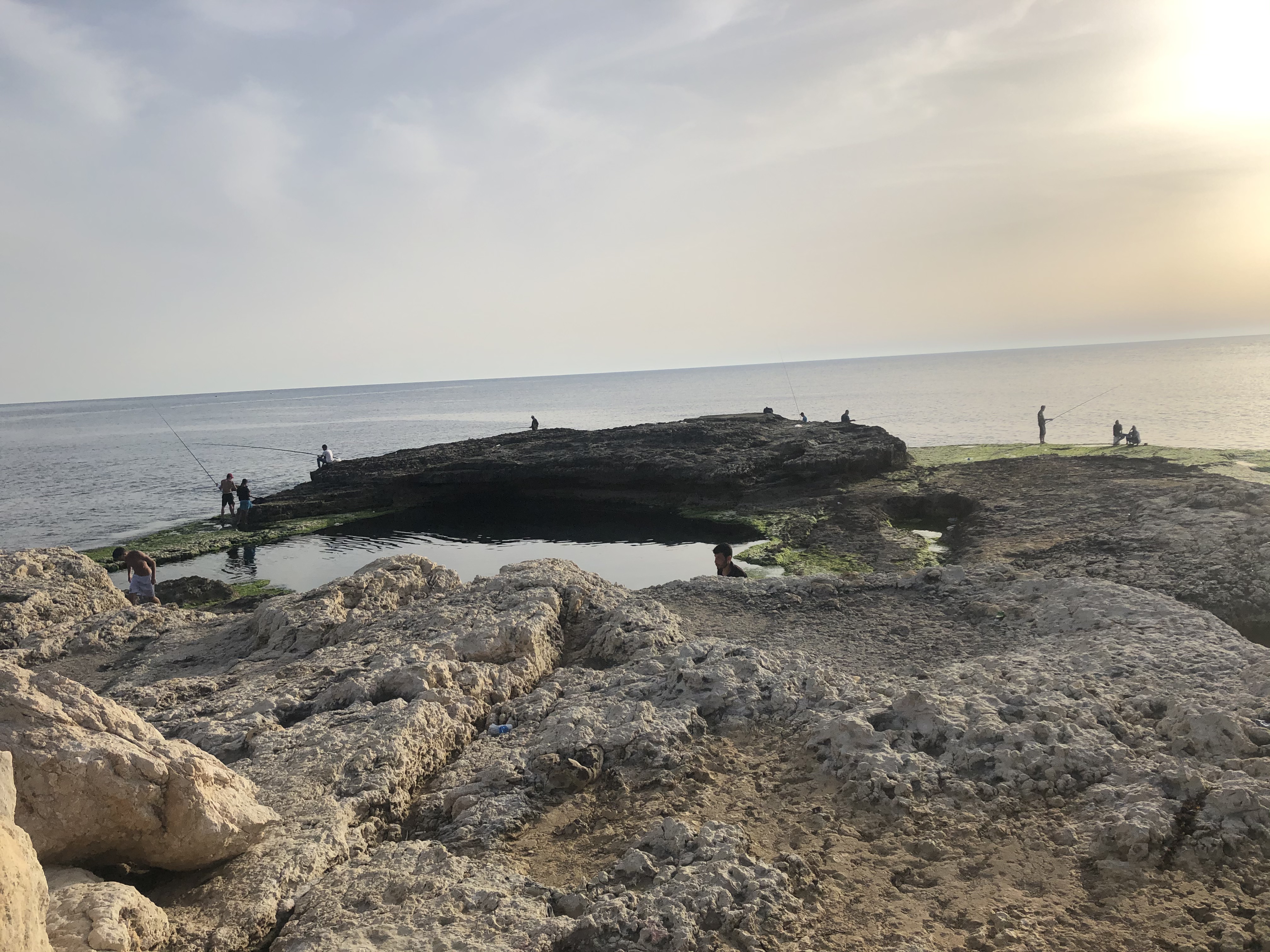
Food insecurity is becoming a visible problem here, even in middle class Hamra.  Beggars no longer ask for money as food has become so expensive it is better to ask for it directly.  A 50,000LL note used to be the equivalent of $37.50 and buy the groceries for the week.  Now it is worth about $14 and buys very little as prices have risen disproportionately. In spite of its climate and varied ecological niches Lebanon is a net food importer and that requires dollars.  Nowadays grocery lines are slowed by customers needing to have subtotals before they add another item to the counter.  Many people with access to land, or even large balconies, are planting food for the first time, a movement that got a lift from director Nadine Labaki (Capernaum, Caramel, L’Wayn Halla’?) on Instagram. (See link at bottom.) Ramlet el-Bayda, a hotel area in Beirut overlooking the sea, is now filled with people fishing for dinner.

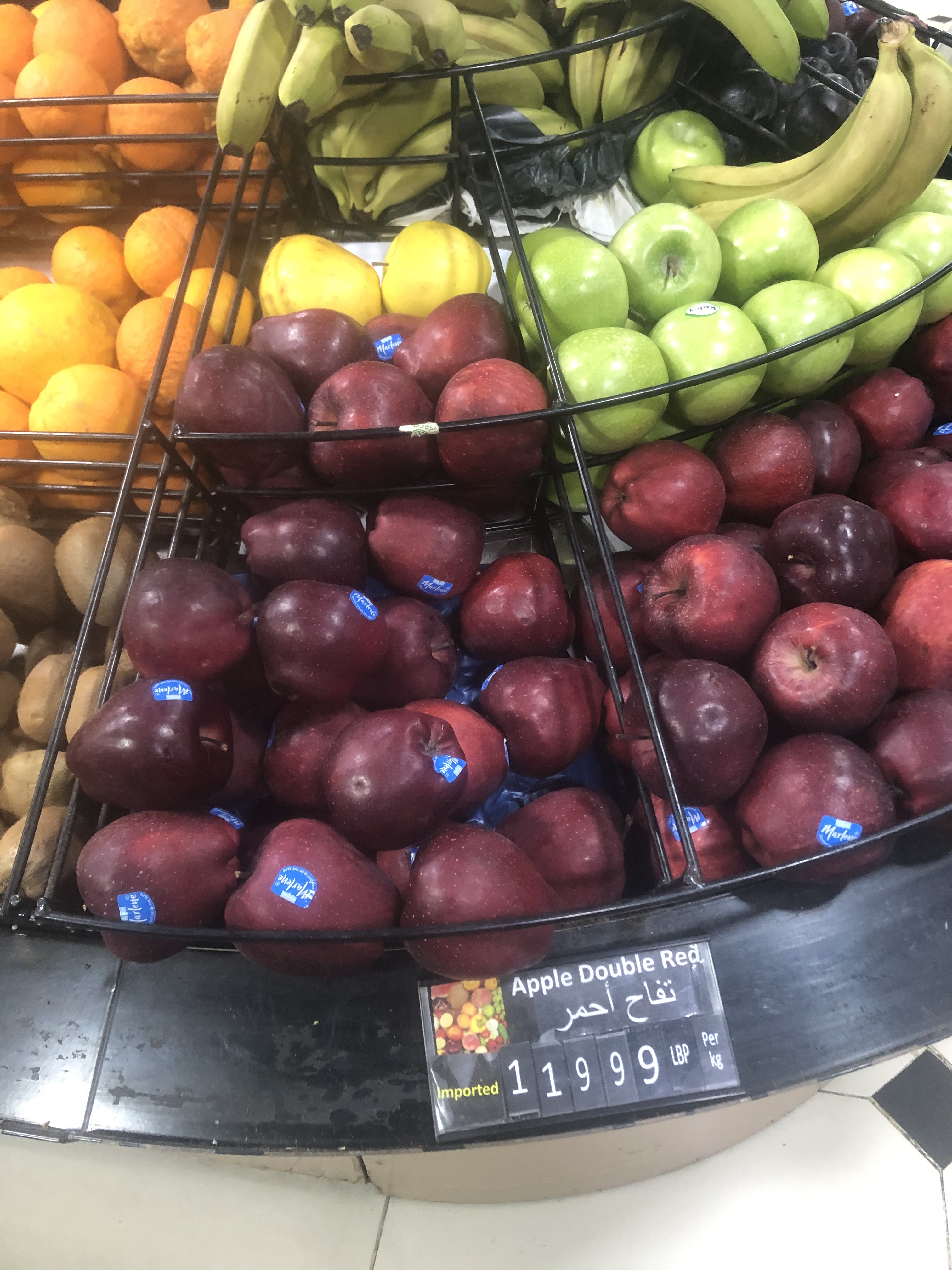
Imported apples at Spinney’s at $3/kilo if you have dollars or $8/kilo at the pegged rate; people fishing for their dinner at Ramlet el-Bayda.

There is no safety net here although PM Diab has acknowledged the need for one.  Right now the estimate is that 60% of the population is unemployed.  The percentage of functional unemployment is higher as a person is considered employed if he works as a waiter or taxi driver and receives no custom or if her job has been cut back to part-time.

It didn’t help that we had to go back into a strict lockdown for four days this week due to an uptick in cases, some of which were brought back into the country by returning nationals.  

This is a highly volatile situation.  In a recent interview conducted by syndicated columnist Rami Khouri with AUB economics professor Simon Neaime over the AUB Facebook page, the latter said that Lebanon was at the end of its options and that if it didn’t comply with what the IMF and Cedre Conference required in order to get outside funds, then it would collapse into another Somalia.  

This is not hyperbole. As a friend keeps reminding me, the political parties have their own militias and gun ownership is widespread here.  In fact, a man working at the reception desk of my building told me he had an AK-47.  I asked why he had such a powerful weapon and he told me it was to defend the family home in the “village” – the place where the family comes from and which provides an identity even if no one of the family lives there anymore.  Home invasions are reportedly a real problem now, especially since so many people withdrew their money from banks and are keeping a lot of cash at home.  Turns out that this man’s home in the village was just robbed and the AK-47 was taken.

The closest militia presence to my apartment is the Syrian Socialist Nationalist Party, a small-time player at this point. It has a couple of militia men sitting in chairs at a spot on Makdisi Street which they have blockaded off for their use. Their support purportedly comes from the Assad government in Syria.  A friend told me a friend of hers tried to park there after the militia men told him he couldn’t and they beat him to a pulp.  Of course no one was arrested.  I thought I would venture out today to see if I could take a photo of this militia post but the two militia men came running across the street and demanded my iPhone. As I was arguing with them a man came and told them they had no right to demand my iPhone as they were not military.  But these militias demand the deference due to military operations. We argued a bit but then I relented because I know their reputation.  The by-stander apologized to me and said, “what can we do?” and I answered “disarm them” and he answered “the day will come.”  I already had a photo of the flags hanging from another building a few streets away and that will have to suffice (see above).  Other neighborhoods have other flags – in South Beirut there are Amal and Hezbollah and in East Beirut one sees the Kataeb flag, the party of the Christian fascists. 

An example of a confrontation with my friendly neighborhood militia can be read in this account from nine years when anti-Assad protestors squared off with the SSNP on Makdisi Street:

https://www.jadaliyya.com/Details/24281/One-Night-in-Hamra

This brings us to recent events in the name of the revolution.  That spontaneous, angry, and hopeful efflorescence is at risk of being hijacked.  Already in December, a friend from church told me, her car was being stopped outside of Tripoli and young men purporting to be from the revolution would demand a “contribution”.  I went to visit her up north and when I came back we took a secondary road back to Beirut as this shakedown was happening that day on the main road.  When I told friends in Beirut they shook their heads and said that it was like this  leading up to the civil war, but in the south with the PLO stopping traffic and demanding contributions.  This is what a weak state looks like. (Are you listening, Michigan?)

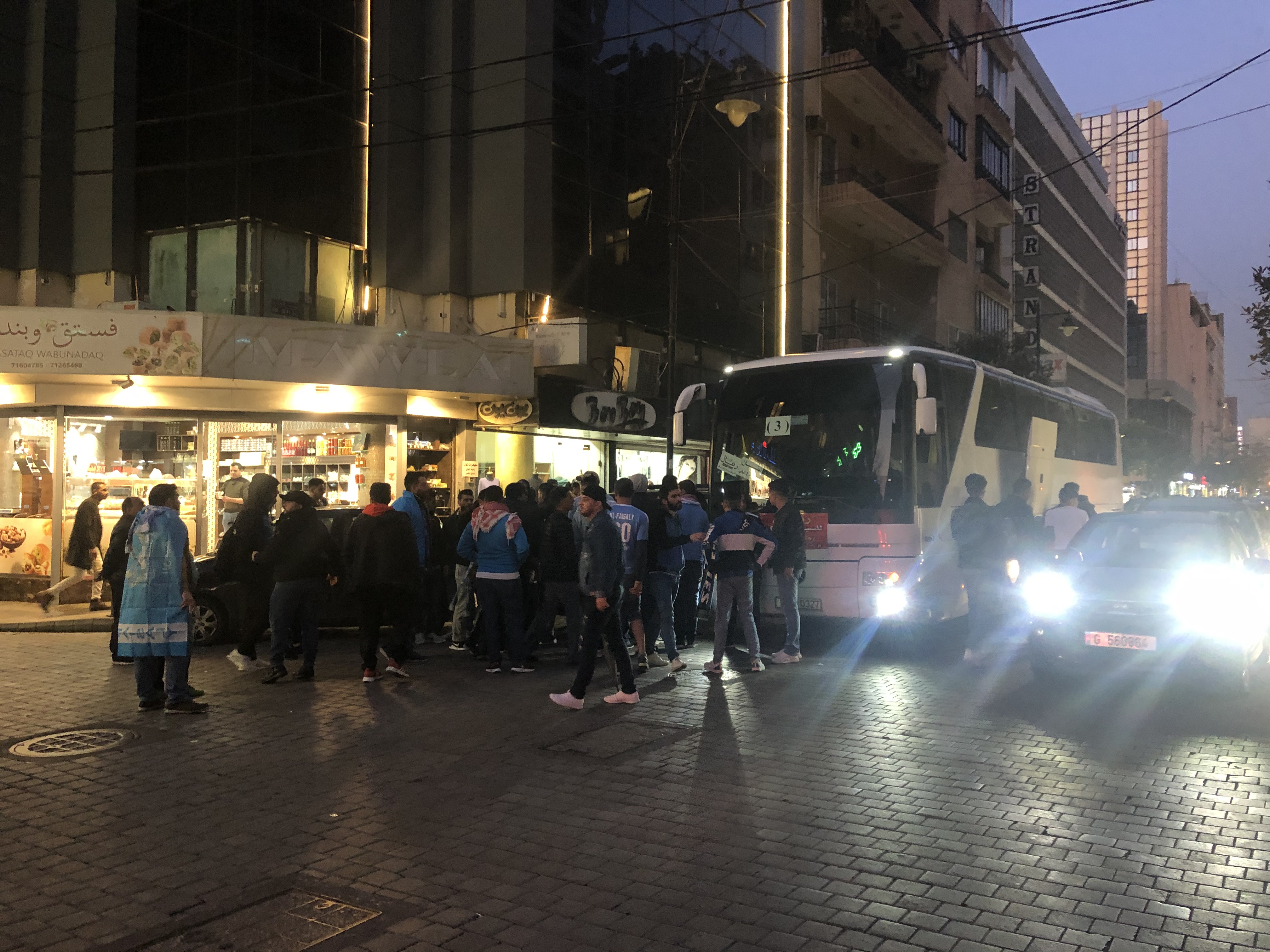
A more ominous hijacking of the revolution has been the recent demonstrations and vandalism in Tripoli and in Beirut by young men from Tripoli.  Certainly, economic desperation is fueling their activity.  However, I saw a demonstration by young men from Tripoli in February on the main street here, Hamra, and I found it curious that they all got on and off a very nice coach bus. One would expect rattletrap cars and vans as these are the usual transports of the working poor.  Also, the poor do not have the money to put in banks in the first place so it makes little sense for them to come down to Beirut to trash bank buildings.  Looting local grocery stores would make more sense.  So, I’ve been asking people here if they think these demonstrators from Tripoli are being supported by anyone. Barely is my question out of my mouth when I get the answer: “Hariri”.  This is the former prime minister who resigned in October once the revolution got underway and he and his proxies have been trashing the current government ever since.  

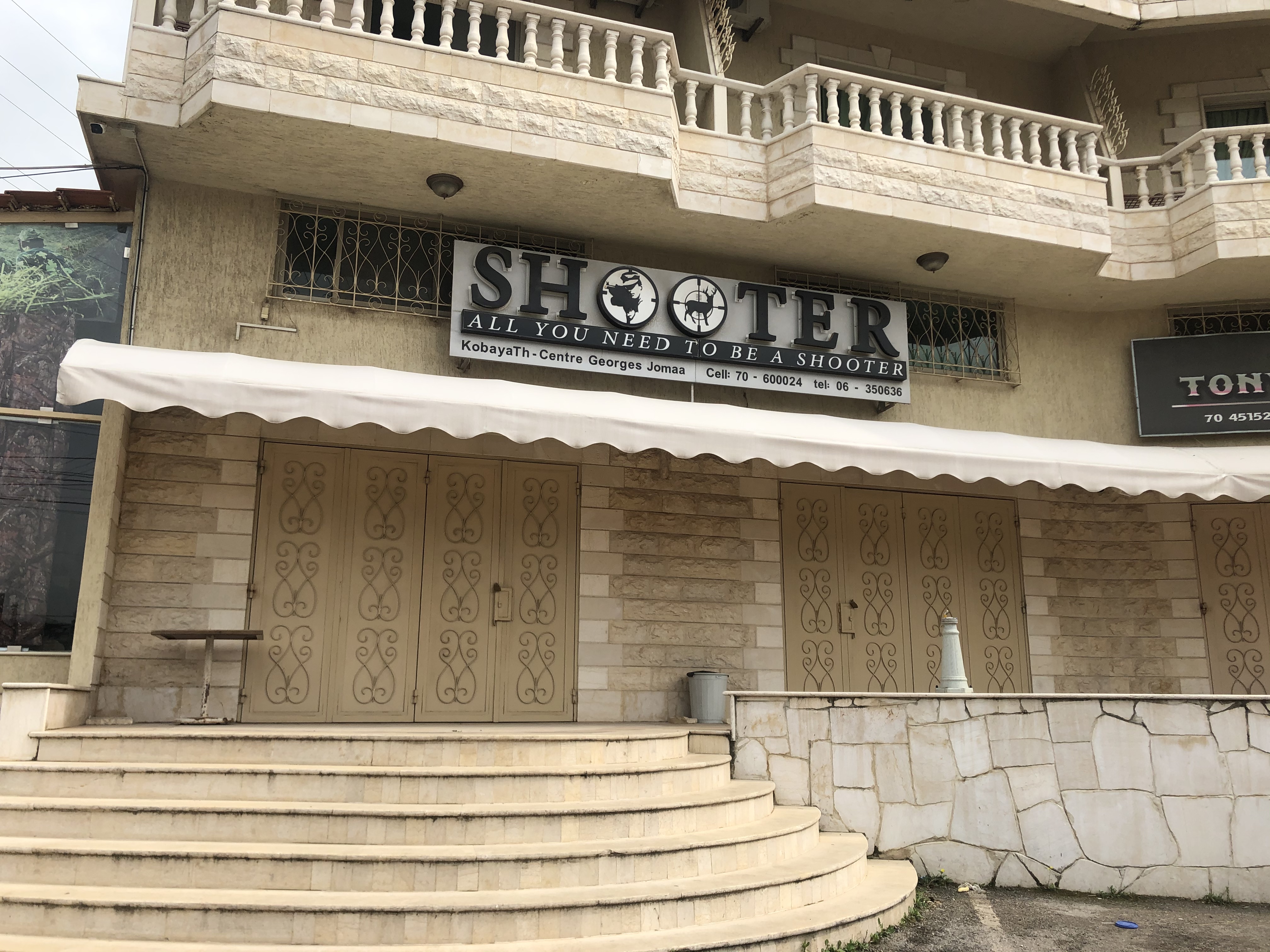
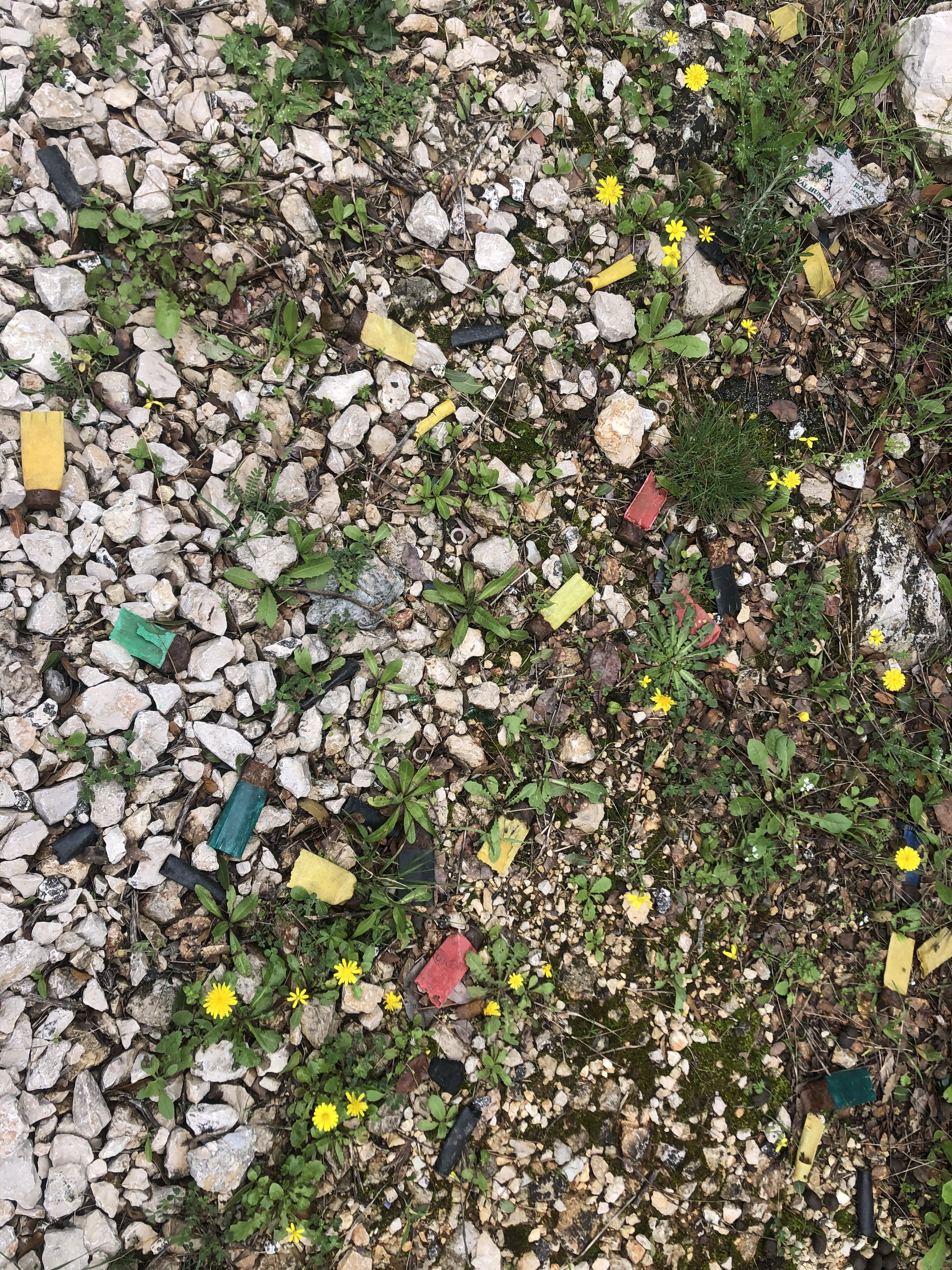
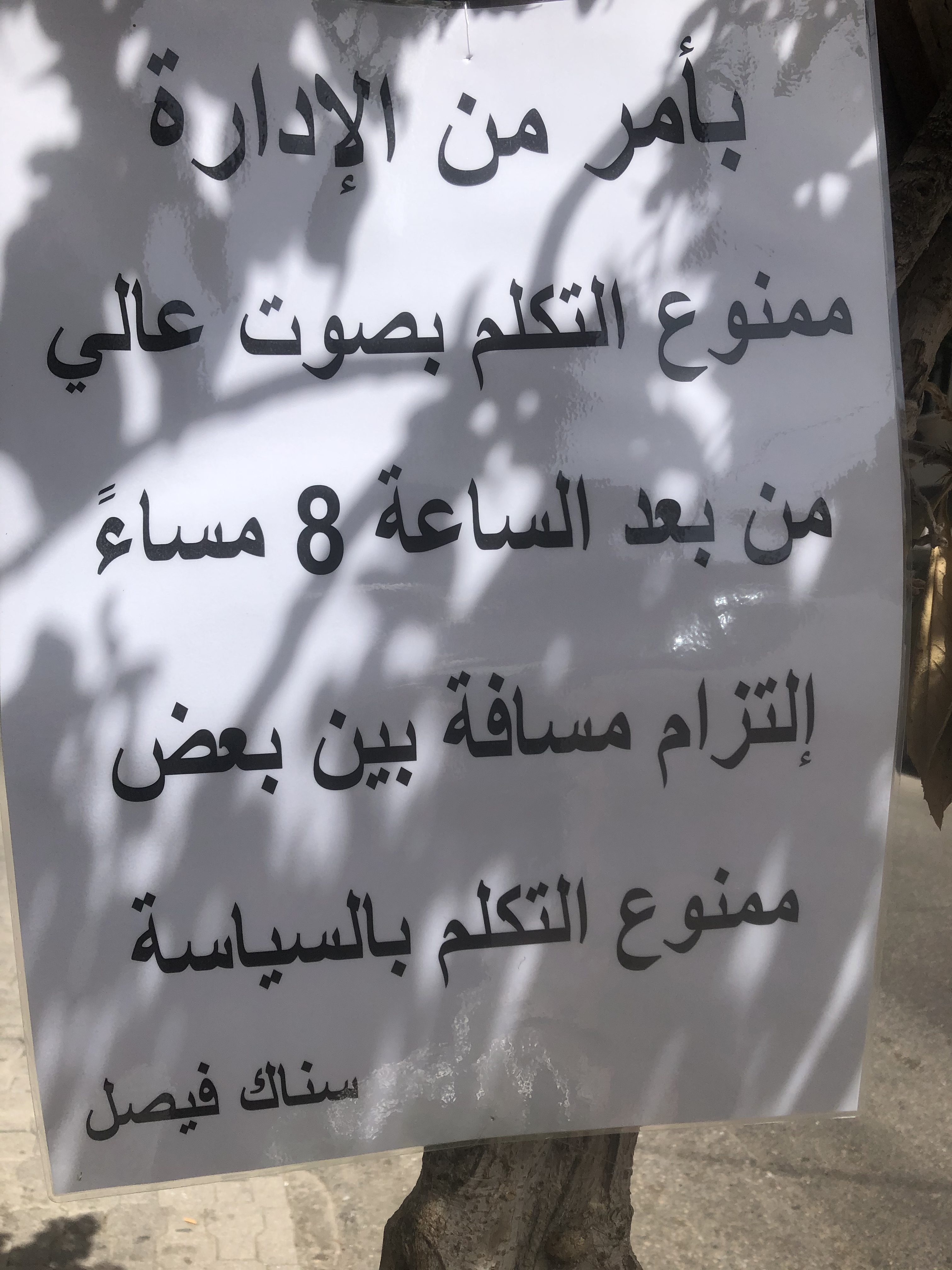
A gun store in northern Lebanon; shell cases on a country road in Qobayat, in northern Lebanon; protestors from Tripoli on Hamra Street getting ready to re-board their bus; a sign outside of a snack shop telling us to keep our voices down, maintain physical distance, and not to talk politics; a sign in the lobby American University Hospital.

Saad Hariri’s incentive to get back into government is as clear as a Forbes ranking: he has lost billions of dollars in his personal, ill-gotten fortune and is now worth less than a billion dollars. In a kleptocratic system, there is a vicious cycle between accessing the goods of the state, building a personal fortune, and buying loyalty to stay in power.  A friend recently told me that Saad’s father, a real estate developer who became prime minister and was assassinated once out of office, would buy the poor for demonstrations and buy the middle class by paying for hospitalizations and foreign education fees for their children.  His offer to pay for the hospitalization of a prominent literary figure here who had quit his newspaper job when Hariri bought the publication was declined, as I hear it from the family.  But Saad cannot keep up with his late father.  His real estate business in downtown Beirut, Solidere, was worth $40/share in 2008 and is now worth $10.30. His family’s real estate conglomerate, Saudi Ogero, ceased operations in 2017. His Future Party television channel operated for years arrears with its employees’ salaries and was shut down this fall.  This leaves his political operation without a media outlet, a disadvantage when other political groups have their own. One can imagine Hariri’s desperation to get back into power and access the public purse.

When I come back to the States in about a month’s time (if I can get assurances about precautions on flights home and some sign that being back in the States might be safe) I will be leaving Lebanon with a great sense of apprehension.  People are already asking if I am coming back and I tell them I will come back if there is fighting in Dahye (the poor Shi’a neighborhood where Amal and Hezbollah compete for support)  but not if there is fighting in my neighborhood, Hamra.  We can only hope that the Diab government can pull the country back from the brink so it doesn’t descend into Somalia. The militias are going to have to co-operate with him if only because they need a live state to feed off of.  And the Lebanese people need to eat.

View this post on Instagram

#zarri3et_albi is a national campaign gathering most of the sustainable agriculture initiatives and aiming to help citizens who are willing to grow seeds and vegetables in their homes or their lands . This has been a beautiful partnership and a collaborative work between many talented artists, family and friends . Thank you @khaledmouzanar for your brilliant idea, your talent and your amazing inspiring music . Thank you my dear friend and director @eliefahed for your magical touch and partnership . Working with you over FaceTime made the confinement a lot more bearable! I m in aw of your patience, talent and dedication . Thank you @georgeskhabbazofficial for the ongoing creative collaboration . You are a true poet ! Thank you @lynnadib and @zeidhamdan for the beautiful chorus .Thank you @taniasaleh for your great heart and generosity. Thank you @zeinaesfeir @eli.youssef @ghadyazar for your hard work and dedication . Thank you to all the great sustainable agriculture initiatives working endlessly to promote sustainable living and taking part in this campaign : @ardiardak @aub_fafs @beitelbaraka @buzurunajuzuruna @agronote.lb @regeneratelebanon @esdu_aub #izraa #helpthemseedforthemtofeed المبادرة_الزراعية_الشعبية# #سكّة And a huge thank you to all the beautiful citizens and artists who filmed or sent us their videos @wissamsmayra @raneemboukhzam @amaltalebofficial @farixtube @patricianammour @adelejamaleldine #antoinelabaki @ammounz @gilleskhoury @georgeskhabbazofficial @eatlikenicole @arlettelampsos @zeinadaccahe @khaledmouzanar @yvonnemaalouf @darinechaheen @alexpaulikevitch @eliasnmattar @charlottemattar #philipkhairallah @fadi_mogabgab @aliamouzannar @pierrerabbat @monasalibaofficial @marianawehbepr @antoinette_labaki @laylahakim @talal_eljurdi @carolinelabaki @anjorihan @darinedandachly @lamamatt @alissarcaracalla @alaindargham @youssefyammine @samersalloum @mouradayyash @halimatabiah @youmnajreidini @patrickdaoud @salamelzaatari @dolly.ghanem @joseph_tawk @hayatfakhereldine @haladaaaa #antoinettenoufaily #zainabhamis #boudyaboujaoudeh @makramalhalabi @elie_s_ @joanna__hajj @habib_assaf77 @brunotabbal @elie_loutfallah #pierregabriel

A post shared by Nadine Labaki (@nadinelabaki) on

For Once, Lebanon is Safer Than America

Let’s Celebrate While We Can

A policeman checking a driver to see if his car is allowed to be on the street that day, one of the many precautions taken against the spread of Covid-19 here.

Three weeks ago the U.S. embassy in Beirut chartered a flight to evacuate U.S. nationals like myself from Lebanon. I was not on it. Nor were other Americans I know here in Lebanon. We know that we are better off here in this bankrupt, politically divided, and corrupt country than risking our health in the disaster that is America right now. We watch with horror the news of America alongside our Lebanese friends. We see the scales fall from their eyes.  “America is a fake superpower!” summed up one of my friends. 

I do not need the nightly news here to tell us what catastrophe awaits a hospital patient in America. I have our own horror stories from better times. I remember arriving at the emergency room of Mount Sinai Hospital in New York City to find my mother in a sea of gurneys so densely packed that they formed a log-jam. My mother had not even been given water during the nine hours she had been there. A few years later I became acquainted with New York Hospital when my uncle required regular visits to the emergency room.  There conditions were even worse. On one occasion, after hours of waiting, my uncle needed to use the rest room. As there was no staff to be found I reluctantly took him myself and cleaned him up afterwards.  No sooner had we opened the door to leave the bathroom than another elderly man appeared asking for help at the toilet.  So, I toileted him, too. And then some elderly women.  Then I went back to sit on the floor. 

Lebanon feels positively safe in comparison. The normally dysfunctional government has been single mindedly focused on flattening the curve. The borders are shut and the airport closed except for repatriation and cargo flights. And of course, the private jets of the very rich.  Every business, service, and institution has been closed down but pharmacies, food stores, laundries, and take-out food restaurants. Certain villages, like Bsharri, where Khalil Gibran came from, have been in special lockdown because of the number of cases there.

But today, Lebanon is coming out of hibernation. There is an almost festive feeling.  Restaurants are re-opening and barber shops are plying their trade.  Other stores are open, pretending to be cleaning up for re-opening next week but ready to do business on the spot. 

Lebanon deserves its celebration.  It took precautions very seriously in most places and at great cost everywhere. Most stores and offices have been shuttered.  For weeks now we have entered the supermarket in small numbers, wearing face masks and gloves, and only if the temperature gun clears us. I can readily get face masks at the pharmacy and the supermarket. All forms of media, including our cell phone messages, tell us to stay home. Curfew begins at 9 p.m. now (pushed back from the original 7 p.m.) and ends at 5 a.m. Public transportation has been shut down.  Cars may only be driven three days a week, according to license plate, and not at all on Sundays. The police and army are checking streets and roads and issuing tickets. 

Cafe Younis on Abdel-Aziz is opening up again

The army is also delivering food parcels to the hungry. Lebanon was facing an economic catastrophe before the arrival of Covid-19, stemming from years of corruption, indebtedness and gross mismanagement. The 25% unemployment rate of Greece in 2008 is an aspirational improvement here.  The real unemployment and underemployment rate may well be 75%. It’s not just janitors who are on half-pay here but doctors and professors. The lira is half the value it was nine months ago, so between half pay and devaluation spending power is now at 25% of a year ago.  

In March the government made the right decision to delay repayment of its Eurobond and subsequently has some capacity to function in this crisis.  Additional resources have come from Hezbollah in the form of medical staff and equipment. This has been criticized as image burnishing by its detractors, and it probably is, but at least we are not being treated to scenes of Lebanon’s political leaders playing golf at Mar-el -Lago. Press photos show Prime Minister Hassan Diab and President Michel Aoun wearing masks and gloves. This is re-assuring.

Nor have we heard stories of conditions in Lebanese hospitals to trigger any kind of alarm.  Were the number of afflicted much different from the 740 cases or the number of deaths much different from the 25 publicly announced we would probably know.  In this small, deeply divided nation of 4 million citizens and 2 million refugees it is hard to keep a secret. Ex-prime minister Saad Hariri, desperate to regain power, would have raised questions by now. We would have seen Facebook accounts like the one a distant cousin of mine recently posted of conditions in New York City hospital describing how he, an emergency medical technician, is wading through corridors where the living and the dead lie side-by-side on the floor. We would have heard of shortages at the hospitals and felt compelled, like another cousin, a high school math teacher, to sew masks for the local hospital at her kitchen table. Nothing of the kind is happening here. In fact, today a beggar offered me a facemask from a box he had when I gave him money.

It is no surprise, then, that Lebanese ex-pats are scrambling to come home.  Bringing them home by the kind of charter flight my friends and I recently rejected to America is a major controversial undertaking here as it is likely some of these Lebanese nationals are now infected.  Yesterday three returning ex-pats tested positive. Yet here again, the Lebanese government has surprised everyone with how diligently they are quarantining and tracking the recent returnees. An account of one such returnee, translated and posted onto the961 website, includes follow-ups to the address she gave the authorities once she was cleared for sheltering in place. They are doing to contact tracing that America should be doing.

But this period of mobilization is coming to a bumpy end. A few weeks ago the Health Ministry announced an increase of PRC testing to 1,500 a day plus random testing but here it has run into a problem – the anger of the people who have lost patience with all these containment measures in the face of real hunger.  The pause button on the revolution has been lifted and there has been some violence during the protests and one death.  We can only hope that the return to economic activity brings real relief to the many who are suffering. It is hard to see how this can happen quickly enough.

Still, I have asked myself how Lebanon of all places could have gotten it so right while America gotten it so wrong. Two answers come to mind. The first is that Lebanon has lived through repeated catastrophes in the past several decades and knows that life is unpredictable.  Civil war and invasion are constant threats. So is natural disaster. The country sits on the same fault lines that have brought devastating earthquakes to Turkey in recent years. My own building swayed with a tremor in January.  Lebanon knows only too well not to let its guard down. Meanwhile, in New Hampshire where my husband is, people are still going to the supermarkets without masks and there are no gloves and temperature guns at the entrances.  

The second is that Lebanon understands the importance of government even if it can’t manage to create a functional one.  In fact, part of the frustration expressed at the revolution last fall was the understanding that government can be a force for the good. Unlike Trump and his enablers, the Diab government has not shillyshallied about the role government plays in containing this epidemic.  We can only hope it does not revert to type when this is all over and become blatantly sectarian again. But it probably will. This week may be the last time I can write good news about the state of affairs here in Lebanon. The future looks very troubling otherwise.

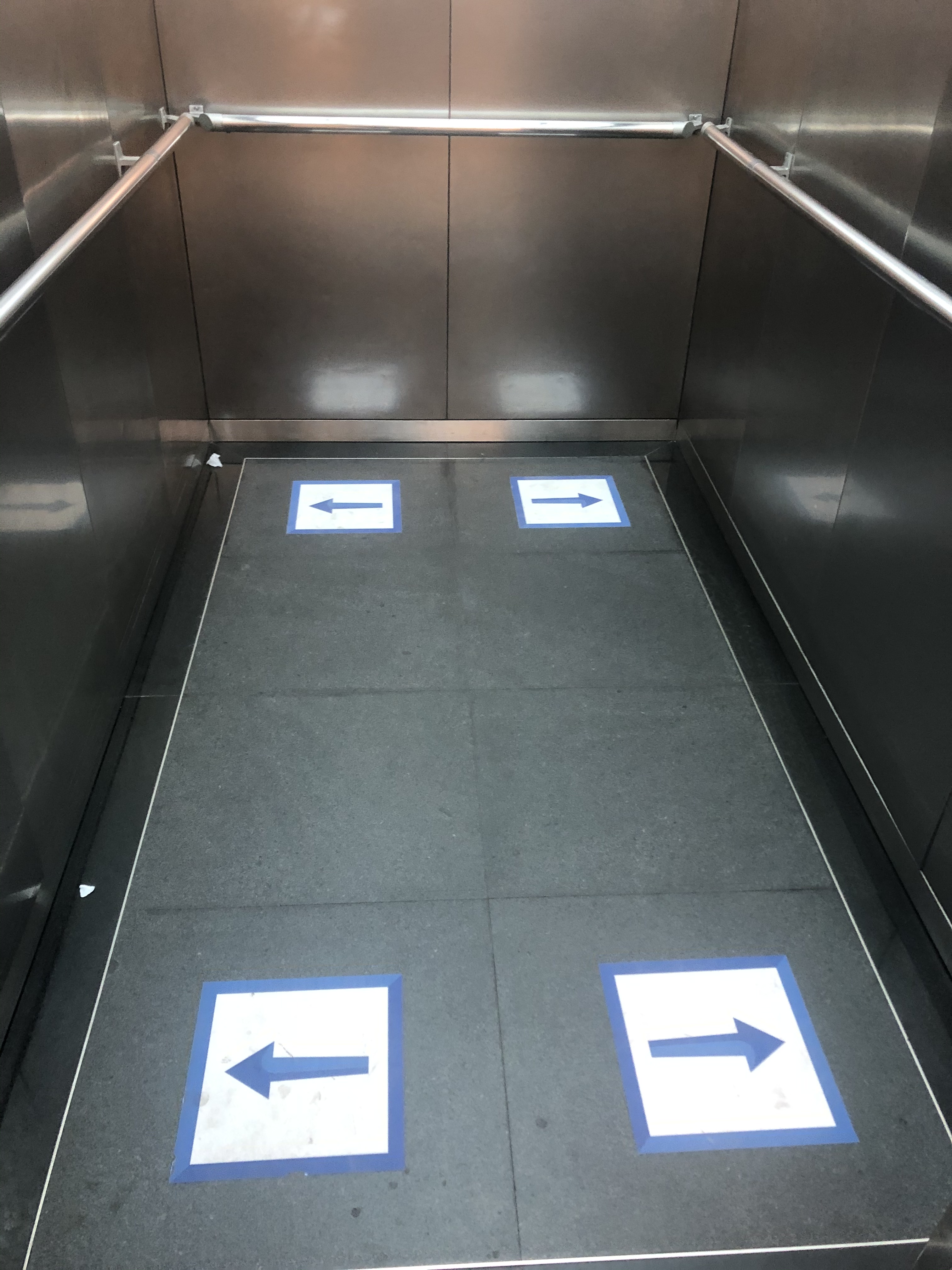
Signs of serious commitment to the General Mobilization: Prime Minister Diab wearing facemark and gloves; Bliss Street deserted of traffic; Ministry of Health messages to cellphone users offering information on the virus and instructions, at Easter, to pray at home; the elevator at the American University Hospital where passengers are supposed to be limited to four people facing the wall.