
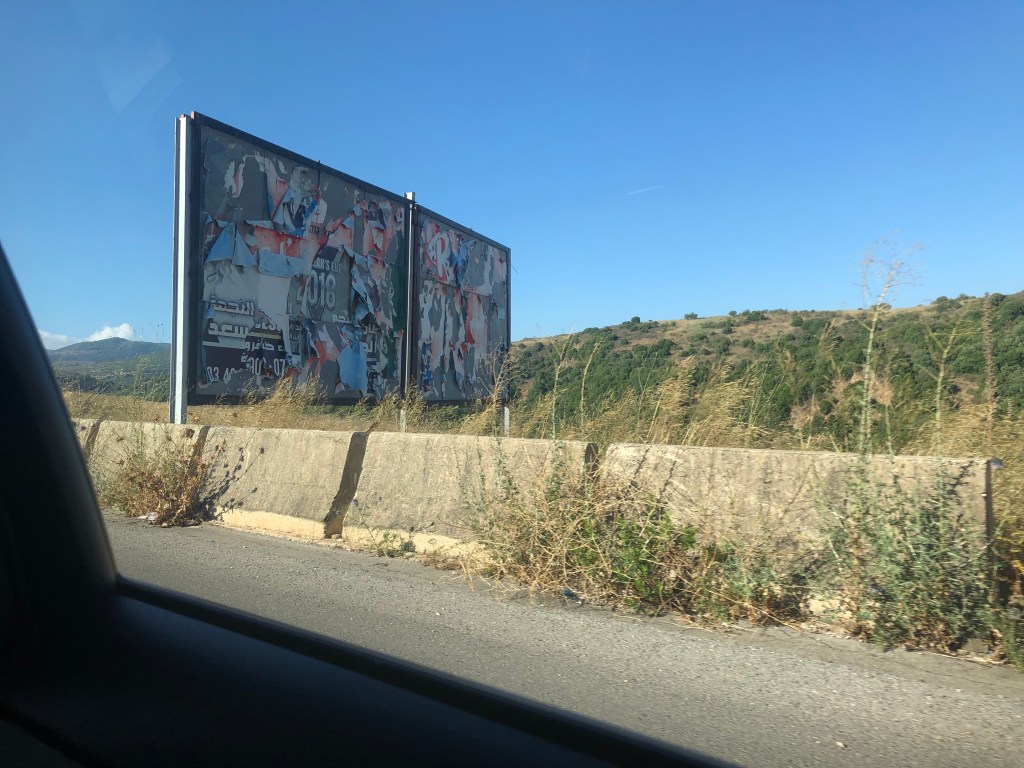
In a few short hours I will be driven to the airport by some friends. I have an acute case of survivor guilt leaving Lebanon during this moment of collapse. The currency has lost 80% of its value and half the people aren’t working. Electricity is only running three hours a day in Beirut and the back-up generators can’t cover the rest of the day. Pharmacies and hospitals are running low on supplies. Food is eating up family budgets. The airport lights cut out last week while a plane was trying to land.
Everyone has a scenario for what will happen in the next six months and none of them is positive. Quite a few people worry that Israel will take advantage of the country’s weakened state and invade “for security reasons”. That would help create a diversion for Netanyahu and his corruption baggage and perhaps secure water sources. Others fear a clash of militias, mainly Shi’a versus Sunni, another front in the proxy war between Iran and Saudi Arabia. Some see the “revolution” turning violent and/or the military taking over. No one doubts the continued emiseration of the Lebanese people and a rise in crimes for survival. On my own street, we had a two-man break-in of an apartment building in which a doctor for an international NGO got quite cut up fending off the intruders (she and her husband have since left the country). One of the intruders was the bawwab (super) of the building next door, someone who at least had a roof over his head. Last week, a woman was robbed of her purse on the street and got a black eye. The robber was a Sudanese, probably a house servant whose wages hadn’t been paid.
Those who dare hope hope that Hezbollah leaves the government in a gesture of solidarity so that the IMF loans can come through. Some place great store on the Lebanese diaspora coming through and in fact, in the last week or so, I’ve seen Lebanese expats in my hotel and in neighborhood restaurants. But there are not enough of them to turn the tide, I don’t think. It’s a seasonal appearance to visit family. Some predict the rise of disaster capitalism with corporations buying up public assets like the coastline just as they did in Thailand after the tsunami. Except, of course, the Lebanese political mafia has already found a way to get ahold of much of this supposedly inalienable property. Mostly, though, people are hoping for their families – and that hope lies in leaving the country. One of my teachers told me that even unmarried Muslim women from conservative households are being pushed to leave the country, unchaperoned, to find employment. Turkey and Cyprus are favored locations for their ease of entry. Residency and even citizenship can be had for the price of an apartment, as I understand it.
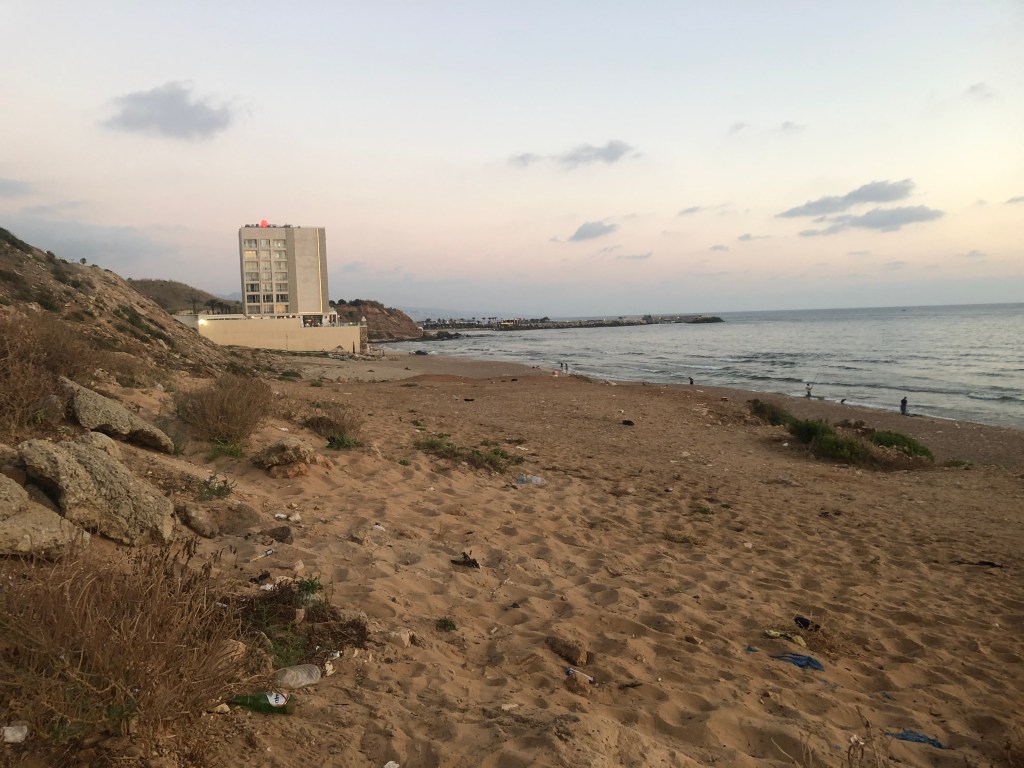
One of the great concerns is bank failure. Lebanese banks used to be solid, gold-backed institutions. It was a point of pride that Lebanese banks did not get involved in the casino capitalism ending in the 2008 crash. But then came “financial engineering”, the Ponzi scheme of attracting dollar deposits by offering high interest rates. Now, people can’t access their dollar savings accounts. Many Lebanese working in the Gulf have found themselves in this position. The only thing a depositor can do is write a check to be deposited in another Lebanese bank, so this has meant the real estate sector, in a slump for years because of the overbuilding of high end apartments, is now experiencing a rush of investment. People are trying to buy land or housing just to clear out their bank accounts. The sellers are often in the category of people who are allowed limited access to their dollars – people with children studying abroad, for example. Within families, people are buying up the debts of their children and other relatives so that they can clear out their accounts and become the family banker. There is no FDIC here so when a bank fails, the money is gone for good. Buying real estate only exacerbates the problem of non-productive uses of capital in Lebanon, of course. How will the economy be financed if the banks are cleared out?
Institutions of every kind are now shutting their doors. The venerable Bristol Hotel, neighborhood stores and restaurants, and private schools. Even the American University has furloughed staff, mostly from its hospital, where low level administrative staff were let go this week in their hundreds. Quite possibly these were mostly patronage jobs shoved onto the university by the political mafia, but these are families without an income now.
Bizarrely, the prime minister, Hassan Diab, is suing AUB for a million dollars of salary to be paid into a foreign bank account. He was an administrator there before his political elevation. This tone deaf initiative has little legal merit as an AUB employee only receives an unpaid leave of absence under these circumstances. The suit has become a sign of how detached the political class is from the problems of subsistence gnawing at the rest of the Lebanese.
Where is the revolution? It has split. One part wants early elections and a change of personnel at the top of political life here. The other part sees the problem as systemic and that elections would only benefit a new generation of politicians who would succumb to easy corruption. And who believes that there isn’t vote buying, ballot box disappearances, and other corrupt practices in the election system? In three months we will have the first anniversary of the revolution and its fault lines will become more apparent. Maybe it will be re-energized.
When I arrived here in January, as the lira was losing value and banks were breaking trust with their depositors, the word “miracle” was on everyone’s lips. They saw trouble ahead and wished for a miracle to take Lebanon in a new direction. This was before Corona and hyperinflation.
Now, though, no one talks about a miracle. There is just an agonized litany of terrible conditions, a pervasive sense of dread.
A friend here quoted to me from MacBeth:
“Bleed, bleed, poor country!
Great tyranny, lay thou thy basis sure,
For goodness dare not check thee.
Wear those thy wrongs;
The title is affeered.”
We can only hope that the corruption and mismanagement of Lebanon will not come to as bloody an end as Shakespeare’s play.
 goingfortheguttural