The Public Cats

DSC00977AUB catsDSC00715LAU Cat Water Bowls

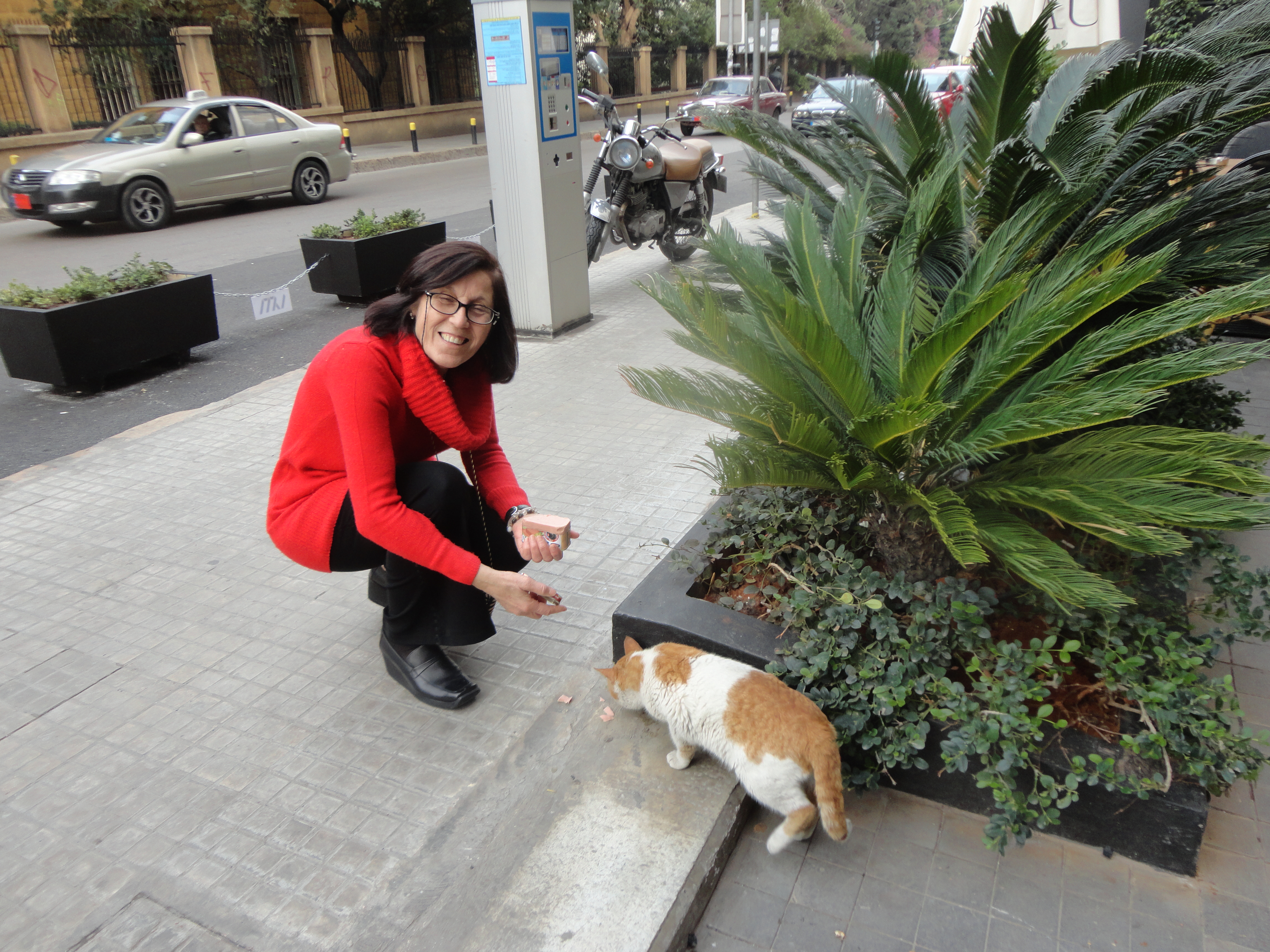
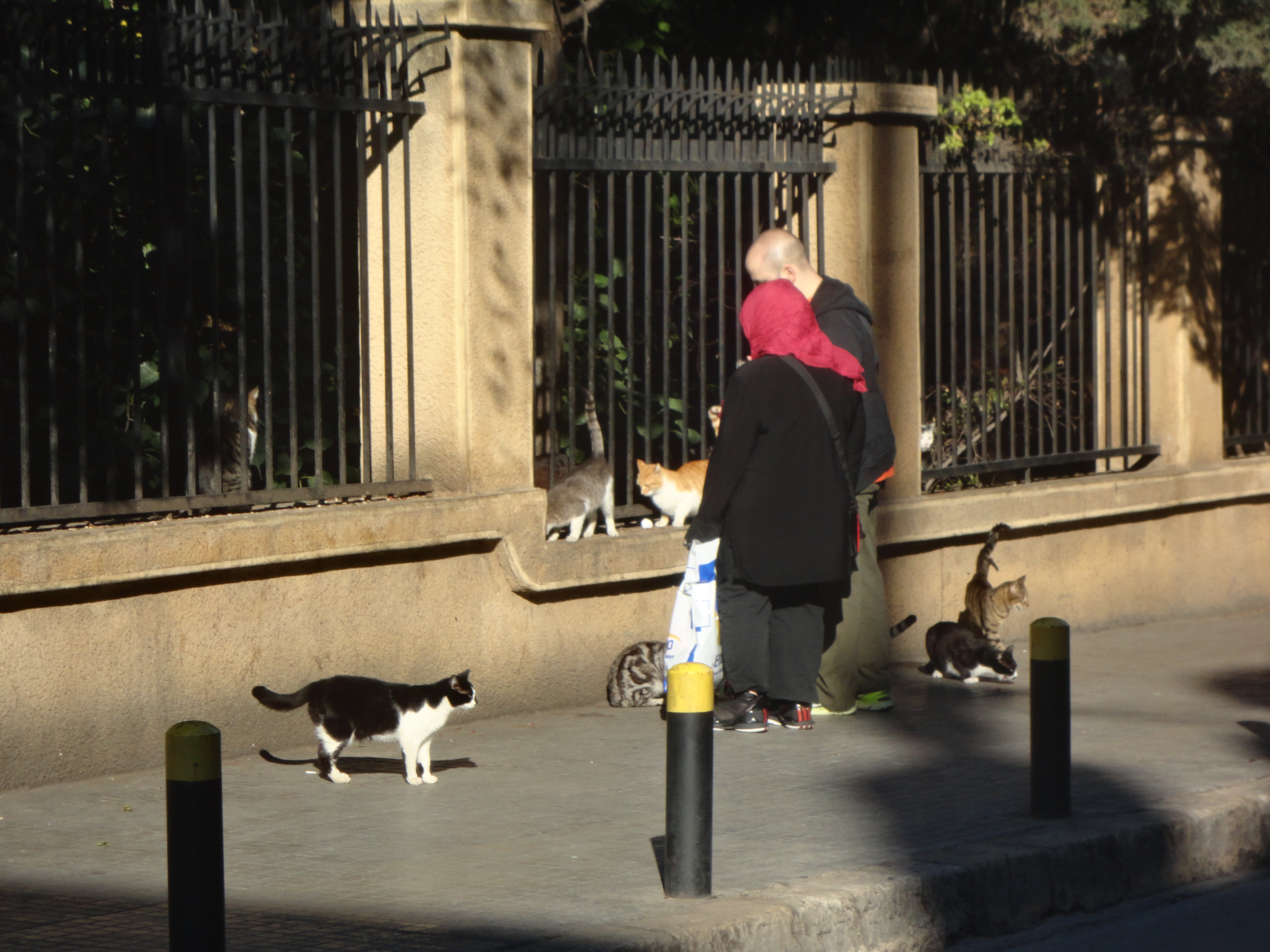
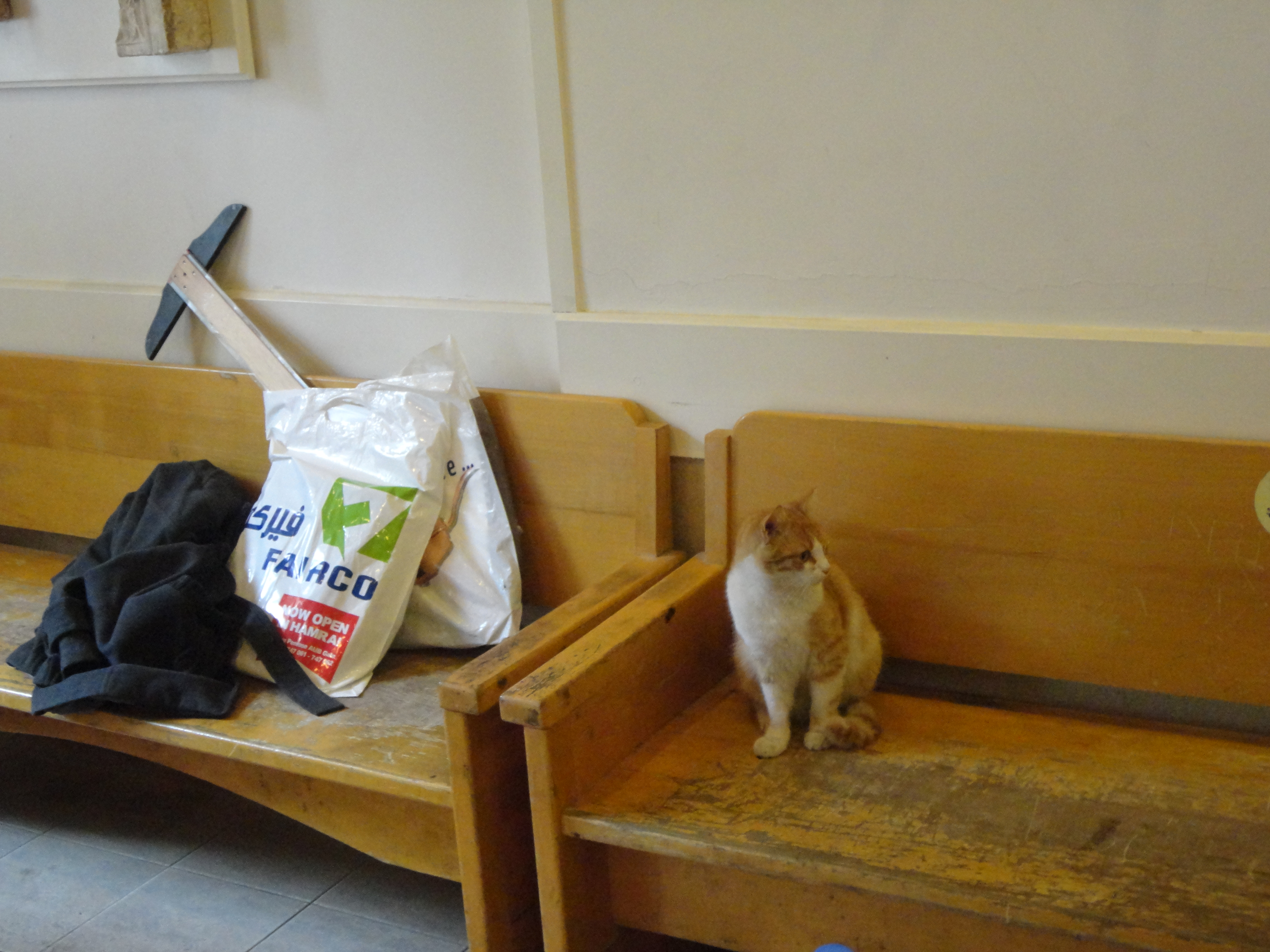
My friend Diana feeding one of her charges; a man and woman feeding cats outside of AUB; a cat waits outside of class at LAU; and a water offering.

For me, one of the most unexpected aspects of Beirut life has been its thriving population of cats.  These are no mere street cats, feral and half-starved.  These are healthy and affectionate animals who live in yards, streets, shopping malls, and university campuses.  I call them the “public cats.”  I vastly prefer them to public intellectuals.

People make it their business to feed cats around here.  There is a small army of Lebanese, mostly women, who make daily rounds of the neighborhood feeding “their” cats and caring for those who are sick.  They enlist the help of the men behind prepared food counters to donate their chicken and lamb leftovers to supplement the kibble they buy from the supermarkets.  Making the cats happy is very much a neighborhood effort.  This year it has also entailed bringing water to the cats as there has been a drought.  One now sees cut down water bottles alongside the kibble as one walks along the streets.

Probably the best kept cats are those at the universities.  AUB spays and neuters its cats, and marks each fixed cat with a small nip in its ear.  The cats at LAU fall under a special faculty committee that provides for their care.  (Can you imagine an American university having such a committee?)  These institutions are the best environments for cats in the city as their campuses have grass, trees, and places for the cats to run around.  It’s good for the students, too.  I see them on benches, haphazardly petting cats while they do their homework or talk with friends.

It was because of cats that I met my friend Diana my first day here last year when I was lost trying to find the university.  She was on her way to church, feeding cats along the way.  She asked if I wanted to accompany her to church but I declined.  Then I kept seeing her in the neighborhood and finally accepted as she seemed like such a kind person.  So, that’s how I ended up going to my Arab church on Sundays.  And yes, the parishioners there sit around, drink coffee, and sometimes talk about the neighborhood cats.

The general fondness for cats here put into new perspective what I call “The Great Cat Massacre” I witnessed in Jerusalem 30 years ago.  There, the Hebrew University treated cats as nuisances and gassed them one summer day.  The Israelis make a huge point of being the opposite of Arabs – one of the phrases they use is “we are not polite” as the word for polite (adeeb) is an honored trait among the Arabs, meaning not just “polite” but “cultured”.  The Great Cat Massacre was all too reminiscent of the one in Paris in 1730 where printing apprentices massacred as many cats as they could get their hands on because cats represented the masters who coddled them.  If Arabs love cats, then Israelis will slaughter them.

The one neighborhood here that seems almost devoid of cats is the so-called “Downtown”.  This is the neighborhood adjacent to mine (the real downtown) and it was heavily shelled during the Civil War here.  Its “revival” meant tearing down Ottoman architecture and the old suq and replacing them with Gold Coast condos and shopping precincts with retailers like of Sonia Rykiel and Giorio Armani.   It was the work of the assassinated former prime minister Rafiq Hariri and is legendary for the scale of corruption involved.  Gulf Arabs have bought these condos and visit them mostly in the summer.  As it is not a real neighborhood the cats have boycotted it.  They are very righteous in this way.

I had an Arabic teacher in my former life who loved cats and used to quote hadith about the Prophet concerning cats.  While I remember the general gist was that a person who was good to cats was assured a place in heaven (where, hopefully, there are more cats to greet us) I thought I’d look up on the Internet some hadith.  So here, for your delectation is how a resource called The Muslim Kids Journal relates hadith about cats:

There is a story in the Hadith that tells us about a woman who was punished because of a cat. She had neither provided the cat with food nor drink, nor set it free so that it might eat the insects of the earth.

Prophet Muhammad (PBUH) told his companions that a great sin had been committed because one of Allah’s creatures had been ill-treated. The woman who had treated her cat so cruelly was not forgiven for her sins: she was sent to Hell for her wrongdoing. (Sahih Bukhari, Volume 3, Book 40, Number 553)

So, remember to take good care of your pets and other creatures. Allah rewards kindness to animals but punishes those who are cruel.

One of the Prophet’s companions was nicknamed “Father of the Kitten” (Abu Huraiya) because he was so devoted to his kitty. Here in Lebanon there are surely legions of “Mothers of Cats”.
Is the Bible Good News for the Canaanites After All?

DSC00783

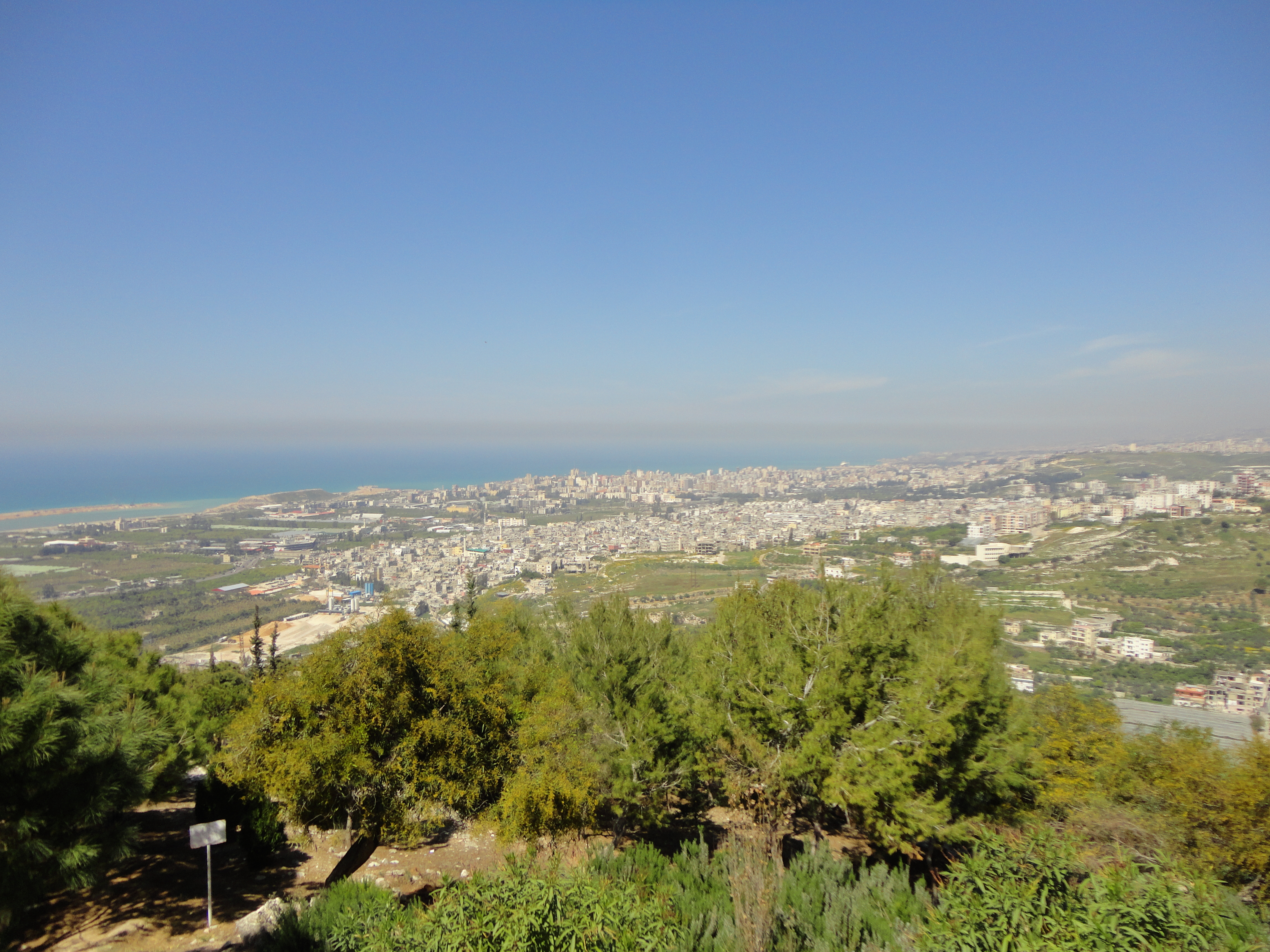
The Land of Canaan as seen south of Sidon, Lebanon.  

“We are the Canaanites. We don’t like the Old Testament.”  This, from my friend Diana, a Lebanese whose former husband is a Palestinian.

When I hear the Old Testament, I consider myself part of the “good guys”, the Israelites, God’s chosen people.  I had never considered what it must be like to be singled out as part of the “bad guys”, the Baal-worshiping Canaanites who resisted God’s plan for the Holy Land which was, after all, to change the Land of Canaan into the Land of Israel.

The past is so visible in most of the world, something we don’t understand as Americans.  Here in Lebanon the centuries of Crusaders, Ottomans, Romans, Byzantine, and Phoenician/Canaanite are jumbled together in buildings and ruins, refusing to be forgotten.  The Lebanese are proud of their Canaanite ancestry which brought forth splendid city states like Tyre, produced the first alphabet (without which the Old Testament could not have been written down), and established such extensive trade routes in the Mediterranean that when it was time to escape Persian rule, they went to Tunisia and founded Carthage.

I asked Karen, the woman pastor at my Presbyterian church here what her experience was in preaching the Old Testament to Arabs.  She and her husband had been in Damascus for years before moving to Beirut.  She said the Damascenes in her congregation there would not listen to the Old Testament at all – simply repudiated it.

Now, this issue was supposed to have been settled in the second century AD. That’s  when the Christian Bible was being compiled to include the Old Testament.  There was a school of thought that held that the God of the Old Testament was so unlike the God of the New Testament that they were two different Gods.  Hence, no reason to include the Old Testament in the canon.  As every graduate from Sunday School knows, the Old Testament is read as the backstory to the New Testament which would make very little sense without it.

So what about this backstory?  I asked Richard, the pastor of the Baptist church how he dealt with the issue.  He immediately said that Christians have no business using Scripture to justify Israel as a Jewish state. He told me that God’s chosen people is not a race, Jewish or otherwise, but the community worshiping the One God.   (Presumably this could include Muslims although I don’t think that’s what he meant.)  The point he was making was that three thousand years ago the One God was having a tough enough time fending off Baal, Ishtar, Moloch, and other deities of the area that Canaanites, Moabites, and anyone else who believed in the One God was included in the chosen people.  The names of such people appear in the Old Testament and as some of Jesus’ forbearers in the New Testament.

But to get to the issue of the land and who has a right to it, Richard said that the whole point of Christianity is that it is a New Covenant.  The land deal is off.  The promise is of new life, of everything that the Resurrection means.   Solving the issue of Palestine/Israel by promises found in Old Testament is pouring new wine into old wine skins.

One of the most eloquent writers on the subject of the Torah and the land is Peter Beinart, a progressive American Jew. His book, The Crisis of Zionism, reminds those who justify Israel’s existence through the Jewish scripture that the gift of the land was always contingent.  God expects justice to be done in the land.  When the land becomes corrupt and full of violence, God expels his people from the land, just as the prophets warned over and over again.  Actually, some of the Biblical phrasing is that the land will “vomit forth” those who defile it — a verb I learned in Arabic this week, strangely enough.  It is in this prophetic tradition that Beinart reminds his Jewish readers that God will not tolerate the injustice done to the Palestinians and the land will be taken away again if the Zionists and their American collaborators don’t shape up.  When I came back to Lebanon this year I brought several copies of this book as gifts because for some reason it isn’t in the bookstores here.

Personally, I love the Old Testament.  I find its human stories of love, betrayal, and discovery so accessible.  I find the prophets, especially the Minor Prophets (so-called because their books are short, not unimportant), thrilling in their denunciations of the powerful and in their visions of a just world.   I even find the books of Leviticus and Numbers absorbing as historical artifacts, early attempts to integrate the body and spirit.  In contrast, how much of Paul’s ranting can a person take?  Would Prozac help?  Would Prozac have helped Paul?  Those Christians in Damascus must have had a fearsome faith to have listened to just the New Testament every week.  It would have driven me right back into the arms of Baal, Ishtar, and Moloch for sure.

A Moral Agony

Image

Image

Two groups of beggars encountered today walking home from church.  The boys are named Mohammed and Ibrahim.  

Every day I am faced with the heart wrenching presence of Syrian refugees begging in the streets.  The humanitarian crisis here is of a country of 4 million being unable to absorb 2 million refugees without help from the outside world.  The president of Lebanon went to Paris last week to beg help from the US and other wealthy nations but the support he got was mostly military, not humanitarian.

Here is my moral agony: people say that these pathetic souls are being controlled by organized gangs who use and abuse them for the money they bring in.  I can see that there is certainly a level of exploitation involved here of young children who are either used as props in the laps of women begging or even let loose to beg alone, some at very young ages.  Sometimes there is the fig leaf of selling something like Kleenex packets or pens. Then there is an army of boys between 10 and 14 who carry around shoeshine kits, begging for the opportunity to shine your shoes and promising to kiss your feet. 

I have been told by good-hearted people not to give money to the beggars because it will only end up in the hands of criminals.  Thus, the dilemma.  I feel one should never walk by a beggar and avert one’s eyes.   I feel one should offer them something, if only to recognize their humanity.  But I don’t want to incentivize their further exploitation.  While it is very possible that organized crime is exploiting some of the beggars –- that has happened in New York — I haven’t been able to get a handle on how extensive such exploitation might be here.

I spent ten years of my life advocating against the normalization of a slightly different manifestation of poverty and its exploitation by others: prostitution and pornography.   In fact, this week the 58th Conference on the Status of Women is meeting at the United Nations in New York.  I began advocating at the UN when Eastern Europe was advocating for prostitution to be regarded as a form of labor, therefore taxable by the state, manifesting better employment figures and possibly even a means of denying women social welfare because prostitution is, after all,  “sex work”.

I know that no one goes into prostitution willingly.  The push comes from poverty, although in the United States this is usually helped along with drugs and violence.  However, societies prefer to exculpate themselves from their own structural violence by blaming the women for being morally corrupt, not the rich and powerful whose moral corruption allows the institution to flourish, and not the men who believe paying for sex makes it somehow different from rape, which also extinguishes the soul.  Consent is a poor moral barometer in such circumstances and is a far cry from the full development of the human spirit which should be moral standard.

The same hold trues for begging.  No one goes into begging by real choice.  They might even be begging as a last resort before entering prostitution which here in Lebanon is reportedly booming. Of course there are people around both here and in the States who will try to say that people beg because they are lazy or because it’s more remunerative than an honest job. 

A group of beggars I am especially interested are the shoeshine boys because this group doesn’t appear to have poverty pimps compromising their begging.  The ones I see around seem to be on their own, sleeping in a small park behind the AUB hospital.   Some of them seem to be fairly well educated.  I have asked all kinds of people about how to help them get off the streets and into some kind of school.   I hope to speak to some people in a youth organization later this week.  But I do not hold out much hope – The Daily Star, Lebanon’s English newspaper, wrote of the police busting a group of families who had sent their children into Beirut to beg. The girls were sent to an orphanage whose staff hadn’t been paid in six months. 

I have decided to continue giving money to beggars here, although when it’s young children I give them fruit because I think they should be spared this activity somehow.  I give more to woman begging without children.  I expect there are organized gangs exploiting some of the beggars but I don’t know who they are and I don’t trust the Lebanese television stations, which have spread the stories about the gangs exploiting the beggars, as there is a rich vein of anti-Syrian feeling here to exploit.   If some of the beggars are being violently exploited, I hope they will remember that people like me care about them and that they will forgive us for not having the discipline to walk by.  Let real humanitarian aid be soon in coming!

Nudity and Nakedness

Nakedness

An actor takes off his shirt during Issam Mahfouz’s “Nakedness”.


This week my friend Diana invited me to see a play written by her brother, Issam Mahfouz, a leftist playwright who died several years ago.  Its title was “Nakedness”.   I had to look that word up in the Arabic dictionary and I only caught the odd line of the play. This both depressed and encouraged me by driving home that I have a long way to go in mastering this language, at the same time reminding me it is really just a matter of exposure that will determine my eventual success.


Before the play started, a young Frenchman from my class asked me the difference between “nakedness” and “nudity” in English.  I told him that “nakedness” was simply the state of being without clothes whereas “nudity” implies the presence of a fetishizing eye.   Western art, of course, is filled with nudes, almost invariably female.  As my classmate went back to his seat, a young woman wearing an hijab turned to me and said, “I couldn’t help overhearing your conversation.  My favorite painting in the whole world is Botticelli’s “Birth of Venus”.  Do you think it is a nude?”  So, we discussed the painting and we both decided that while Venus is beautifully naked she isn’t nude the way Manet’s  “Olympia” is.


“Nakedness”, the play, was about a freethinking young woman and a man at the beginning stages of a secret police career being thrown together in a cell. They have to remove their clothing until the young woman renounces her freedom and accepts the totalitarian regime.   It has echoes of Orwell but Orwell was writing against communism where Issam Mahfouz was writing the same thing as a communist.  For the record, the actors didn’t get very far in their stripping.

A Lebanese who went a good deal farther in her stripping was the Lebanese ski champion Jacki Chamoun who posed for a photographer three years ago without much on apart from underpants and ski boots.  The photographs surfaced during the Olympics and questions were raised in political circles whether she ought to be representing Lebanon at Sochi.  Her supporters pushed back with a campaign called “I Am Not Naked” in which they had themselves photographed in the altogether except for a sign reading # Strip for Jacki.   They said that their nakedness was to call attention to the truly serious issues facing Lebanon like the war next door in Syria.


Something about this claim didn’t sit quite right with me and I’ve finally figured it out.  Certainly the war next door in Syria and its spillover into Lebanon are more pressing problems than who gets to represent Lebanon in the Olympics, yet the fact remains that this war, like all wars, is fought on a field of gender.  Women, in this case with or without their hijabs, are loaded signifiers of group values and control.   Downplaying indiscrete photographs isn’t disrupting male control of women’s bodies or the fetishizing male gaze that produces a genre of art called “The Nude” in one culture and an equally asymmetrical clothing of women in another.   It’s just declaring sides.


When women can be naked without being nude it will be another world entirely, as beautiful as Botticelli’s Venus.


If You Have To Ask (for An Address), You Don’t Belong

Beirut Street SignGNC moving address

A hopeless cause, rationalizing the Beirut street map.  The GNC went with the flow and publicized their new address in a way the Lebanese can understand…..everyone knows where Antoine’s is.

Not all those who wander are lost is a marvelous phrase from Lord of the Rings but it doesn’t apply to me here in Beirut.  I get lost here quite a bit and not just because the city isn’t laid out in a modern grid system.

First, there is the problem of addresses.  They don’t exist, except in theory.  A restaurant or shop may have an actual street address like the shop 499 Orient does on Omar Daouk Street but if you ask anyone where Daouk Street is they will probably look at you blankly and there is certainly no point in asking where #499 is.

But if they happened to know where Daouk Street is, then you can only pray that they know that there are two Daouk Streets, one which runs parallel to Clemançeau and the other, across a large street, becomes the extension of Clemançeau until a third name jumps in and the street becomes Bab Idriss.   Even straight streets change names with some frequency.   The French had tried to rationalize the street system at one point, giving each street and district their own numbers, but that was an effort doomed to failure.

Instead, one navigates by landmarks.  Hotels, hospitals, and universities are important landmarks. If I need a camera recharger I go to a shop near the Commodore Hotel.  It happens to be on Baalbek Street but the man at Radio Shack couldn’t tell me that when he directed me there – and we were a block away.  I live near the American University in Beirut.  There is no point in telling a taxi driver I live on MakHoul (well, actually, just off it on a street with no name) as he has never heard of it.  What he might know is that there are two churches on the street side by side – I say that I live on the “Street with Two Churches”.

How do people get their mail, you ask?  Well, they don’t.   The mail, privatized out to a Canadian company, is just about useless.  People tend to have post boxes or use the postal addresses of family businesses. Today a woman from my Arab church brought a Christmas card to show us that had only just arrived from America.   Email has been a salvation.

It’s too bad the street addresses aren’t used with more currency as they inscribe the history of the city and its rulers.  I live between Joan of Arc Street and Omar Ibn Adbelaziz Street, the one a French saint, the other a revered early caliph.  LAU is on Marie Curie Street, AUB is on the street that celebrates its founder, the American missionary Daniel Bliss.  Clemançeau Street, named for the French statesman, becomes John Fitzgerald Kennedy Street at one point.  And there is Mahatma Ghandi Street and a street in honor of a 19th century emir, Emir Bachir, who converted from Sunni Islam to the Maronite faith, not to mention a host of streets memorializing local families.

When it comes to the dangers of the street it is cars, not car bombs, that one worries about here.  Crossing a street is a sauve qui peut moment as the few traffic lights are routinely ignored and if you fail to look both ways on a one-way street you are either a) dead; b) badly hurt.  I’ve seen entire convoys of cars head down a street in the wrong direction, never mind the motorcycles.  Sometimes I am just plain petrified of crossing the street and have to wait for a bold Beiruti to cross with.

As you know, there were some suicide bombings here this week.  Thank you for not emailing me in a panic after the latest incidents made the news.  For all that the Western press talks about a “jittery” city, I can only tell you that the Lebanese seem to take these horrors in stride.   They’ve been through worse.  I’ve started to ask people how they feel about these bombings and mostly the answer is “depressed”.  The outlook seems less an immediate sense of doom than a slow motion unraveling with no clear end in sight.

Still, I am happy to report that the monthly tango gathering at the St. George Beach and Yacht Club was well attended.  I went with some members of my English-speaking congregation, one of whom is an avid tango dancer.   Tango has become quite popular here in Lebanon and is even taught on campuses.  I was surprised to see that there were more men than women in attendance at last night’s event and that most people came without partners.   The atmosphere was friendly and low-key.   As the evening began the news had just reported the latest suicide bombing. People were talking about it in hushed tones.  But when the music started, they put down their drinks and answered its call.

Everything’s The Same, Only Different

 NEC-basementValentine's display

The church basement at the National Evangelical Church and a store displaying Valentine’s Day gifts.

Sunday is my Day of Two Churches, one in the morning and one in the afternoon.  I get to experience Christianity in a slightly different and surprising way.  To begin with, coffee hour happens right at the very beginning before the service begins, as hospitality requires.  After all, what kind of host or hostess does not immediately offer the guest coffee?

In the morning I attend a Presbyterian-like church where I am experiencing the role reversal of being part of the congregation that worships in the basement while the main congregation, well-to-do Arabs, worships in the sanctuary.  The English-speaking congregation is a mash-up of the English speaking world living in Lebanon – teachers, language students, spouses of Arabs, employees of NGOs, Philippine and African housemaids, plus a few Arabs who happened across the congregation one way or another.   We rarely see State Department employees.  I understand they are barely allowed out of their compound – no wonder they produce such drivel about the dangers of Lebanon.

In this upside-down world of basement worship we hear the organ upstairs and the congregation singing lustily, in Arabic, the 19th century Methodist hymns we grew up with, “Holy, Holy, Holy”, “Lord, I Want To Be A Christian”, etc.  Downstairs we sing new age hymns projected on PowerPoint accompanied by the pastor’s guitar and the piano played by an Armenian named Vartan.   Our basement space looks like somewhere in Nebraska with its plain wooden table, folksy banners, and stackable chairs.  Upstairs the sanctuary looks like Bryn Mawr Presbyterian Church.

The best part of the service is the prayer requests because one gets such a heart-tugging glimpse into life here.  The housemaids ask for prayers for their children at home and sometimes that “madam pay me my wages for the past six months”.  Today we heard from a woman whose husband had kidnapped their children but decided to return them.  We hear prayer requests that belongings being shipped from home be released from customs without exorbitant “fees” and for children to pass their exams so they can go to college.  Today we prayed that the newly formed government of Lebanon be guided by a spirit of service to the people and not by greed and corruption – that is to say, we were praying for a miracle.

Last year I witnessed the first sermon preached to this congregation by a woman.  The male pastor was afraid that wouldn’t go over with some of the congregation but he had to go away one week and she stepped into the breech and everything was fine.  Both pastors are American, the man of Lebanese heritage who came over with his family a few years ago; the woman a teacher at a local seminary.

The church I attend in the afternoon is a small Bible Baptist congregation that worships in Arabic. It is just down the street from where I live.  I would never have bothered with it except that my first day here last year, when I was disoriented and jetlagged, a woman helped me find my way to the university.  In the weeks that followed I kept running into her and finally agreed to accompany her to church.   (Her name is Diana and I will tell you more about her when I later write about cats.)  The Baptist congregation is mostly elderly Arab women although there are a few younger women and about three or four men.  Sometimes Filipina housemaids join us but only for the service and not the hour-long coffee hour in the basement beforehand.  I like this coffee-hour very much as it restful and chatty and I can listen to the colloquial Arabic.  The pastor of this congregation is Lebanese but educated in the States.  His mother, Elizabeth, who is part of the congregation, comes from a line of Scottish businessmen who lived in the Middle East and married locally.  Her cousin Agnes is the aunt of the Palestinian activist Hanan Ashrawi whom the congregation got to know when she attended AUB and stayed with her aunt.  Elizabeth speaks Arabic fluently, of course, but she can neither read nor write it as she was educated in a American school in Beirut that never taught the literary Arabic.  Like the other grandmothers in the congregation, her grandchildren are all over the world as that generation sent their children away for their educations and careers  during the Civil War.

This week was Valentine’s Day whose celebration looks very American – flowers, chocolates, balloons.  It first started appearing here about 25 years ago when war exiles began returning with the custom from the States.   And it does seem so Lebanese – sweets and love being very dear to the Lebanese heart.  So much so, that my colloquial teacher, a young woman of about 30,  sent me down another cultural rabbit hole when she asked me if we in America had the custom of celebrating Valentine’s Day, too.

Good Taste, Bad Taste, and Hope

My bedroomThe Living Area

Two photos of my apartment

This is my second year at Sky Suites, the apartment hotel I stay in while here.  It’s about a 15 minute walk to the university and within easy reach of the daily amenities like bookstores and food markets.  The place is well run and provides housekeeping services but its real appeal to me is that its furnishings are simple, with clean lines, Japanese by way of Ikea.

I thought of changing venues for this second year, of getting to know a slightly different neighborhood, maybe even finding an apartment with a view of the Mediterranean.  There is no lack of apartment hotels here but the problem with most of them is a furnishing style I call “Arab Baroque”.  Think of the interior of any overthrown dictator’s palace and you’ll know what I mean: grotesquely ornate interpretations of Louis Quinze.   As an assault on the aesthetic sensibilities it is far too distracting to allow any work to get done.  It would just make me nervous.

The environs here are relatively quiet given that the city has never heard of zoning or noise abatement,.  The hospital is a block away but ambulances don’t generally blare.  The noise of taxis, which beep at every possible passenger on the sidewalk, somehow doesn’t penetrate here.  When the windows are open I hear the call to prayer, a sound whose tonal resonances I rather like.  The only neighborhood sound that annoys is the church bells of the Greek Orthodox Church down the block whose clanging makes sure that no one sleeps late on Sunday morning.  It’s called “The Church of the Dormition of St. Mary” but I guess that means unless you’re Jesus’ mother you aren’t going to get much sleep.

This week I added a new activity to my life: yoga.  A friend here wanted me to join her in a class so with great reluctance I agreed.  I’ve tried yoga before and it’s driven me mad with its elevator music and pharisaical perfections.  Here, though, the silence is broken from time to time with desultory conversation.  Our teacher is a British woman who came here over 40 years ago to pursue a love affair and never left.  She must be 80 if she’s a day and has a widow’s hump but is so supple she can put her foot over her head. For two days after the class I was not so much in pain as hearing from parts of my body I hadn’t spoken to in a while.  I won’t be managing the lotus position anytime soon.  As in all physical and athletic endeavors, I am in special ed.  Touching my toes would be a real achievement for me.

The Arabic is creeping along at about the pace of my yoga mastery.  I have to direct the drivers of the shared taxis (called “serviis”) to where I go to church on Sunday mornings and now I am managing this task.  There is also a peasant woman who sells vegetables on my street who terrifies me with her swift salesmanship but now I can tell her what I want and that I already have radishes in my refrigerator.  When I listen to the sermon in my Arab church sometimes I hear groups of words I can understand or even simple sentences.   I can read a good deal from the hymnal — it’s a fairly limited set of vocabulary words after all — and I try to sing along but I don’t always keep up.

Sometimes I wonder why I am trying to learn Arabic at my age, especially when I am two years away from my father’s age of death.  My friend Diana here says that her neighbor thinks I am CIA and that my intentions in learning this language are deeply suspect.  I have to laugh at that, because I credit the CIA with enough sense to invest in people half my age, not in someone like me who takes three pills before breakfast.

The answer always comes back that I am learning this language because it makes me happy to do so.  It’s an end in itself.  I love the problem solving of grammar, the mental gymnastics of choosing vocabulary that doesn’t quite line up with English, the leap of faith that the noises coming out of one’s throat are actually meaningful and not total gibberish.  And I love this part of the world with its deeply felt history, its generosity and quirkiness, and how this region puts into stark relief the behavior and habits of mind of our own.  As part of this reflection, I count my dislike of “Arab Baroque” and the politics of taste, taste being an ordering device in the realm of social capital. It would be an act of dissolving my internal hierarchies to learn to love “Arab Baroque”.

Finally, I suppose that learning a language at my age is like planting an apple tree: an act of faith that one’s life will extend long enough to enjoy its fruits, in sha’ Allah.


NB: I have to make two corrections on last week’s post — the population of Lebanon is four million, not two million which is the size of the refugee population here from Syria.  Also, for the record: the president must be Maronite, the prime minister Sunni, and the speaker of parliament Shi’a.

Preaching the Gospel to Hezbollah

DSC00925Today I met a local legend, a Dutch lay preacher who tries to convert the Muslims  by preaching on the Corniche and going to their gatherings.  He started his peculiar ministry in Tripoli but his house was bombed in 2003 and the government told him to leave the city or they would revoke his passport.  So, he and his family moved to Beirut  where he has been preaching ever since.  Last year I heard about his attempts to convert members of Hezbollah.

So, I asked him, how did it go today?  He said he was preaching on the Corniche that God had given Israel to the Jews 2,000 + years ago and two Palestinian Muslims came up to his table and started shouting at him.  He’s a very mild mannered man and he said he was simply stating an historical fact.  In his view, he explained, God is gathering the Jews to come to Israel so he can turn them into Christians!  His audience still disputed this but then the preacher received a cell phone call from a member of the Baptist church that I attend to hurry up and come to the ordination of the pastor, so he explained to his audience that he had to leave early and the two Palestinians kissed him and said good-bye.

For all one hears about the sectarian divides in this part of the world, there is still so much evidence of not just tolerance and humor but sometimes the blurring of boundaries altogether.  My colloquial teacher is a Greek Orthodox who was raised a Druze. I asked her what her mother thinks about her conversion to Christianity and she said her mother tells her if that God had wanted her to be a Christian she would have been born one.  Her family lives in the mountains outside of Beirut and she visits them often – she has not been cast out for her apostasy.   In the two churches I attend I have met a number of families who belie the sectarian divide: in one family the husband was a Muslim who was shot during the Civil War and rescued by a Christian neighbor and subsequently converted; in a number of families, the Christian wives of Muslims raised their children Christian; in another, the Christian husband of a Muslim woman did a paper conversion and attends church with their daughter every Sunday.  I don’t suppose this could happen in Saudi Arabia.

One of my friends here is from the South of Lebanon where Hezbollah is so much a feature of the landscape that they have their own museum.  She told me that when the Shi’a and Druze of the area are very sick, some will go to a church dedicated to St. Mary and get baptized.  No one considers them converts – it’s sort of an extra dose of spiritual power.

The divisions in this country are not sectarian in nature, but political.  The French colonial powers left the country a constitution that guarantees division based on sectarian lines.  The prime minister must be Maronite, the Finance Minster a Shi’a and the Interior Minister a Sunni. Between these groups plus the Greek Orthodox, Greek Catholics, and the rest of the spoils of Lebanon are divided up and the hangers-on of all confessions defend their prerogatives.  The confessions are essentially the political parties.  Now that natural gas has been discovered in the Levantine Basin the Ministry of Energy is a plum assignment that is being squabbled over and holding up national development. This is the constitution that the U.S. devised for Iraq – and look how well that’s working.

The ordination I attended today was of a Baptist pastor who had been preaching and serving communion for 11 years.  I asked him how he had managed to do his job without ordination all these years.  He said that the Baptists are divided on the topic but that it’s within the sphere of acceptability for a local congregation to call a person to be a pastor without undergoing ordination by other pastors.  Why then, I asked, did he bother with this now?  The answer, it turns out, is that he has been asked by his fellow Baptists to represent them to the government and to perform official functions and that the government insisted on his ordination for him to be recognized in his new role.  You can see how thickly intertwined government and confessions are there.

Amin Maalouf is a Lebanese Catholic (of Catholic, Presbyterian, and Greek Orthodox parentage) who fled Beirut during the civil war.  He’s written an important book that reflects his Lebanese heritage called On Identity in English but I think it’s French title says it better: Les Identités Meurtrières (Murderous Identities).  His point is that we all have multiple identities as members of faiths, families, nations, occupational and other groupings, and they cross-cut each other’s boundaries.  He believes that peace lies in the claiming of our multiple identities and that forcing people to assert one identity over another is itself an act of violence that escalates into others.

I spend my days here in this beloved city hoping its people will continue to assert their multiple identities even with the challenges of the Syrian civil war.  This country of two million citizens is dealing with two million Syrian refugees of all political persuasions.  Think about that for a minute, and then pray for rain.  For on top of everything else, there is a drought here and unseasonably warm weather and the crops are in peril as well.  Preaching the gospel to Hezbollah may come to an end and the political parties representing the various religions start blowing up each other’s natural gas pipelines.

Arrival and First Day

I was counting on dosing myself up with Ativan so I could subdue my terror of flight but I couldn’t find the bottle before I left.  I’m so phobic I have to take tranquilizers just to get to the airport.  Such was my panic upon leaving the apartment that I began to worry about having a heart attack at 39,000 feet.

This is one of the reasons I don’t worry about the bombings in Beirut.  By the time I’ve wondered about just how alcoholic the pilot is, how underpaid and demoralized the maintenance crew is, how freakish the air currents are going to be, and whether or not the control tower and the pilots can communicate, I have nothing left to give garden-variety fear.

I improvised and took two Advil PMs so at least I would be sleepy.  I focused on Lufthansa having a good safety record. And, God is good – I had the two smoothest flights of my life.  To boot, both flights were less than half full so I had no neighbors to induct into panic-mode had that been necessary.

Now a word about the Frankfurt airport: it’s so German.  One exits the plane and is immediately facing a flight of stairs.  I guess Lufthansa passengers run up and down the Alps in their spare time.  There are no people movers in the terminal either but a great deal of distance to travel.  Apparently the Germans don’t trust our security state — one has to go through security checks all over again to get to the connecting flight.  The food in the terminal restaurants is of the beer and bratwurst variety. There are smoking rooms at regular intervals in the terminals – and people were in them, furiously puffing!

The flight landed in Beirut 15 minutes early (of course).  The arrivals area was filled with women dressed in black comforting one of their own who was wailing and keening.   I gleaned that their mother had died.   It brought me to mind of meeting my sister Evelyn at the airport when our own mother had died – we were sobbing but oh, so quietly and pulled ourselves together quickly in true WASP fashion.  This little black huddle of women with their wailing sister was eventually bundled into three vans, with great affection, by the men of the family and driven off.

My first day has been napping and errands.  The weather is in the low 60’s – about ten degrees warmer than last year.  The staff at the apartment building have been welcoming and asked after the family. The lady at the dry-cleaners recognized me and apologized for not remembering my name.  The guard at the Near Eastern School of Theology waved at me as I passed by.  It feels good to be here.

One curious thing: the produce at the food market and the produce shop wasn’t nearly as fresh and beautiful as it was last year.   Maybe it’s new owners, maybe it’s the end of the week, but I do wonder if this is a sign of something more systemic like worn-out bills are a sign of inflation.   There also seems to be much more garbage in the streets.  Maybe the formation of a new government after 10 months limbo will help but I wouldn’t count on it.

Tomorrow the week starts with my day of two churches, mainline Protestant in the morning, Bible Baptist in the afternoon (it’s a long story).   I will be communicating via blog once a week from now on so I can focus on my studies and not overstay my welcome in your inbox.

Do write if you have any questions.  Part of the fun for me is asking people for answers and learning more about this wonderful place.

Departure

Returning to a place is like having a second baby – the intoxication, the mystery, the thrill of novelty is gone.  Instead, familiarity brings with it a grave appreciation of what could go wrong.  And a hopeful idea of what could go right.

I return to Beirut with a sense of how fragile Lebanon is as a nation state.  The spillover from the Syrian civil war was in evidence last year from the refugees begging in the streets to hearing the bombing of Damascus while visiting the Bekaa Valley.  Lately there have a number of targeted bombings of government and official targets, including the Iranian Embassy, that are widely understood as continuations of the Syrian conflict.  These do not deter me from Beirut any more than drive-by shootings in the Bronx keep me from living in New York. City – different neighborhoods, different people, different situations.

What does cause me some concern is the bombing of ordinary people.  That kind of bombing occurred on Tuesday when a bomb exploded in the same Shi’a neighborhood as the Iranian Embassy.  Where will the retaliation occur?  Now, it’s no longer a matter of assassination but terrorism of entire segments of the general population.

But returning to a place also brings with it the pleasure of renewing acquaintances, absorbing a culture more deeply, walking around the streets and shops with familiarity, and noting the changes from year to year.   I am by nature a returner.  I know this means I will probably never see the Ganges, the Grand Canyon, or the Great Barrier Reef.  But I hope I can keep coming back to Lebanon and that we will all be safe.

So, as I complete my packing I make sure I have enough clothes for two seasons because I know from last year’s experience that I am far too Northern European in build to fit into the clothes meant for the slight Lebanese.  I am bringing an extra duffle bag with warm clothes and knitting yarn to give to an organization helping Syrian refugees sustain themselves.   And I am bringing a peculiar assortment of books, knitting supplies, and spices that friends in Beirut have requested.

For those of you who choose to worry:  keep in my experience in going to Israel 30 years ago – my family kept obsessing on car bombs and tried to dissuade me from going.   When I got to Israeli the people there exclaimed in horror, “You live in New York? That’s so unsafe!”