
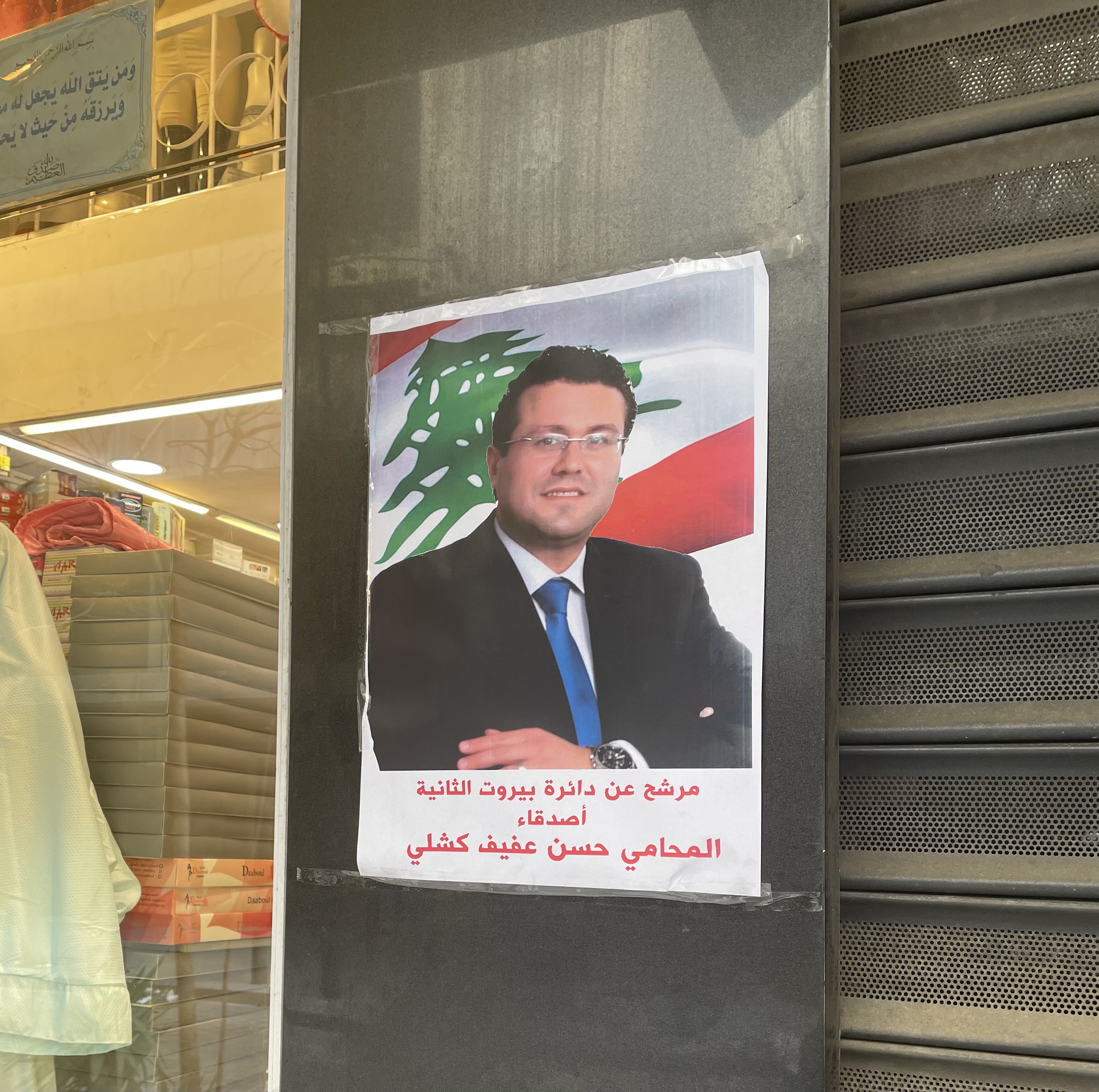
Tomorrow is when Lebanese in Lebanon go to the polls, or, at least, that’s the theory. I’ve only found one person who is actually going to cast a ballot and it will be a spoiled or “white ballot” at that. He won’t actually vote for any “list” or fixed combination of candidates. He just wants to show that he was there, furious at the system, and take his ballot away from anyone wanting to use an unused ballot for their preferred list.
This man has some shops in Hamra. Today he closed them early so he could go to his ancestral village before the roadblocks and other impediments crop up to make travel to the polls difficult. Decades of residence in Beirut is not enough to qualify to vote in Beirut. Men and single women go to their ancestral village and married women to their husbands’. The system insists on keeping people parochial rather than forming the kind of progressive political force that cities tend to produce. Church-going Christians find it especially onerous to go back to the village on Sundays and several have voiced their view to me that Sunday was especially chosen to dampen Christian voting participation.
I’ve pressed people on why they aren’t bothering to vote and the answer is a firm belief that the elections are corrupt and a foregone conclusion. I certainly remember hearing that the cost of selling one’s ballot in 2018 was about $500. This year, people tell me the price is much cheaper as so many Lebanese are desperate. “They can be bought for a bag of bread”, an elderly woman told me. The dead who vote don’t expect anything at all.
Still, the phones ring constantly urging people to vote for a particular party and its list. Friends tell me it is driving them crazy. There is a lot of money sloshing around political campaigns in Lebanon. No one questions that there is a lot at stake: the banking system, the economy, the Iran versus Saudi alignment, Hezbollah and its continued use of arms, to name a few of the issues.
But the system is set up for stasis. A person votes first for a set list of candidates and then may indicate the preferred candidate. Each candidate’s religious affiliation is listed along with the party. Each electoral district has an assigned number of Muslim and Christian seats. It boils down to a contest between preferred candidates of winning lists getting slotted into these sectarian seats. These people go on to determine who the President will be (Maronite), Prime Minister (Sunni), Speaker (Shi’a). The ministries are similarly horse traded. The system is designed to perpetuate sectarian politics, not transcend it.
It doesn’t help that those wishing to institute real reform in Lebanon have not organized into one party and list for each district. About a third of the candidates running tomorrow are opposition candidates — over twice as many as in the 2018 election. The revolution or “thawra” was always internally divided between the incrementalists and the revolutionaries. In some districts, the opposition groups are running against each other.
The one significant change in the make-up of the lists and candidates is that the party of former prime ministers Hariri, father and son, is not participating in this election. The Future Party consolidated Sunni votes and now these votes are up for grabs. It is expected that Hezbollah will end up the winner here but it is nonetheless an opportunity for the opposition.
For the last several years the Lebanese government has made efforts to get expatriate Lebanese to participate in the elections. In fact, it has encouraged people of Lebanese ancestry through the male line to claim Lebanese citizenship and vote. This was part of an effort to get expats to invest in Lebanon, to be the country’s white knights. A total of 244,442 Lebanese abroad registered to vote this year, over twice the number for the 2018 election. This increase may reflect the estimated 300,000 Lebanese who emigrated in the past two years. Expat voting occurs a week before the Lebanese elections so it is now known that only 60% of those registered expats actually cast a ballot. Here again, the pessimism of the Lebanese about their system comes through: expat ballot boxes come through the airport, Hezbollah territory.

People seem to be holding their breath until the elections are past. There is concern about violence like that which occurred in the south a few weeks ago when a rally for Shi’a candidates running in opposition to Hezbollah was disrupted by gunfire. Some of my now expat friends abroad do not want to return to Lebanon until the election is over and things appear safe. There is concern that entrenched parties may destabilize the country by delaying the formation of the parliament or resorting to violence.
Maybe the gloominess about the election is justified and voting really just ratifies a corrupt and broken system. I don’t know. But I do know that this general distrust of the electoral system is closing off an avenue for change in Lebanon just as surely as the myth of “The Big Steal” is doing so in America. If citizens see their elections as dirty, what is Plan B?
 goingfortheguttural