
So many people have left Lebanon in the past two years that it hardly feels like the same place.
The person I miss most is a widow named Elizabeth. She married a pastor nearly sixty years ago here and they committed themselves to their church even during the war. Both of them had foreign passports and could have gone to the UK on hers or to Australia on his but even the war could not budge them from this place. She has described to me life during the war when her husband posed a kidnapping risk and he had to stay in their apartment full time except on Sundays when a posse of parishioners came to escort him to the church. It was left to Elizabeth to lug the water bottles up three flights of stairs, stand in the bread lines, and take their children to school when it was open and teach and entertain them when it was not. Not to mention functioning in her own job as a teacher. At one point, one of the militias took over some apartments in her building and only later did she learn that the building was also an arms dump for them, successfully concealed when the Israelis came looking. One night a car bomb exploded in the street outside her apartment and she and her husband spent hours picking glass shards off of their children and the bedding. Their car was stollen off the street, twice; the second time it was not returned. The family regularly joined their neighbors in spending nights on end in the building corridors and basement during shelling attacks.
I asked Elizabeth once how she managed to deal with the stress of the war and she said she was just too busy getting through each day to think about it. On top of everything else, she also had parishioners staying in the apartment when traveling back and forth across the Green Line became too dangerous. It was crowded at the church, too, as the church allowed a family of Palestinians to camp out there for the duration. There was very little privacy for this devoted couple.
Yet for all the fear and hardships endured during the war, like many Lebanese, Elizabeth remembers the comforts she and her neighbors could extend to one another whether by keeping their children amused together when schools were closed or inviting one another for coffee and a chat. Corona and the economic collapse have put paid to that. Elizabeth has watched her grandchildren live in isolation from their friends when the schools close and she can no longer have coffee with her neighbors for fear of the virus. Once the pandemic started, Elizabeth and I developed a very companionable habit of walking through the neighborhood once a week, picking wildflowers in the various empty lots. She invited me into her family pod and I helped her through knitting projects as we watched t.v. with the grandkids.
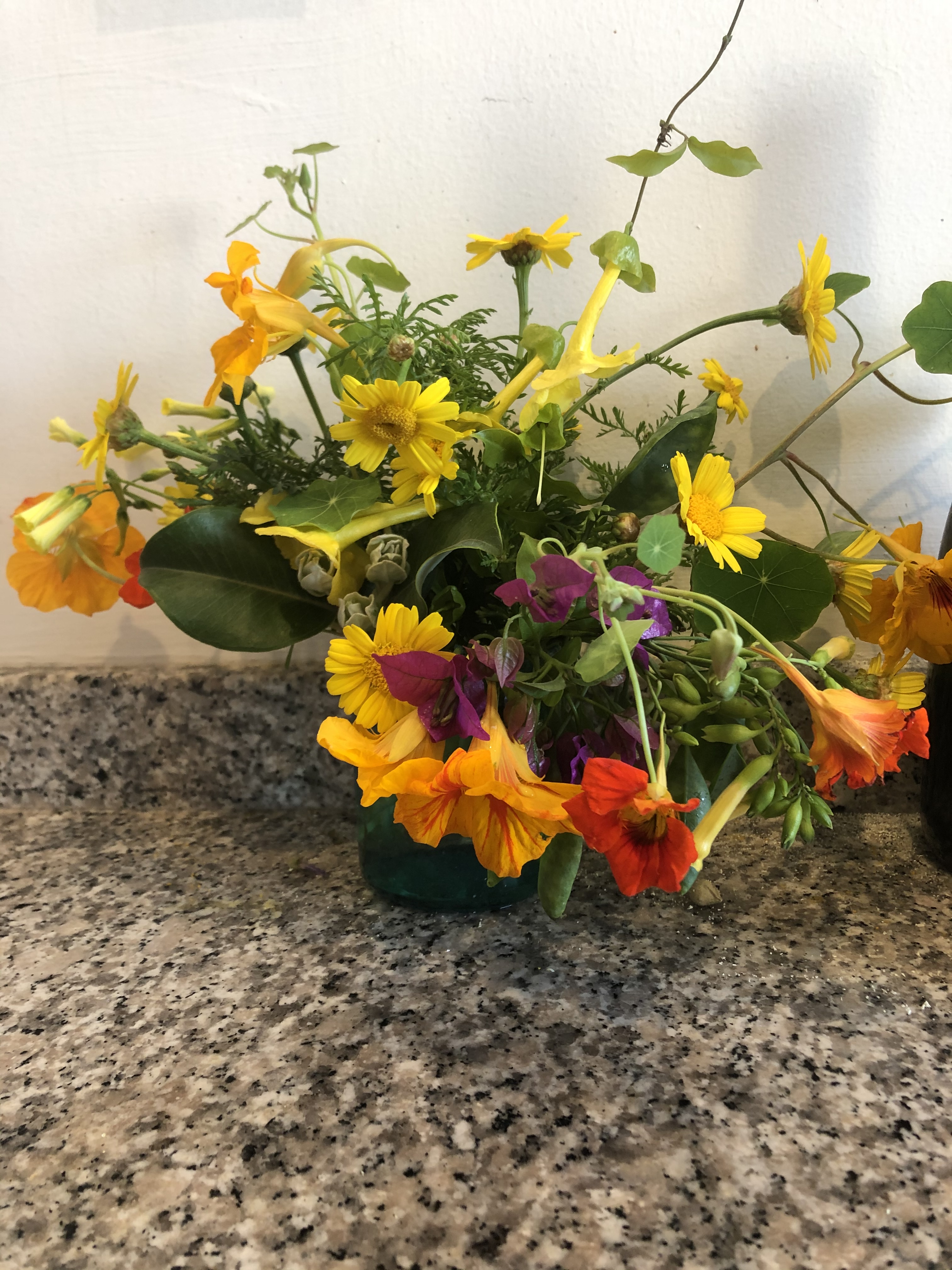
Despite blandishments from her children living in the U.S. and Australia, Elizabeth has never had any interest in leaving Lebanon. As with so many of her peers, she has watched her children leave, get married, and raise families abroad, still hoping that someday they would come back. She is more fortunate than many in having a remnant of the family here and she is still indispensably active in her church.
Now this valiant generation who stayed put during the war is leaving. Elizabeth herself is taking steps to claim her late husband’s Australian citizenship. It is the scarcity of medications and the flight of so many doctors and nurses that has finally tipped the balance. Beirut, once a world class medical center, is now bereft of medical supplies and personnel. Last summer, cancer patients demonstrated in the streets against the scarcity of lifesaving medicines. There are workarounds at the individual levels — day trips to Turkey or the Gulf to pick up supplies — but these don’t help clinics and hospitals do their jobs. Unless this changes, Elizabeth will have to leave and Beirut will lose a steadfast community anchor.
It’s not just Elizabeth I’m missing. I’m missing Ramzi, a commercial film maker, who normally comes back to Beirut from London every chance he gets. But now work has dried up here and even if it hadn’t, editing would take a long time due to the scarce and capricious electrical supply. He and I used to like to hang out in a local bar at the end of the afternoon, waiting for friends to finish work before joining them at a restaurant. Ramzi loves to talk to me about his family’s history as his forbearers were early adherents of Presbyterianism and worked alongside American missionaries as they established schools in Lebanon. His father was a noted folklorist whose photograph greets the traveler in a montage of Lebanese cultural icons at the airport. That family also stayed in Lebanon during the war, moving to Beirut once the south was under the control of the horrifically violent South Lebanon Army, a Christian militia backed by Israeli. Ramzi himself was a journalist at the time and spent two days in a foxhole with the corpses of his colleagues before being captured by the Israelis. Fortunately, his capture was filmed by Western media and he was allowed to survive. Ramzi will be coming back for a final visit next month to close down his apartment and settle his affairs.
I miss Fadi, a banker from a well known Shi’a family who converted to Christianity years ago. He’s now in Cyprus with his wife and son. I miss Samira, a Syrian refugee whom Elizabeth took underwing with her six children and taught them English when the schools were closed for Covid. Samira and her husband allowed their children to attend Elizabeth’s Sunday School as a form of cultural enrichment although Samira herself is Shi’a who wears a headscarf and her husband a Communist who didn’t want his children inculcated with Islam. They fled the Syrian government years before the uprising started but are now back, living in a Kurdish controlled area so they can take care of his aging parents. But there is little work for her husband and no nearby school for their children and Samira misses Lebanon. I miss Lily, an NGO administrator whose last job was with the World Food Programme. These personnel mostly cycle through a region so it was inevitable that Lily would leave but I miss discovering parts of Lebanon with her in the days when there were still traffic lights.
And I miss my church here, not that it isn’t still here in the physical sense but its membership has been decimated and its culture is changing to reflect the views of those who remain. We have lost professional class members who have returned home to the West, having lost their jobs or having found life here too difficult. We have lost women migrant domestic workers from the Philippines and Ethiopia whose employers can no longer afford the pittance they had been paying. In these losses we have lost institutional memory since most of the handful of people still attending haven’t been here more than two or three years. It’s mostly the African men who are still here as their mechanical expertise is still keeping buildings and boats running. Now their transactional Christianity faces little resistance. No theodicy issues here — the good prosper, period. I can’t imagine how they deal with the cognitive dissonance of working for the very rich Lebanese. Time for another sermon on The Book of Job and how the good suffer.
In fact, The Book of Job is a good place to find solace, too. For all that the steadfast Job lost, he regained in new form. Even now I find myself spending time with acquaintances who are becoming friends. Chief among them is the 93-year old Hilda, a retired nurse in my neighborhood who told me the other day she considers me a sister. She has no option but to stay although all her family have left. She regales me with stories of her idyllic childhood in Damascus as the daughter of a doctor and nurse who ran a lying-in hospital there. Sometimes, she talks about living through Lebanon’s civil war and the constant fear she had of home invasion by the militias. She asks me about the US political scene and why there is so much racism there. Her multiple medications are supplied by a businessman relative who flies in and out of Beirut. “I manage, I manage”, she tells me in her darkened apartment lit by a lantern. May her patient endurance be an example to those struggling to remain.
 goingfortheguttural