
“How long will this period last?” is a question I get asked all the time here. “When do you think we will return to normal?”
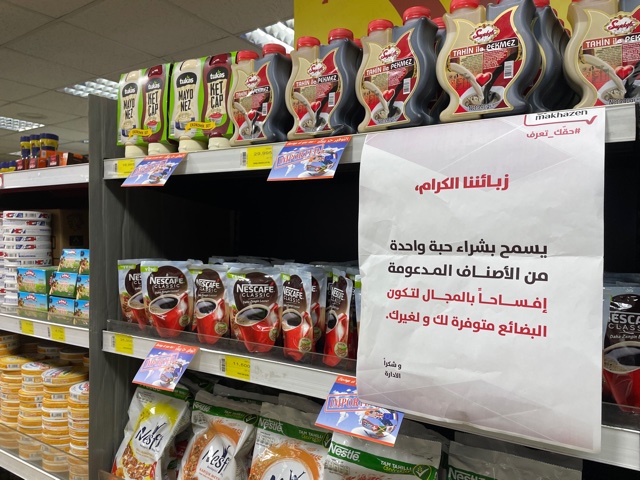
I’ve responded reasonably with the example of Greece and its economic meltdown. Many of the same conditions apply – hyperinflation, capital controls and the lack of access to bank deposits, high unemployment, the brain drain, an entrenched political class, and corruption. But in Lebanon, all of these conditions are worse. A 25% unemployment rate would be a huge improvement here. There was no worldwide pandemic at the time of the Greek crisis. And there was never a worry about a currency collapsing because Greece was on the Euro. Yet still, twelve years on, Greece is not back to normal.
I’ve come to realize that it is not my considered opinion on economic matters that is driving this recurring question. No one would mistake me for an economist. It is not the words but the music that one should listen to in this question. What is really being asked is, “Do I have the strength to weather this crisis? Will I live long enough to see Lebanon restored?” As the Psalmist achingly wrote:
How long, O Lord? Will you forget me forever?
How long will you hide your face from me?
How long must I take counsel in my soul
and have sorrow in my heart all the day? (Psalm 13:1-2a)
Yesterday the lira dropped to 15,000 LL to the U.S. dollar. It is now at 10% of its value of 18 months ago. The middle class has been effectively wiped out, their savings gone. Even those with the prescience to save in dollars cannot access them as dollars now. Demonstrators reacted to the bitter milestone by forcing stores to close on Hamra Street, the business street near my apartment, and cutting off the roads with burning tires and trash. No one blames them. The acrid taste of anger is in everyone’s throat. Fifty-five percent of the people here now live below the global poverty line of $3.84/day.
The political class is unmovable. A friend read me the president’s schedule for last Wednesday, March 10: he was napping in the afternoon to preserve his health. When he is awake he is demanding select posts for his party in any new government. There is no roadmap in sight for this nation in distress.
There is the persistent dread of worse to come, of waiting for the other shoe to drop. Surely, the August 4th blast was a reminder of the power of the unexpected. There are fears of Israel exploiting the moment and invading; of ISIS gaining a footnote, which it attempted to do about ten days ago but the army caught them; of what Hezbollah might do to maintain its considerable power. What is coming around the corner next?
Eyes are now turning to the army, one of the few public institutions held in high regard here. Soldiers, too, are feeling the economic plain. Their purchasing power has been reduced to about $150/month. Retired soldiers are reportedly in the forefront of the demonstrations. The army commander, a distant relative of the president, went on television and reassured the Lebanese people that the army was with them. This was widely interpreted as a shot over the bow aimed at the political class. Is a coup really how this impasse is going to end? How much longer can the people here hold out? Already one sees the reddish hair of malnutrition among the poor. Food, medicine, and gas subsidies, a clumsy system that incentivizes the trafficking of subsidized goods into the disaster that is Syria, are supposed to end in June. The other day a fight broke out in a Spinney’s supermarket over a box of powered milk, an incident now famous here as the reporter on Egyptian television took it as an indication of how far the country had fallen.
Today protestors tried to storm the headquarters of the Economics Ministry but were repelled.
The mood here is so different from what it was little more than a year ago. In those long ago days the lira was at 2,000 to the dollar. People were nervous but were still looking for a miracle. That was the word they used, “miracle”. And they described the circumstances they were living in as “the situation”.
Nowadays there is no longer talk of miracles. The word “situation” has been replaced by “catastrophe”. It is all people talk about. The pandemic is just an irritant.
Friends advised me to move out of my apartment hotel with its view of the sea and find somewhere safe. They didn’t feel safe walking there, or even driving, as car thefts are on the rise. So, I am back in my old neighborhood in a fortress of a building and see nothing but buildings across from me. But at least I get to see my friends.
Today I stocked up on water, detergent, and basic foodstuffs. I don’t know where things are going. I heard shots fired this afternoon. Ambulances arriving at the hospital. Church bells ringing. Is there a connection? I don’t know how to interpret this environment of sounds.
A friend just called. There was a sectarian shooting in Verdun, a tony neighborhood near mine. The shops have all closed and the streets are empty.
“Never mind”, says my friend. “We are used to this”. Then he went on to talk about exchange rate of the lira.
 goingfortheguttural