
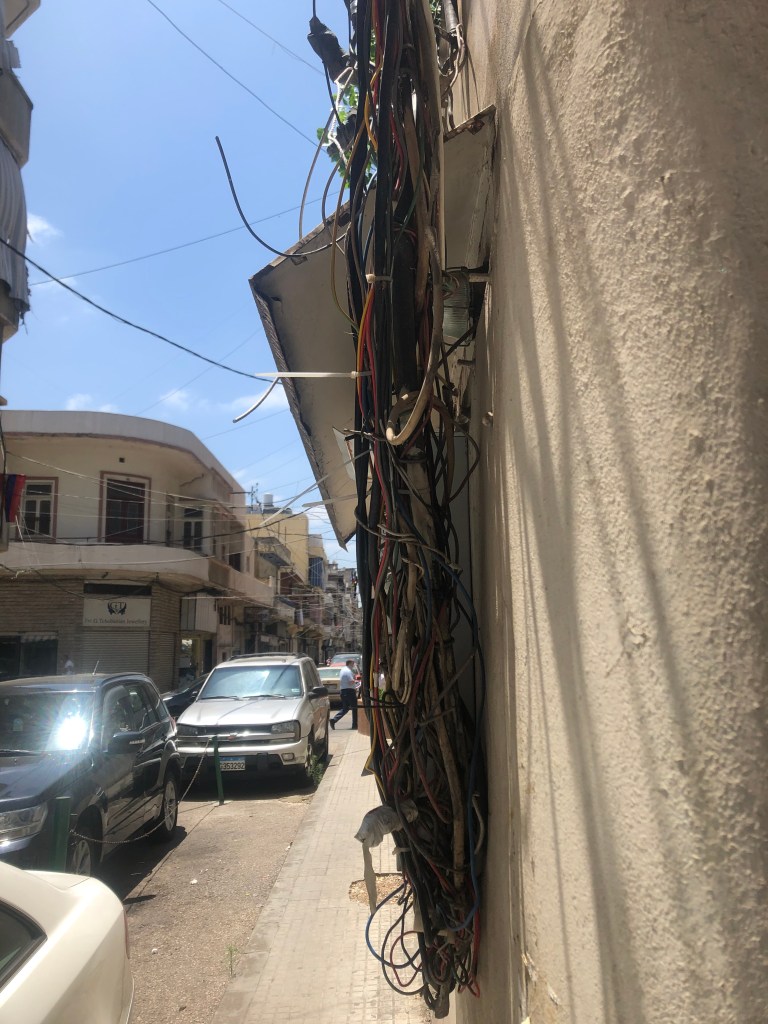
The other day I left my building for a dental appointment and saw the shopkeepers of the area milling about on the street. Accident? There were no police. Block party? Not a festive feel. I went up to the shirt maker and inquired. “No electricity” he said. “The back-up generators aren’t working either.” Sure enough, their shops were in darkness. The shirt maker, the tailor, the falafel maker, the dry cleaner – these are the lucky ones who still have paid employment and now they can’t work. Then the dentist called and said his building didn’t have electricity either.
The electricity sector has been a problem since the civil war started forty-five years ago. That was when back-up generators became commonplace. Since the war in Syria and the increased pressure on the system by the flood of refugees, there have been regularly scheduled three-hour power cuts in all neighborhoods of Beirut. Nowadays, the power cuts last most of the day and during the hours of service they still cut regularly. One evening I counted eight power cuts. The traffic lights are out on the city streets so crossing an intersection is now especially terrifying in a country where road travel already was a white-knuckle experience.
Part of the lack of service is structural. The back-up generators are now part of the economy and close to political power. The last thing they want is a functional electrical system. A few years ago Zahle, a city in the Bekka, managed to get 24-hour electricity going and found its transformers mysteriously shot at. People who can afford it now are doubling up on generator companies so they can do their jobs.
Fully half the population does not pay for its electrical use. Partly this is government subsidies, mostly to Shi’a neighborhoods. It is also bold theft of electrical lines. The Baptist church near me had both its telephone and electrical lines spliced by a family of squatters in the basement of their building. They removed the telephone line. When I asked why a friend why they didn’t call the electrical company to remove the splice, she said it was the price of peace. A small Protestant community can’t go up against Shi’as. Maybe it would be different if they were Maronite or Greek Orthodox.
Reforming the electricity sector is one of the major demands of the IMF and other sources of foreign loans. There have been loans and grants in the past to upgrade the system and the money has been misappropriated. Now foreign lenders are getting tough. They want the $2 billion a year loss the government takes on the electricity sector to end and that means ending subsidies and theft, a heavy lift during this current economic collapse. Smelling opportunity, Gebran Bassil, the Maronite president’s son-in-law and a former minister in the Parliament, is demanding that a power plant be built in a Maronite community because “Lebanon is a Christian country.” Could he be more offensive to the Muslims and Druze? He regularly trolls members of other faiths.
There are rumors that China may buy up the national electrical company. It already has a large presence in Africa and the Middle East may be its next step. It has been expanding its presence in Lebanon of late by building Beirut a new music conservatory and sending medical supplies during the pandemic. It has troops in UNIFIL (United Nations Interim Force in Lebanon) ensuring Lebanon’s sovereignty and has a field hospital near the southern town of Marjayoun. Hassan Nasrallah, the Secretary General of Hezbollah, is encouraging the government to look East for its partnerships and to forget the West. The United States has not done its standing here any favors by imposing yet more sanctions on the region, this time via the so-called Caesar Act, which penalizes any person or institution doing business with Syria. The effect on Lebanon could be catastrophic as the economies are intertwined. America’s influence here may well dwindle as a result of its punitive policies.
The economic problems here are now drawing comparisons with Venezuela. The hyperinflation is being accompanied by scarcities in supplies. Food prices are astronomical — I spent 72,000 LL on four cans of black beans last week — in official terms that was $47.52 but as the dollar is trading for ten times more than the official rate, it was more like $5.00 for me — still, a ridiculous price and nowadays most Lebanese don’t have access to dollars. The hospitals are two weeks away from running out of medical parts. This means, for example, if a surgeon wants a particular size screw, he may have to adapt a screw of a different size to do the job. Pharmacy shelves are already looking bare. I have to cut some of my pills in half to get the right dosage. The dry cleaner asked me to bring back the plastic covering they wrap my order in — I was already bringing back the hangers.
The other day I was walking down the street feeling so pessimistic about Lebanon. Then I realized I heard the bangs and clangs of building construction. “Surely,” I said to an acquaintance shortly afterwards, “they wouldn’t be building unless they were confident in eventual sales and no invasion from Israel.” The reply? “What you heard, my dear, was the sound of money laundering.”
Instead, what the Lebanese mention when the Venezuela comparison crops up is that Lebanese ex-pats will not let the country or their families collapse into poverty. Foreign remittances are a big part of this economy. The dollars they have built up in the banks here may be as good as gone but new dollars, or “fresh money”, will not be touched. Or so the banks say. At least for now using “fresh money accounts” is the only way to wire dollars into the country so the recipient can receive them.
In the meantime, the sardonic humor of the Lebanese is as active as ever.
Q: Why is Lebanon the safest country for children?
A: Because they can put their fingers in the light sockets and not get hurt.
 goingfortheguttural