
Let’s Celebrate While We Can
Three weeks ago the U.S. embassy in Beirut chartered a flight to evacuate U.S. nationals like myself from Lebanon. I was not on it. Nor were other Americans I know here in Lebanon. We know that we are better off here in this bankrupt, politically divided, and corrupt country than risking our health in the disaster that is America right now. We watch with horror the news of America alongside our Lebanese friends. We see the scales fall from their eyes. “America is a fake superpower!” summed up one of my friends.
I do not need the nightly news here to tell us what catastrophe awaits a hospital patient in America. I have our own horror stories from better times. I remember arriving at the emergency room of Mount Sinai Hospital in New York City to find my mother in a sea of gurneys so densely packed that they formed a log-jam. My mother had not even been given water during the nine hours she had been there. A few years later I became acquainted with New York Hospital when my uncle required regular visits to the emergency room. There conditions were even worse. On one occasion, after hours of waiting, my uncle needed to use the rest room. As there was no staff to be found I reluctantly took him myself and cleaned him up afterwards. No sooner had we opened the door to leave the bathroom than another elderly man appeared asking for help at the toilet. So, I toileted him, too. And then some elderly women. Then I went back to sit on the floor.
Lebanon feels positively safe in comparison. The normally dysfunctional government has been single mindedly focused on flattening the curve. The borders are shut and the airport closed except for repatriation and cargo flights. And of course, the private jets of the very rich. Every business, service, and institution has been closed down but pharmacies, food stores, laundries, and take-out food restaurants. Certain villages, like Bsharri, where Khalil Gibran came from, have been in special lockdown because of the number of cases there.
But today, Lebanon is coming out of hibernation. There is an almost festive feeling. Restaurants are re-opening and barber shops are plying their trade. Other stores are open, pretending to be cleaning up for re-opening next week but ready to do business on the spot.
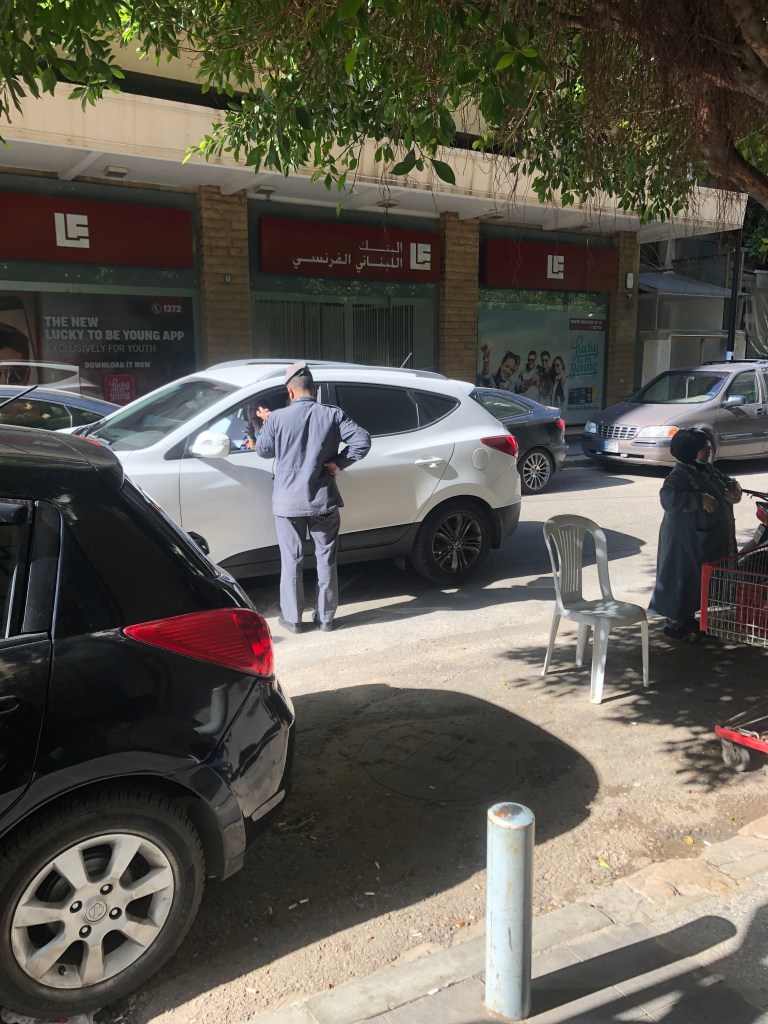
Lebanon deserves its celebration. It took precautions very seriously in most places and at great cost everywhere. Most stores and offices have been shuttered. For weeks now we have entered the supermarket in small numbers, wearing face masks and gloves, and only if the temperature gun clears us. I can readily get face masks at the pharmacy and the supermarket. All forms of media, including our cell phone messages, tell us to stay home. Curfew begins at 9 p.m. now (pushed back from the original 7 p.m.) and ends at 5 a.m. Public transportation has been shut down. Cars may only be driven three days a week, according to license plate, and not at all on Sundays. The police and army are checking streets and roads and issuing tickets.

The army is also delivering food parcels to the hungry. Lebanon was facing an economic catastrophe before the arrival of Covid-19, stemming from years of corruption, indebtedness and gross mismanagement. The 25% unemployment rate of Greece in 2008 is an aspirational improvement here. The real unemployment and underemployment rate may well be 75%. It’s not just janitors who are on half-pay here but doctors and professors. The lira is half the value it was nine months ago, so between half pay and devaluation spending power is now at 25% of a year ago.
In March the government made the right decision to delay repayment of its Eurobond and subsequently has some capacity to function in this crisis. Additional resources have come from Hezbollah in the form of medical staff and equipment. This has been criticized as image burnishing by its detractors, and it probably is, but at least we are not being treated to scenes of Lebanon’s political leaders playing golf at Mar-el -Lago. Press photos show Prime Minister Hassan Diab and President Michel Aoun wearing masks and gloves. This is re-assuring.
Nor have we heard stories of conditions in Lebanese hospitals to trigger any kind of alarm. Were the number of afflicted much different from the 740 cases or the number of deaths much different from the 25 publicly announced we would probably know. In this small, deeply divided nation of 4 million citizens and 2 million refugees it is hard to keep a secret. Ex-prime minister Saad Hariri, desperate to regain power, would have raised questions by now. We would have seen Facebook accounts like the one a distant cousin of mine recently posted of conditions in New York City hospital describing how he, an emergency medical technician, is wading through corridors where the living and the dead lie side-by-side on the floor. We would have heard of shortages at the hospitals and felt compelled, like another cousin, a high school math teacher, to sew masks for the local hospital at her kitchen table. Nothing of the kind is happening here. In fact, today a beggar offered me a facemask from a box he had when I gave him money.
It is no surprise, then, that Lebanese ex-pats are scrambling to come home. Bringing them home by the kind of charter flight my friends and I recently rejected to America is a major controversial undertaking here as it is likely some of these Lebanese nationals are now infected. Yesterday three returning ex-pats tested positive. Yet here again, the Lebanese government has surprised everyone with how diligently they are quarantining and tracking the recent returnees. An account of one such returnee, translated and posted onto the961 website, includes follow-ups to the address she gave the authorities once she was cleared for sheltering in place. They are doing to contact tracing that America should be doing.
But this period of mobilization is coming to a bumpy end. A few weeks ago the Health Ministry announced an increase of PRC testing to 1,500 a day plus random testing but here it has run into a problem – the anger of the people who have lost patience with all these containment measures in the face of real hunger. The pause button on the revolution has been lifted and there has been some violence during the protests and one death. We can only hope that the return to economic activity brings real relief to the many who are suffering. It is hard to see how this can happen quickly enough.
Still, I have asked myself how Lebanon of all places could have gotten it so right while America gotten it so wrong. Two answers come to mind. The first is that Lebanon has lived through repeated catastrophes in the past several decades and knows that life is unpredictable. Civil war and invasion are constant threats. So is natural disaster. The country sits on the same fault lines that have brought devastating earthquakes to Turkey in recent years. My own building swayed with a tremor in January. Lebanon knows only too well not to let its guard down. Meanwhile, in New Hampshire where my husband is, people are still going to the supermarkets without masks and there are no gloves and temperature guns at the entrances.
The second is that Lebanon understands the importance of government even if it can’t manage to create a functional one. In fact, part of the frustration expressed at the revolution last fall was the understanding that government can be a force for the good. Unlike Trump and his enablers, the Diab government has not shillyshallied about the role government plays in containing this epidemic. We can only hope it does not revert to type when this is all over and become blatantly sectarian again. But it probably will. This week may be the last time I can write good news about the state of affairs here in Lebanon. The future looks very troubling otherwise.

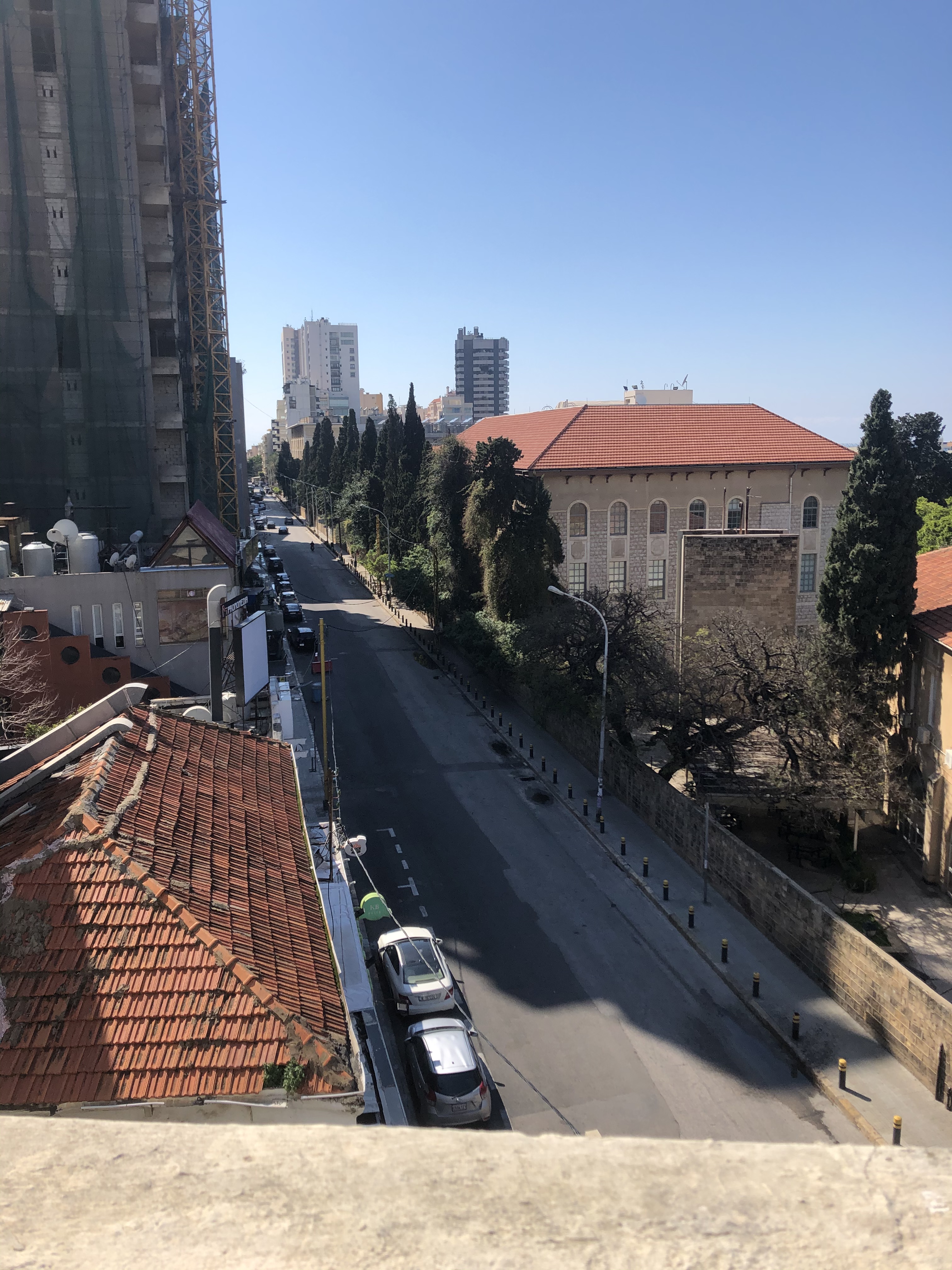

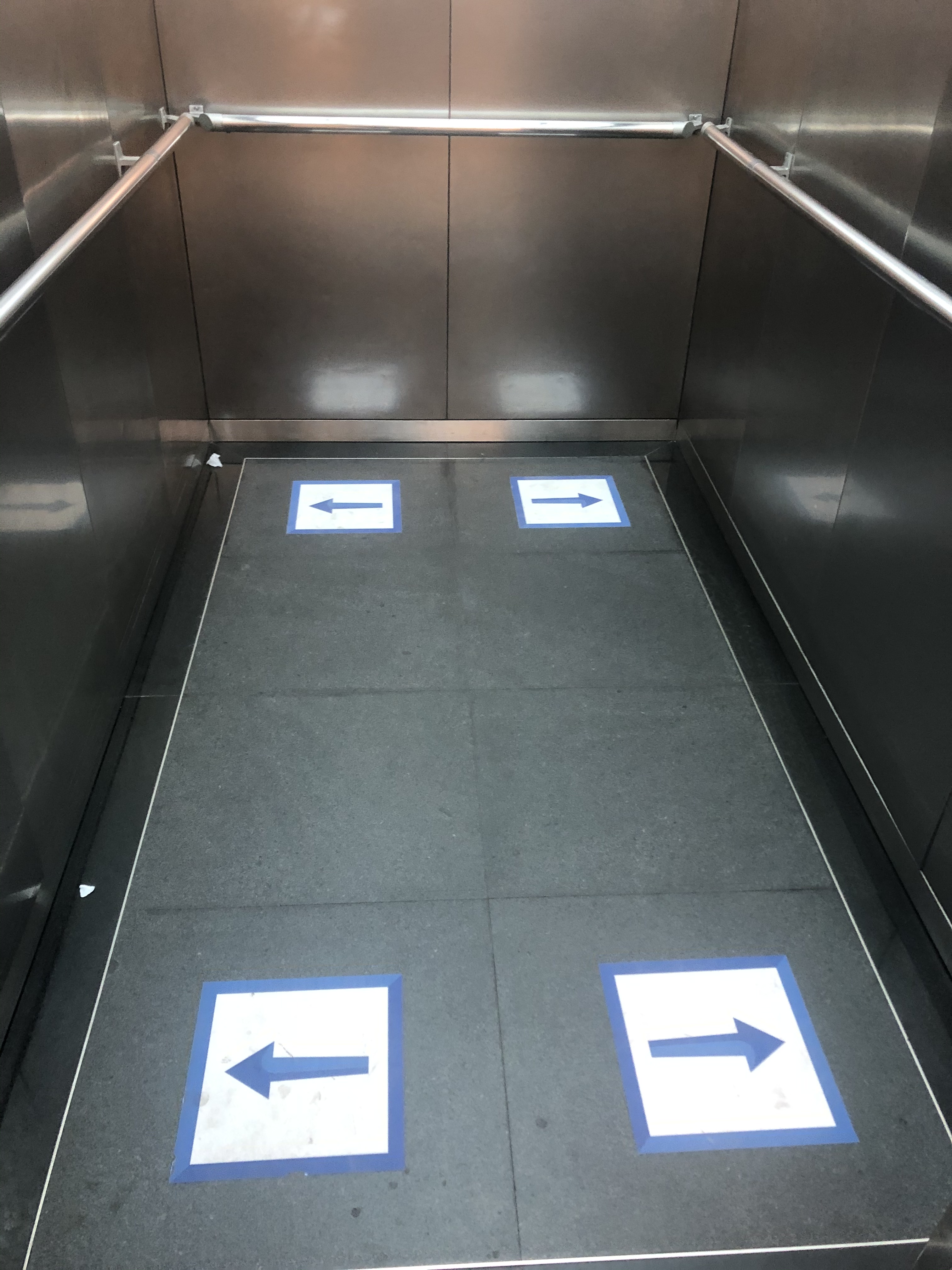
Signs of serious commitment to the General Mobilization: Prime Minister Diab wearing facemark and gloves; Bliss Street deserted of traffic; Ministry of Health messages to cellphone users offering information on the virus and instructions, at Easter, to pray at home; the elevator at the American University Hospital where passengers are supposed to be limited to four people facing the wall.
 goingfortheguttural