

We are now in the second week of the General Medical Mobilization here in Lebanon and to my surprise it looks like my neighborhood, West Beirut, is generally complying with the shelter in place order. Police are stopping people in cars – a friend who has a clinic in my neighbor was stopped twice on his fifteen minute drive into town. They are issuing substantial tickets for offending businesses. Anyone walking in the street is subject to police questioning although it is permitted to be out doing vital business. I hear from a friend in cat feeding circles that these ladies are making their rounds with excuses at the ready, although in this cat-besotted place I expect the activity is considered vital enough. We now have a curfew between 7 p.m. and 5 a.m. with stores are closing around 5 p.m. so employees can get home. The mobilization has been extended two more weeks but expectations are that it will go on for another month at least.
Things got off to a shaky start when the schools were closed down a month ago. Families of the “velvet class” treated the school closings like a holiday and rushed to the ski slopes where press photographs show them in a tight mass jostling for the ski lift. The daily press updates on the number of cases, currently at 412 (population: 6 million) apparently had a sobering effect. Anyway, places of congregation are now closed.
But yesterday a friend who went to a Shi’a neighborhood to buy fruits and vegetables told me that the streets were as crowded as ever. I asked why they could get away with such non-compliance and the answer was “Hezbollah and Amal are in control: the police don’t dare interfere.” The weakness of the state, even with a Shi’a health minister and a Hezbollah-leaning government, is a real challenge here. Likewise, photos are circulating on the internet of the souk in Sunni-dominated Tripoli showing it filled with people going about their business, mostly without masks.

In explaining the mobilization the prime minister pointed to evidence of non-compliance found on social media where people had been posting photos of their revelries. It wouldn’t surprise me to learn that Lebanon was employing the same methods of the surveillance state that the U.S. employs, like cell phone tracking. All of us need to be vigilant about our freedoms in the midst of this. The media reported today that the government destroyed the tent cities that had been erected during the revolution in October for teach-in purposes, using corona as an excuse for their demolition. When I mentioned this to a friend he said it wasn’t the government but Amal, the thuggish political party which has opposed the revolution all along. Who knows? At least the government isn’t talking about being open for business in time for Easter. The prime minister is acknowledging the suffering of the people and asking for patience. But you can’t eat patience.
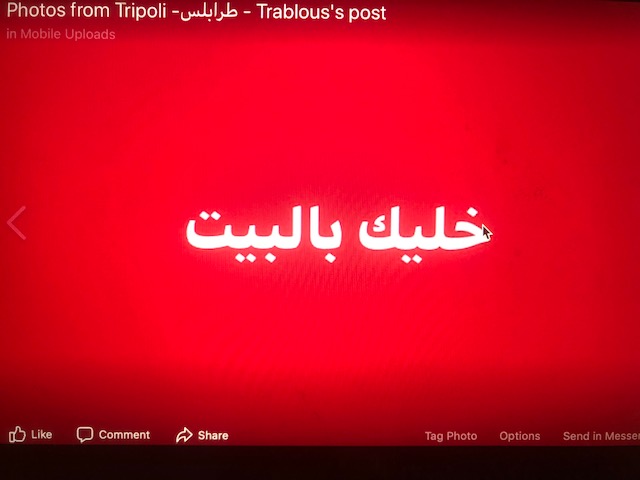
The revolution has not been entirely suppressed. It cannot be. Desperation drove young men into the streets of Tripoli last Saturday where they shouted: “We’re hungry! We’re hungry!”. A Facebook page on Tripoli shows messages saying: “Either we die of Corona or we die of hunger!”.
To my great surprise, on Monday I read that the army delivered food packages to a very poor neighborhood in Tripoli. I told Lebanese friends about this and they assured me that I was mistaken, that the food packages had to have come from an NGO. But I had the article to show them. Could this be a sign of functionality from a political system so incompetent and corrupt that no one expects anything of them at all?
Maybe. In another sign of functionality, the government paid its back bills to the country’s hospitals, both public and private. The Rafik Hariri Hospital, the public hospital at the forefront of combatting the disease, had been unable to pay its employees during some periods of late. A shortage of supplies and poor working conditions brought hospital staff to demonstrate at the revolution soon after it started. The arrears had gone back to 2011 and the total due to private hospitals alone was $1.3 billion, although I doubt it was paid in full given the economic conditions. The government also forwarded to the municipalities their dues from the telecommunications sector as these funds are necessary for monitoring the lockdown. The army is even manufacturing its own face masks as there is a shortage.
The current Prime Minister, Hassan Diab, is a Sunni who is not from the major Sunni party, the Future Party. That party is headed by Saad Hariri, son of the former Prime Minister. Hariri resigned two weeks after the revolution began, probably because he didn’t want to be carrying the can when the economic system, already tottering, collapsed. He is now outside of government calling for a state of emergency which would strip his political rival of much of his power.
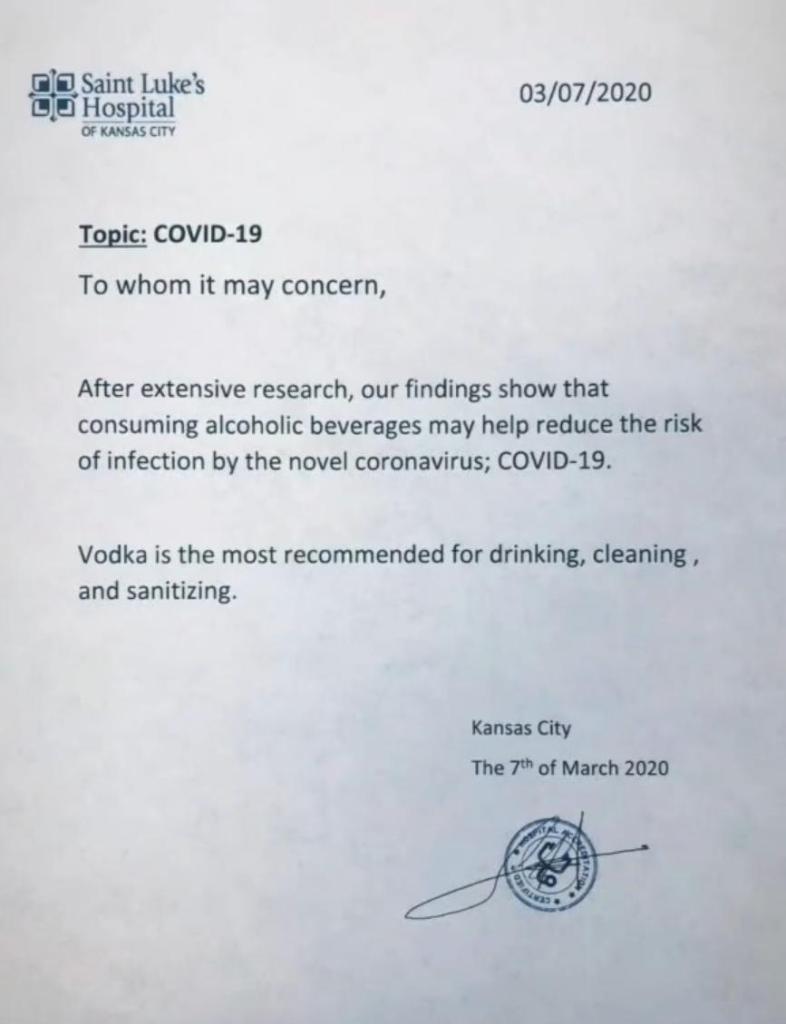
The bitter partisan quality of politics here adds to mixed messages to the public and goes some way in explaining non-compliance. (Sound familiar, my fellow Americans?) Much of the local media is owned by political parties or political dynasties so the Lebanese tend not to trust any of it. Instead, they go onto the internet to get their information and here they are as uncritical of what they read as many Americans. I have been told by a number of people that Arak, the local tipple, is a specific against Corona. How do they know? They read it! (Please, dear God, let this not be the case about the Tripoli news story.) Via WhatsApp I got a poorly worded letter about vodka to this effect which purported to be from a St. Louis hospital. Particularly distressing to me is that these cosmopolitan, multi-lingual Lebanese are watching American purveyors of fake news like Fox TV and are coming away de-incentivized from adopting the necessary precautionary measures. I keep trying to tell people about Snopes and FAIR.
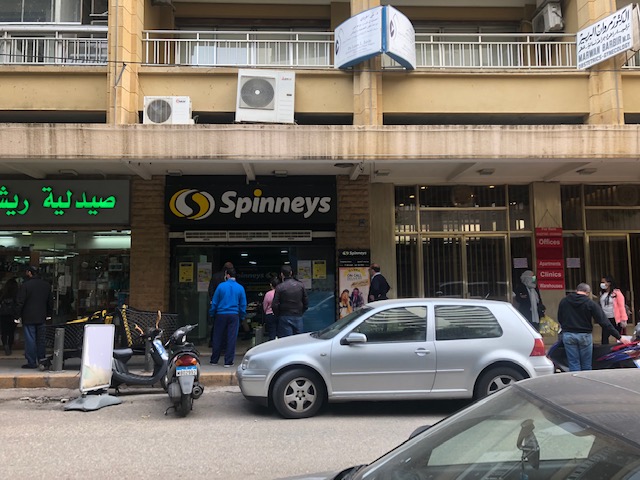
The American University Hospital has been part of the problem for my own understanding of Covid-19. I go there three times a week for physical therapy. I had to get after them to wipe down the equipment between patients. There are more precautions at the entrance of the near-by Spinney’s supermarket, where they insist on masks, use a temperature gun, and only allow a few in at the time than at the entrance to the most prestigious hospital in the country. What’s up with that?
Some people are keeping businesses open despite the risks and the ambiguities of the law. My usual photocopy store tried to stay open by only accepting business at the door but it was shut down by the police. A local coffeeshop owner, who was just hanging around his shuttered business, told me about another photocopy shop that I could use. Its gate was halfway down when I got there to hand over my work – I felt like I was at a speakeasy as I squatted down to call inside. There are quite a few of these half-gated businesses. I noted wryly that a bodega owner had extended his stock in trade to fresh vegetables as a way of keeping open. A bookstore is in a Christian neighborhood is using coffee in the same manner although bookstores are allowed to be open for an hour or two in the morning, a nice nod to Lebanon’s history as a publishing and cultural center. The messenger services delivering the books have not always been so fortunate in staying on the right side of law enforcement. My drycleaner will come to pick-up my laundry for the wash-and-fold. The liquor has posted its phone number for deliveries. These adjustments in business practice might well be legal but they expose owners to the whims of the police and the ever present reality of bribery. The MacDonald’s on Corniche was fined 24 million LL ($16K by the official rate) even though they were only doing take-out, according to the papers. We all read that as a warning to other businesses. I will never forget seeing a health officer a few years ago enter a row of restaurants flanked by police, emerging about a minute later from each one. Corruption is deeply rooted in Lebanon and now that there is no traffic to stop and drivers to shake down, the police will be looking to shopkeepers. And they will pay.
I only leave the apartment to go to physical therapy and the grocery store. Yet, as journalist Robert Fisk says, we are not really social distancing at all these days – we are only separated by physical distance while being very social. I very much appreciate the increased contact with family and friends these days. To keep my spirits up I am also cooking more – I even produced a stovetop cornbread that isn’t half bad. Still, I am actually losing weight as I have little appetite.
This morning I tried to place an on-line order for detective novels as well as loftier reading from a local bookstore but, as usual, Chase Bank declined the order and isn’t answering the phone. Their international customer service number isn’t working at all. Covid-19 is giving them an excuse to be as incompetent as ever. I wrote their “stranded customer” department as I need the card to be ready for immediate use but they haven’t gotten back to me. I guess I am really stranded.
Another bunch of incompetents is the consular section of the American Embassy here. I always register with them when I come and they as good as say that I am on my own here as I shouldn’t be here at all. Now I read in the newspaper that all but their emergency section have decamped. They didn’t even send out an email telling the US citizens here!
At least there is the church I attend. We are now meeting online. I find it surprisingly moving to see everyone’s face looking so cheerful – usually all one sees is the back of their heads at worship. I phoned a few of the members without internet to see if they were okay – they are. Everyone seems to be cleaning out their closets these days just as they are in the States. This virus is showing us our common humanity in so many ways. May we not forget that when it’s over.
 goingfortheguttural