
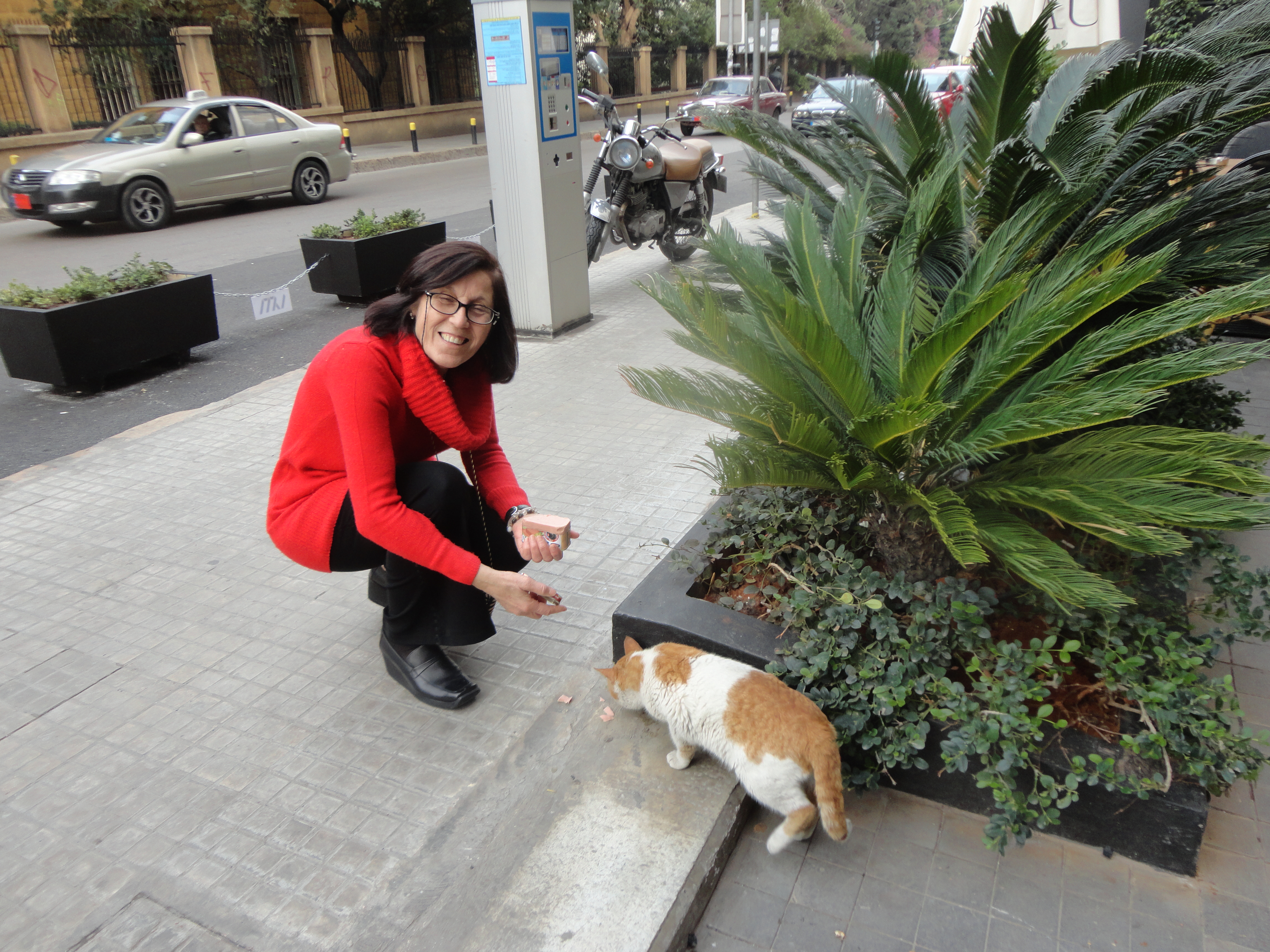
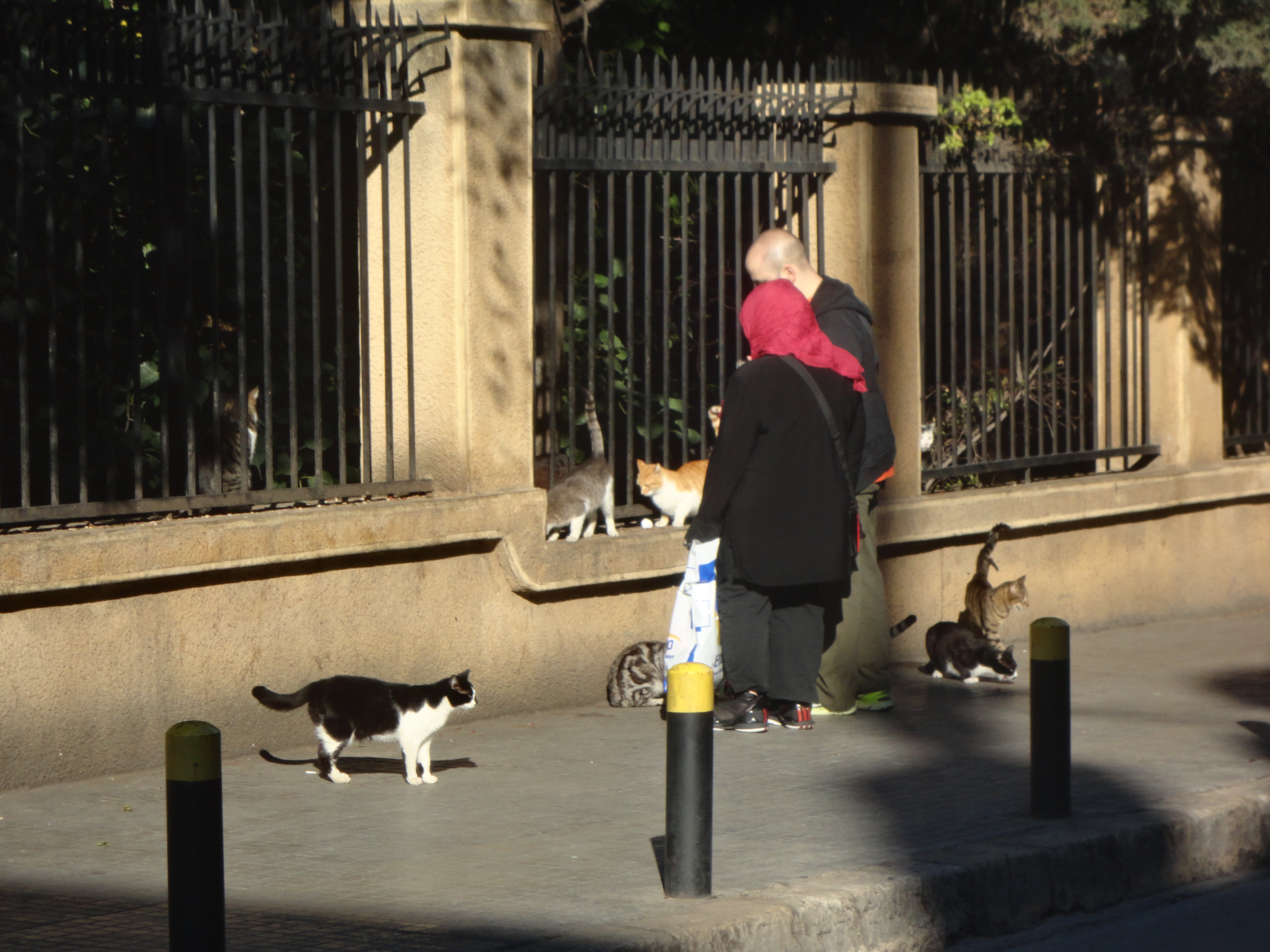
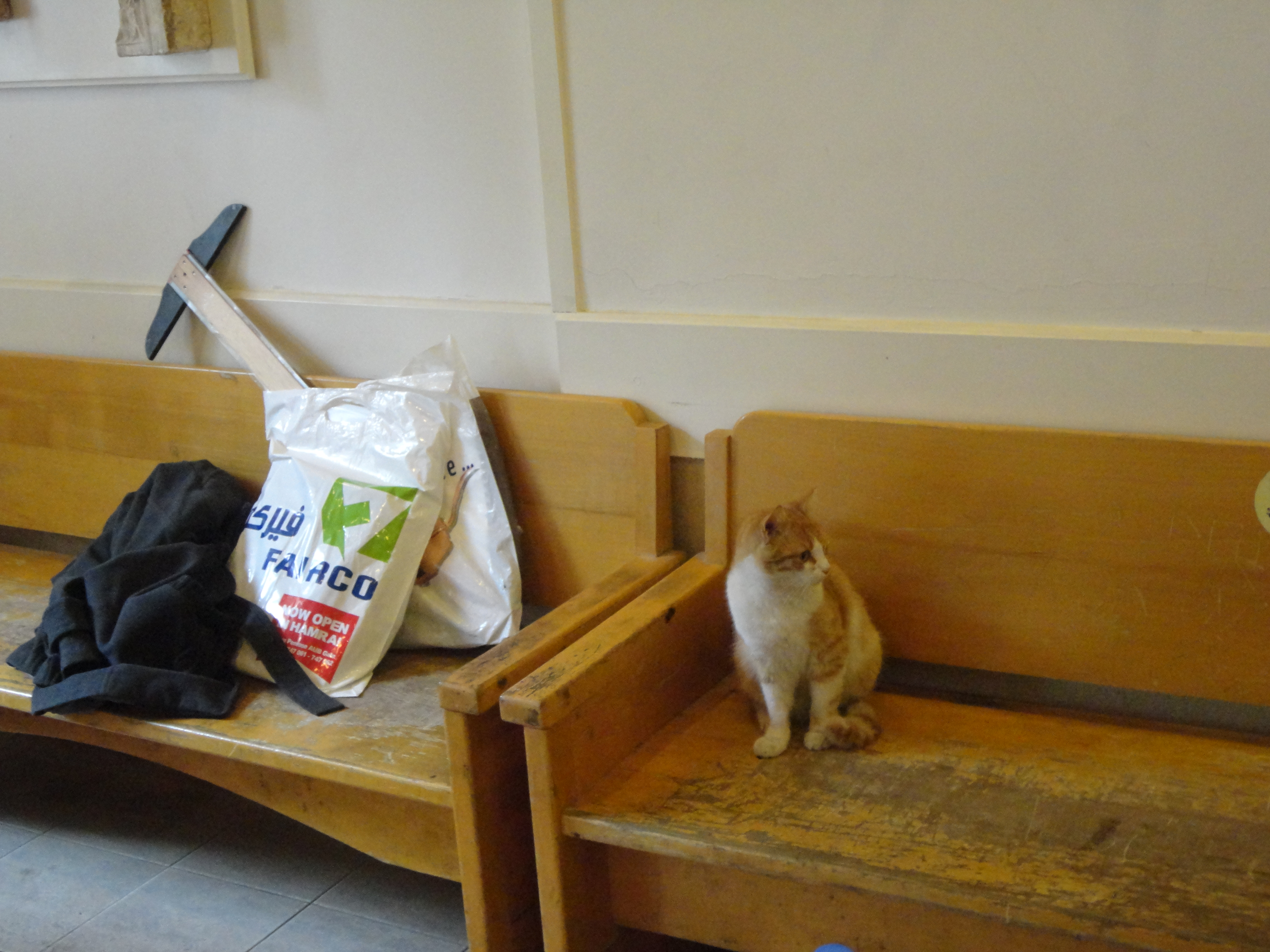

My friend Diana feeding one of her charges; a man and woman feeding cats outside of AUB; a cat waits outside of class at LAU; and a water offering.
For me, one of the most unexpected aspects of Beirut life has been its thriving population of cats. These are no mere street cats, feral and half-starved. These are healthy and affectionate animals who live in yards, streets, shopping malls, and university campuses. I call them the “public cats.” I vastly prefer them to public intellectuals.
People make it their business to feed cats around here. There is a small army of Lebanese, mostly women, who make daily rounds of the neighborhood feeding “their” cats and caring for those who are sick. They enlist the help of the men behind prepared food counters to donate their chicken and lamb leftovers to supplement the kibble they buy from the supermarkets. Making the cats happy is very much a neighborhood effort. This year it has also entailed bringing water to the cats as there has been a drought. One now sees cut down water bottles alongside the kibble as one walks along the streets.
Probably the best kept cats are those at the universities. AUB spays and neuters its cats, and marks each fixed cat with a small nip in its ear. The cats at LAU fall under a special faculty committee that provides for their care. (Can you imagine an American university having such a committee?) These institutions are the best environments for cats in the city as their campuses have grass, trees, and places for the cats to run around. It’s good for the students, too. I see them on benches, haphazardly petting cats while they do their homework or talk with friends.
It was because of cats that I met my friend Diana my first day here last year when I was lost trying to find the university. She was on her way to church, feeding cats along the way. She asked if I wanted to accompany her to church but I declined. Then I kept seeing her in the neighborhood and finally accepted as she seemed like such a kind person. So, that’s how I ended up going to my Arab church on Sundays. And yes, the parishioners there sit around, drink coffee, and sometimes talk about the neighborhood cats.
The general fondness for cats here put into new perspective what I call “The Great Cat Massacre” I witnessed in Jerusalem 30 years ago. There, the Hebrew University treated cats as nuisances and gassed them one summer day. The Israelis make a huge point of being the opposite of Arabs – one of the phrases they use is “we are not polite” as the word for polite (adeeb) is an honored trait among the Arabs, meaning not just “polite” but “cultured”. The Great Cat Massacre was all too reminiscent of the one in Paris in 1730 where printing apprentices massacred as many cats as they could get their hands on because cats represented the masters who coddled them. If Arabs love cats, then Israelis will slaughter them.
The one neighborhood here that seems almost devoid of cats is the so-called “Downtown”. This is the neighborhood adjacent to mine (the real downtown) and it was heavily shelled during the Civil War here. Its “revival” meant tearing down Ottoman architecture and the old suq and replacing them with Gold Coast condos and shopping precincts with retailers like of Sonia Rykiel and Giorio Armani. It was the work of the assassinated former prime minister Rafiq Hariri and is legendary for the scale of corruption involved. Gulf Arabs have bought these condos and visit them mostly in the summer. As it is not a real neighborhood the cats have boycotted it. They are very righteous in this way.
I had an Arabic teacher in my former life who loved cats and used to quote hadith about the Prophet concerning cats. While I remember the general gist was that a person who was good to cats was assured a place in heaven (where, hopefully, there are more cats to greet us) I thought I’d look up on the Internet some hadith. So here, for your delectation is how a resource called The Muslim Kids Journal relates hadith about cats:
There is a story in the Hadith that tells us about a woman who was punished because of a cat. She had neither provided the cat with food nor drink, nor set it free so that it might eat the insects of the earth.
Prophet Muhammad (PBUH) told his companions that a great sin had been committed because one of Allah’s creatures had been ill-treated. The woman who had treated her cat so cruelly was not forgiven for her sins: she was sent to Hell for her wrongdoing. (Sahih Bukhari, Volume 3, Book 40, Number 553)
So, remember to take good care of your pets and other creatures. Allah rewards kindness to animals but punishes those who are cruel.
One of the Prophet’s companions was nicknamed “Father of the Kitten” (Abu Huraiya) because he was so devoted to his kitty. Here in Lebanon there are surely legions of “Mothers of Cats”.
 goingfortheguttural